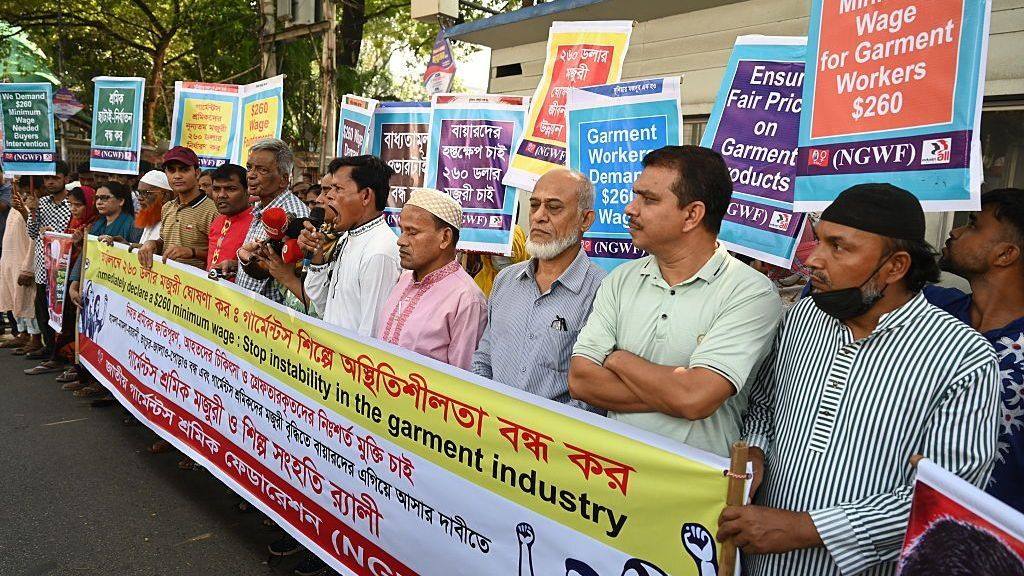
Nearly 150 clothing factories have been shut across Bangladesh's main garment hubs of Savar, Ashulia and Gazipur this weekend, as workers striking for a higher minimum wage walked out and owners put the indefinite closures they had threatened on Saturday into force, the BBC reported on Sunday, November 15.
Source: BBC News
On Saturday the owners' associations warned that factories where production had been disrupted would close indefinitely from Sunday under the 'no work, no pay' provision of labour law, with 55 factories already closed and production halted at 147 units. Sunday is when that warning became reality. Read: Owners warn of indefinite closures (Nov 14)
Workers are demanding a minimum wage of 30,000 taka a month — about £182, yaani roughly two-and-a-half times the current rate — up from the current 12,500 taka, which they say no longer covers the cost of living. On Sunday morning workers massed on the Dhaka-Tangail highway in Gazipur and blocked the road, stopping traffic for about an hour before police stepped in, the BBC said.
Thirteen Gazipur factories closed indefinitely
Gazipur Industrial Police Superintendent Mohammad Amjad Hossain told the BBC officers shut factories in the city after workers walked out: 13 factories were closed on Saturday night and 16 more during the Sunday morning unrest. Separately, at least 13 garment factories in Gazipur were declared closed indefinitely on Sunday, including all the factories of Apex Holding, which said it was suspending operations at all its factories, departments and branches under Section 13(1) of the Bangladesh Labour Act 2006; Far East Knitting and Dyeing Industries, Ecotex Limited and Ahsan Composite also announced indefinite shutdowns.
Source: The Voice News
Police used tear gas and sound grenades to disperse protesters in the Konabari and Mouchak areas of Gazipur, and Border Guard Bangladesh said it had deployed 13 platoons of paramilitary personnel to protect factories alongside police, according to reporting from Dhaka. The unrest has run since mid-October and has at times turned violent.
Owners question wage talks; unions say workers carry the cost
The Bangladesh Garment Manufacturers and Exporters Association (BGMEA) and the knitwear association BKMEA are calling for protection for factories. 'BGMEA and BKMEA have questioned the justification of continuing to participate in wage board negotiations without any assurance that the factories will be protected,' BGMEA President Mahmud Hasan Khan said. Joly Talukder, vice president of the Garment Workers Trade Union Centre, told the BBC's Newshour that 'workers have carried the costs for years' while owners and global retailers profit, adding: 'They are asking for a wage they can survive on.'
The industry is Bangladesh's export engine: it generates nearly $40 billion (yaani about 4,000 crore US dollars) in exports a year, about 10 percent of GDP, employs about four million workers making clothes for brands including H&M, Primark and Zara, and makes Bangladesh the world's second-largest exporter of ready-to-wear clothing after China — which is why a prolonged shutdown in the run-up to the Christmas export season worries international buyers.
What happens next
The government formed a minimum wage board on November 1, chaired by a senior district judge; it is due to finalise recommendations by the end of November, with a revised pay structure expected to take effect from December 1, and its next meeting is scheduled for Monday, November 16. The workers' representative on the board proposed 32,000 taka at its November 9 meeting. Whether Monday's meeting produces an employer offer — and whether the indefinite closures are lifted — is the next test.