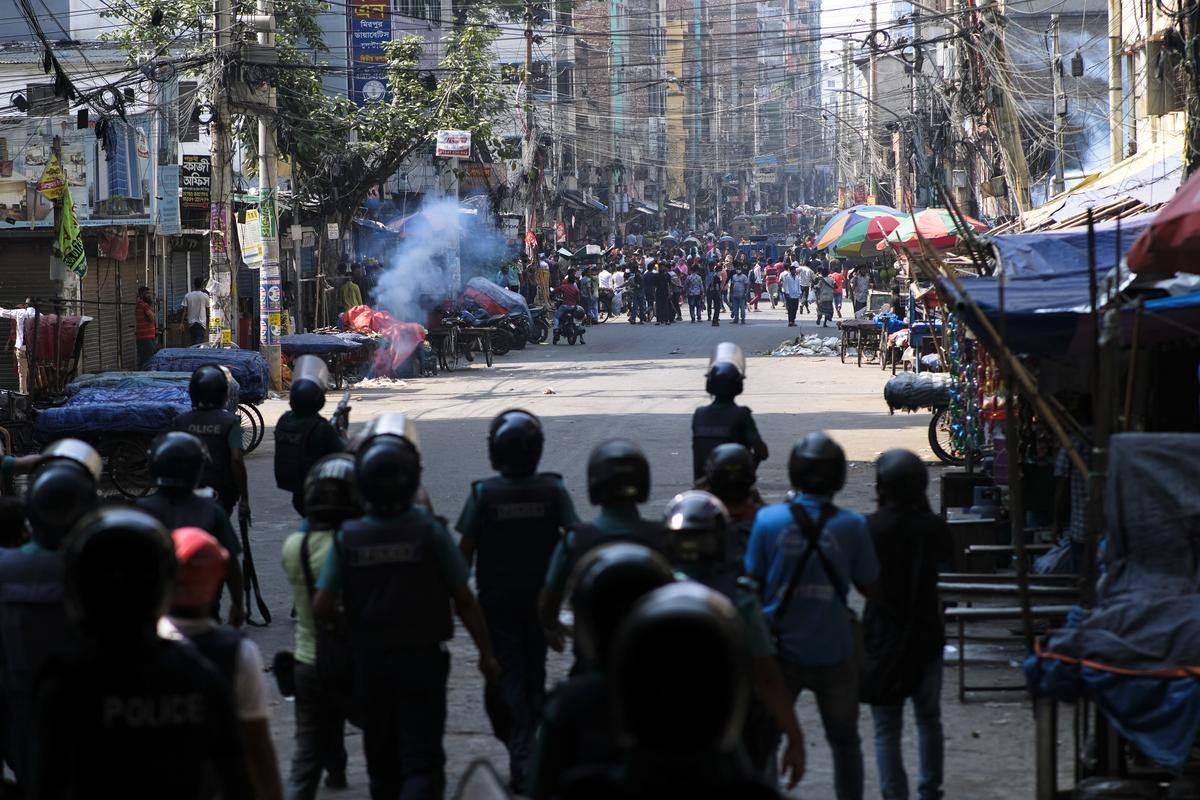
DHAKA — Garment workers blocked roads in Bangladesh's key industrial belt on Tuesday, 24 November, prompting police to fire tear gas and sound grenades, as pay protests disrupted production and forced hundreds of factories to suspend operations. Workers blocked highways in Gazipur, Savar and Ashulia, on the outskirts of Dhaka, and 94 factories declared a general holiday, police said.
Source: Reuters
In Gazipur, workers blocked the Dhaka–Tangail and Dhaka–Mymensingh highways and set fires after a rumour spread that a worker had died at Islam Garments in Konabari, police and witnesses said. Gazipur Industrial Police Superintendent Mohammad Amjad Hossain said no worker had died. Workers at Islam Garments and Ripon Garments stayed away from work and blocked a regional road, and police fired tear gas and sound grenades to clear the routes.
The unrest spread to Savar, where workers of Standard Group took to the streets at Padmar Mor in Hemayetpur after lunch and staged a sit-in on the road, and to Ashulia, where fresh clashes broke out in the Kathgara area in the evening. Police said a group went to the gates of operating factories, threw bricks and tried to vandalise the gates, and officers dispersed them with tear gas and sound grenades. In Savar, 24 factories declared a holiday and workers at seven factories observed work stoppages.
What the workers want
Workers are demanding that the minimum monthly wage more than double to 30,000 taka — about $241 — from the current 12,500 taka, citing soaring food, housing and transport costs. The government-appointed wage board was holding talks on Tuesday on a new minimum wage, a day after factory owners submitted their proposal. No new wage had been announced by the time of reporting.
According to the Bangladesh Garment Manufacturers and Exporters Association (BGMEA), around 397 factories have been forced to suspend operations, while another 84 announced indefinite closures under Section 13(1) of the Bangladesh Labour Act. The protests over pay have triggered repeated factory shutdowns and clashes since early November in Bangladesh, the world's second-largest garment exporter after China.
Workers clashed with police in Gazipur and Savar a week ago after a wage board meeting was postponed. This story covers the new round of protests on 24 November. Read the earlier report
Injuries and arrests so far
On 20 November, the rights group JusticeMakers Bangladesh in France said more than 543 workers had been injured and 748 people arrested during 20 days of protests, and condemned what it called brutal police force and mass arrests. The group called on the government to protect workers' right to peaceful assembly and to investigate allegations against police officers.
What is solid
- Workers blocked highways in Gazipur, Savar and Ashulia on 24 November
- Police fired tear gas and sound grenades in Gazipur and Ashulia
- 94 factories declared a general holiday on Tuesday
- Workers demand a minimum wage of 30,000 taka a month, up from 12,500 taka
What is only claimed
- Whether a worker died at Islam Garments in Gazipur — the rumour spread among workers, but police said no worker died
- The exact scale of closures — police counted 94 factories on holiday, while BGMEA put suspended operations at about 397, a different measure covering a longer period
What happens next
The wage board's talks continue, with factory owners' proposal now on the table and workers' representatives pressing for 30,000 taka. The board has not yet announced a new minimum wage. Its decision is now the next marker — the dispute has run for three weeks, and both sides are watching whether the board bridges the gap between the owners' proposal and the workers' 30,000-taka demand.