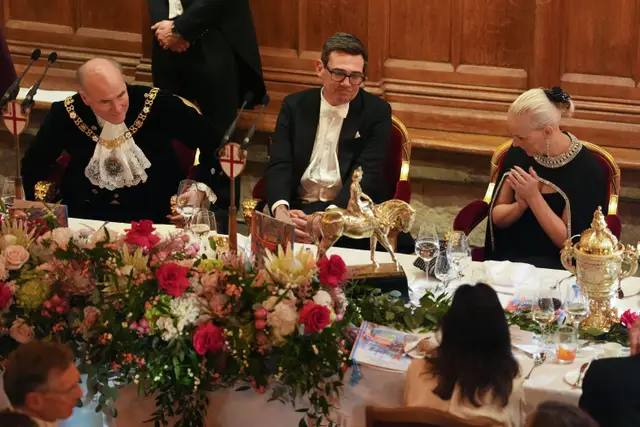
LONDON — Britain has lost more than it has gained from Brexit and its standing in the world has diminished in the decade since the referendum, Prime Minister Andy Burnham said on Monday, November 16, in his first major foreign policy speech, delivered at the Lord Mayor's Banquet in London.
Source: PA via Glasgow Times
“In the decade since Brexit, our standing in the world has diminished. We treated both allies and institutions with insufficient care, and the effects went beyond Europe,” Burnham told the banquet. Comparing the Brexit deal to “the emperor's new clothes, where no one is prepared to say the obvious truth”, he added: “Well, I do try to say things as I see them, and to be frank, we have lost more than we have gained in the last 10 years. The hard Brexit we were given is not good enough for Britain.”
Source: PA via Glasgow Times
BBC News, reporting the same speech, said Burnham argued that a “needlessly hard Brexit” created barriers for businesses and that the promise to “take back control” was not delivered. He is due to sign new agreements on food, energy and youth mobility with the bloc at a UK-EU summit in Brussels on Friday, November 20.
Source: BBC News
Three tests for any new EU deal
Burnham set three tests for any agreement reached in Brussels. “First, it has to be consistent with our manifesto and red lines. Second, it has to improve the Brexit deal to bring it closer to what people thought they were getting in 2016. Third, it has to pass the Makerfield test, producing real improvements in people's everyday lives in areas of the country that have felt neglected for too long.” The Makerfield test, named after the Greater Manchester constituency he won in a by-election, holds that measures which work for that constituency will work for others like it across the country. “If the deal delivers all of this, and I believe it can, it will easily pass the Makerfield test, and I will agree it,” he said.
Source: PA via Glasgow Times
At the summit Burnham will seek to lock in deals on food, emissions trading and youth mobility, PA reported, before sparking a public conversation about forging even closer ties with the EU. BBC News reported the substance of the food, energy and youth mobility deals was set by his predecessor, Sir Keir Starmer.
Source: PA via Glasgow Times
Beyond Europe: Commonwealth, China, Gaza — and an AI compact
Burnham said Britain had failed to “invest in the modernisation of the Commonwealth” and had “blown hot and cold” in relations with China. On the Middle East, he said that while Britain rightly condemned Hamas and the October 7 attacks, “our response to what followed in Gaza left many questioning our moral compass.” He also said he wants to use Britain's presidency of the G20 next year to negotiate a new international AI safety framework — a “Manchester Compact on AI” to be worked towards at next November's leaders' summit.
Source: PA via Glasgow Times
Reaction at home
Supporters of Brexit have in recent days founded two separate campaign groups aimed at keeping Britain out of the EU should Burnham seek to rejoin, PA reported, and former prime ministers Boris Johnson and Lord Cameron — who were on opposing sides of the Brexit debate — have both cautioned him against returning to the bloc. Naomi Smith, chief executive of Best for Britain, which campaigns to restore UK membership of the EU, welcomed the speech, saying Burnham had delivered remarks his predecessors “failed to find either the honesty or courage to give.”
Source: PA via Glasgow Times
For Punjabi and Indian families and businesses in Britain — in food trade, hospitality, study and family travel — the practical stakes sit in the details still to be signed on Friday: food checks, energy cooperation and a youth mobility scheme that would let young people work for limited periods across Britain and the EU. No deal has been signed yet; Monday's speech set the political terms, not the outcome.
Source: BBC News
Burnham travels to Brussels on Friday, November 20 for his first formal UK-EU summit. If agreements on food, emissions trading and youth mobility are signed there, he has said he will then begin a wider public conversation about Britain's long-term relationship with the EU.