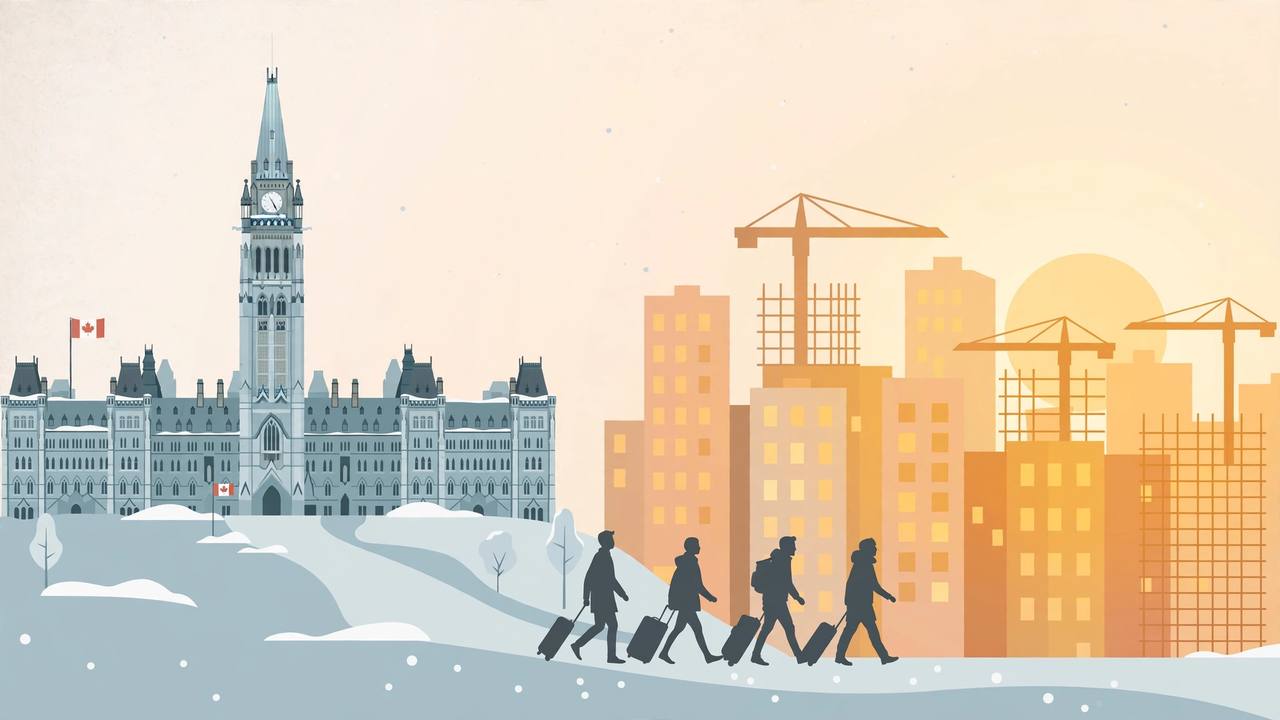
Canada's federal government tabled its 2026 budget in Ottawa on Thursday, November 5 — the second budget of Prime Minister Mark Carney — proposing C$142.1 billion in new spending over five years, yaani about C$14,210 crore, while holding immigration targets steady at 380,000 permanent residents a year, Reuters reported.
Source: Reuters
Finance Minister François-Philippe Champagne presented the budget, which the government framed around affordability, housing, business investment and greater economic independence from the United States. According to the BBC, stronger-than-expected oil revenues, supported by higher global energy prices amid the Iran war, helped finance the spending commitments, and Carney described the plan as a major step toward greater national independence.
Source: BBC via Suara Garut
Immigration levels held — and a pathway for people already in Canada
The 2027-2029 Immigration Levels Plan, folded into the budget for the second year in a row, sets targets of 380,000 permanent resident admissions and 370,000 new temporary resident arrivals in each of 2027, 2028 and 2029 — the same numbers the government had already set for 2027 and 2028 last year, now extended to 2029, according to the budget text reported by immigration.ca. After weeks of speculation that Ottawa might raise levels again, it opted to keep them steady.
Source: Budget 2026 via immigration.ca
The budget's main new immigration measure is a one-time pathway under which up to 200,000 temporary residents already in Canada — a group that includes large numbers of Indian and Punjabi workers and former international students — would have the opportunity to become permanent residents by the end of 2027, immigration.ca reported. The budget's impacts annex names 100,000 of them as workers; it does not yet say who makes up the remainder, how candidates will be selected, or whether these admissions count inside the 380,000 annual target. The government also proposes $56.9 million over four years for Immigration, Refugees and Citizenship Canada (IRCC), starting in 2027-28, with $205.4 million in later years, and says fuller levels-plan details will come when the Immigration Minister tables the 2026 Annual Report to Parliament on Immigration.
Source: Budget 2026 via immigration.ca
Carney told the House of Commons his government has 'taken back control of immigration,' noting temporary foreign worker arrivals are down sharply from their peak, while Immigration Minister Lena Diab said Ottawa 'will not budge from sustainable levels.' In September, Carney had spoken of eventually resuming a 'controlled increase' in population; the budget holds the steady course instead.
Source: Budget 2026 reporting via immigration.ca
Housing, defence and the deficit
On housing, the budget earmarks $45 billion for a suite of measures over 10 years, with a goal of ending homelessness in a decade, a plan to triple the pace of non-market housing starts to 24,000 a year, and a loosening of the foreign buyer ban to allow some new home purchases, Canadian Mortgage Trends reported. Reuters' factbox put the wider package at C$51.9 billion to attract capital and boost innovation, C$15.1 billion for infrastructure, C$30.6 billion in affordability measures and C$34.6 billion for parks, natural resources and reconciliation with Indigenous peoples.
Source: Canadian Mortgage Trends / Reuters
On defence, Canada will spend C$2.3 billion over five years, beginning in 2027, on a drone initiative announced in July, and C$7.6 billion over five years to extend its biggest overseas deployment in Europe, 'to deter Russian aggression on NATO's Eastern flank,' Reuters reported. The cost: a projected federal deficit of C$62.3 billion for the 2026-27 fiscal year, with CBC News projecting the deficit at C$53.4 billion in 2029 and annual debt-servicing costs reaching C$78.4 billion that year.
Source: Reuters / CBC via reports
What happens next: the budget is a proposal until Parliament passes it, and the detailed immigration breakdown — which economic classes, provinces and programs fill the 380,000 a year, and exactly how the 200,000 in-Canada conversions will be chosen — is still to come in the Immigration Minister's annual report. For Punjabi and Indian families in Canada on work and study permits, that report, not Thursday's headline numbers, will decide who the new pathway actually reaches.