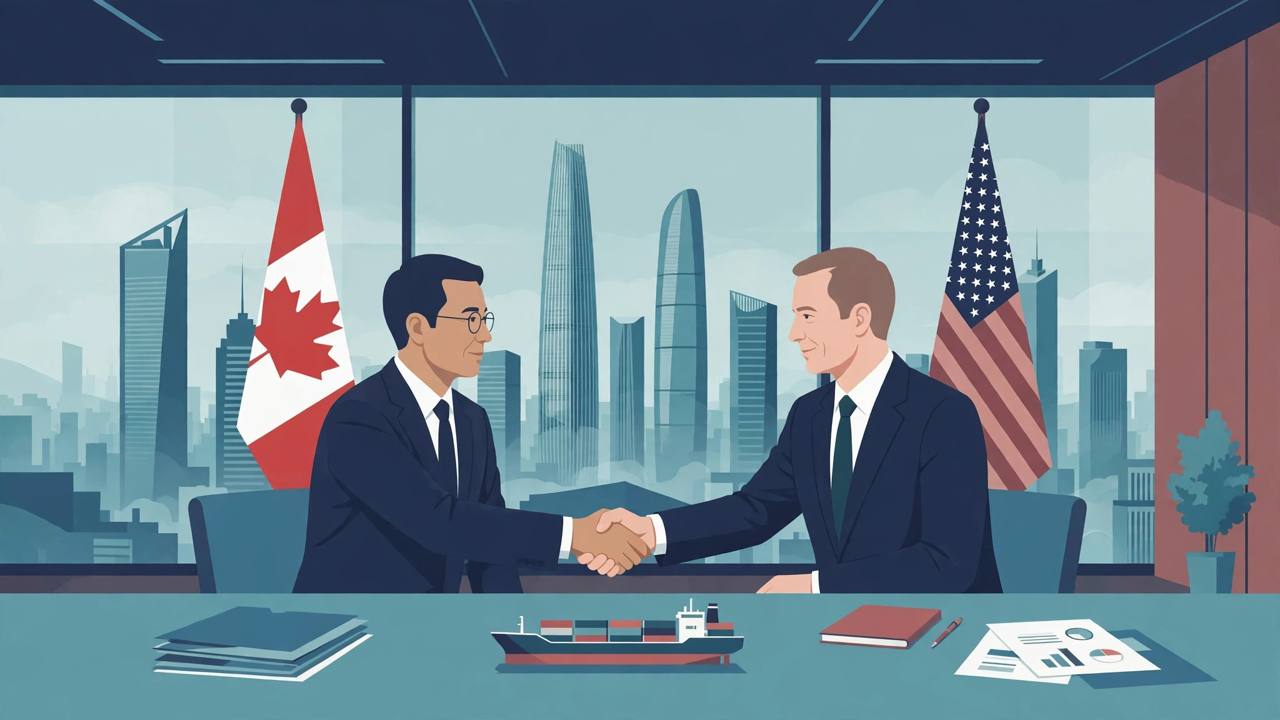
The meeting came a day after Carney and Chinese President Xi Jinping agreed in Shenzhen to extend tariff relief on about C$400 million of Canadian pork and seafood exports — the deal that has drawn criticism from the White House. Read the Canada-China tariff deal report
SHENZHEN — Canadian Prime Minister Mark Carney met United States President Donald Trump in Shenzhen on Wednesday, in a conversation lasting just under 20 minutes on the sidelines of the Asia-Pacific Economic Cooperation (APEC) summit, Carney's office said. It was the two leaders' first face-to-face meeting since formal Canada-US trade talks collapsed in August.
Source: The Canadian Press
“The leaders discussed the work underway to reach a mutually beneficial trade agreement that would create good jobs, boost affordability, and fully respect Canada's languages, culture and sovereignty,” Carney's office said in a readout of the meeting. “They agreed to continue the work and to stay in close contact.”
Source: The Canadian Press
The meeting, held during dinnertime in Shenzhen, included US Trade Representative Jamieson Greer and US Commerce Secretary Howard Lutnick, and also Trump's chief of staff Stephen Miller and Secretary of State Marco Rubio. Carney was joined by his chief of staff Marc-André Blanchard and Foreign Affairs Minister Anita Anand, Bloomberg reported.
Source: Bloomberg Law
China is 'not the top issue' for Trump, Carney says
Speaking at a news conference shortly before the meeting, Carney said he does not believe Trump is uncomfortable with Canada furthering its trade relationship with China. “In my conversation with the president, he's tried to understand where we are with China, where we're going with China,” Carney said. “I shouldn't speak for him, but in his hierarchy of issues, it's not the top issue at all.”
Source: The Canadian Press
Carney said it has been easier for Ottawa to secure new trade arrangements with China because Canada's trade relations south of the border are “much more complex.” Canada's exports to China are commodities, he said: “We are exporting canola, we are exporting pork. We are exporting halibut,” he said, also citing liquefied natural gas and oil. “These are important industries. These are not cutting-edge semiconductors.”
Source: The Canadian Press
“The United States fundamentally changed its trade objectives and we are focused on getting the right deal for Canadians,” Carney said. “We will do what's necessary in order to achieve that deal, but only that deal that is in the interests of Canadians.” He said progress had been made toward a deal.
Source: The Canadian Press
Navarro attack, and the August collapse behind the meeting
Carney's comments came amid criticism from White House trade adviser Peter Navarro, who attacked the prime minister on X on Monday after Carney suggested Canada could turn to Chinese automakers if US talks fail. “Are u really threatening to play China off the U.S.? This is offensive in the extreme,” Navarro wrote. “You should be far more worried China is going to eat Canada alive.”
Source: The Canadian Press
Diplomacy between Canada and the US has been strained since Carney's government walked away from formal trade talks in August, with each side accusing the other of pushing eleventh-hour changes. Carney has said Trump's team wanted to restrict Canada's ability to make trade deals with other countries, endanger Canada's protections for language and culture, and maintain hefty tariffs on some automobiles. Washington then imposed 50 percent tariffs on almost $30 billion in Canadian goods — yaani about 30 billion dollars, or roughly 3,000 crore dollars — and Ottawa retaliated with tariffs on American products.
Source: The Canadian Press
Carney has said the outcome of the US talks will shape how far Canada goes with Chinese investment, and that Canada could turn to Chinese, European or Japanese automakers if Washington negotiations fail to protect its auto industry. Read Carney's automakers warning from Phnom Penh
What happens next
No agreement was announced on Wednesday, and neither side gave a date for formal talks to resume; the two leaders agreed only to continue the work and stay in close contact. Canada is also set to send a trade mission to China in 2027, and Carney brokered a deal with Xi in January to allow a limited number of Chinese electric vehicles to be sold in Canada — steps Washington is watching as Trump, Xi and Russian President Vladimir Putin hold their own meetings in Shenzhen this week.