Drone strikes by Sudan's Rapid Support Forces (RSF) that hit residential areas and civilian infrastructure in El Obeid, the capital of North Kordofan State, killing 37 civilians and injuring 10 others, should be investigated as war crimes, Amnesty International said in a new investigation published on Wednesday.
Source: Amnesty International
The rights group investigated nine RSF drone strikes in and around El Obeid between June and August 2026. Three hit residential areas, four struck key civilian infrastructure — the city's power plant, fuel stations and the main market — and two targeted moving vehicles. In every incident, witnesses said they saw or heard the drones moments before or after the strikes, and Amnesty's investigators said they did not identify any military objective near the sites at the time they were hit.
"The RSF drone attacks we've documented must be investigated as war crimes. They indicate how the Sudan conflict is moving into a new phase where all parties are increasingly using drones and other advanced weapons not only to kill and injure civilians, but also to disrupt essential and lifesaving services," said Agnès Callamard, Amnesty International's Secretary General. She called on the United Nations and the African Union to urgently propose and implement civilian protection measures, including deploying a protection force to Sudan.
A cemetery burial, a family home, a bank queue
On June 10, 2026, an RSF drone strike hit mourners carrying a body for burial at the Dalil cemetery in north-west El Obeid, killing at least five people and injuring three, Amnesty said. Among the dead were the father and brother of 25-year-old Al Nur Ahmed Issa, who had himself been killed in a separate drone strike that same morning. A 19-year-old mosque prayer caller who was seriously injured told investigators a drone circled above their vehicle seconds before it was hit.
A day later, on June 11, RSF drones attacked several neighbourhoods including Al-Matar and Al-Muwazzafin. One strike hit a home in Al-Matar, killing at least nine civilians. The 41-year-old doctor who owned the house said neighbours who rushed to put out the fire were killed when the drone dropped another bomb: "Many neighbours came out to put out the fire in our house and then the drone dropped another bomb that killed my husband, my uncle and seven neighbours. I don't know why we were targeted."
On August 12, a drone strike hit the Agricultural Bank near El Obeid's main market, killing two civilians — 52-year-old Zeinab Babu and Ahmed Salah Awad — and injuring five others, according to relatives and an injured displaced woman interviewed by Amnesty.
Power, fuel and food: the infrastructure strikes
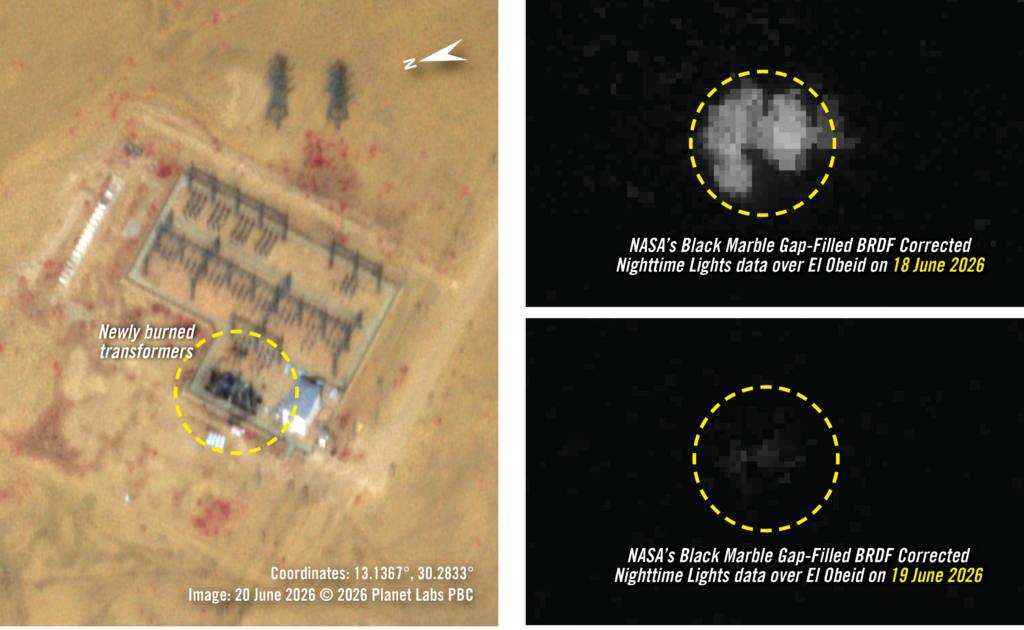
On June 18, an RSF drone strike hit El Obeid's main electricity station, sparking a fire that caused a city-wide blackout; satellite imagery from June 20 confirmed a new burn area at the facility, and NASA nighttime-lights data showed the city's glow collapsing the next night. Fuel stations were hit repeatedly: at least five civilians died at the Al-Mithaq station on June 6, two more at the al-Nahla station on June 22, and 10 civilian vehicles were destroyed at the Agip station on June 25. By July, the medical charity Médecins Sans Frontières assessed that almost no fuel stations in the city were still functioning and that a litre of gasoline cost nearly $15 on the black market. A June 10 strike on a food truck heading to Kadugli killed trader Al-Amin Musa, and a July 6 strike on a vehicle carrying wedding guests near al-Sha'toot village killed 13 civilians, Amnesty said.
RSF denies the findings and blames the army; Amnesty points to the supply line
Amnesty wrote to the RSF about its findings on October 8. The RSF replied on October 24 denying responsibility for civilian casualties in El Obeid and blaming the Sudanese Armed Forces (SAF), without providing evidence for the allegation, Amnesty said. The group added that the RSF said it was considering a "Specialized Investigative Committee" to examine incidents involving civilian casualties or destroyed civilian property, including in El Obeid.
Amnesty said it has previously documented the United Arab Emirates supplying weapons, ammunition, armoured personnel carriers and drones to the RSF, and found the RSF used Chinese-made Wing Loong II and FeiHong-95 drones provided by the UAE — findings the group's report repeats as its own documented conclusions. "This is a war on civilians which is being sustained by third parties including the UAE, the primary backer of the RSF," Callamard said, urging all suppliers to stop transfers immediately and calling on the UN Security Council to extend the Darfur arms embargo to the whole country and explicitly include drones.
El Obeid remains under SAF control and has faced a partial RSF siege for nearly two years; the RSF first attacked the city with drones in October 2025 and sharply escalated the strikes in June 2026 as it reportedly prepared a ground offensive, raising fears of a repeat of the atrocities that followed its seizure of El Fasher a year earlier. Amnesty said it is also investigating SAF drone strikes that caused civilian casualties. Its report cites UN human rights office figures of at least 1,120 civilians killed by drone strikes in the first six months of 2026 — 80 percent of all conflict-related civilian deaths the office recorded in that period.
A day before Amnesty's report, the UN human rights office said drones now account for nearly three-quarters of Sudan's verified civilian deaths this year. Read: UN says drones drive Sudan's civilian toll
Amnesty wants the UN and African Union to move on a civilian protection force for Sudan, arms suppliers to halt transfers to both warring parties, and the Security Council to widen the arms embargo beyond Darfur to cover all of Sudan, drones included. The RSF says it may set up its own investigative committee; no independent investigation has been announced.