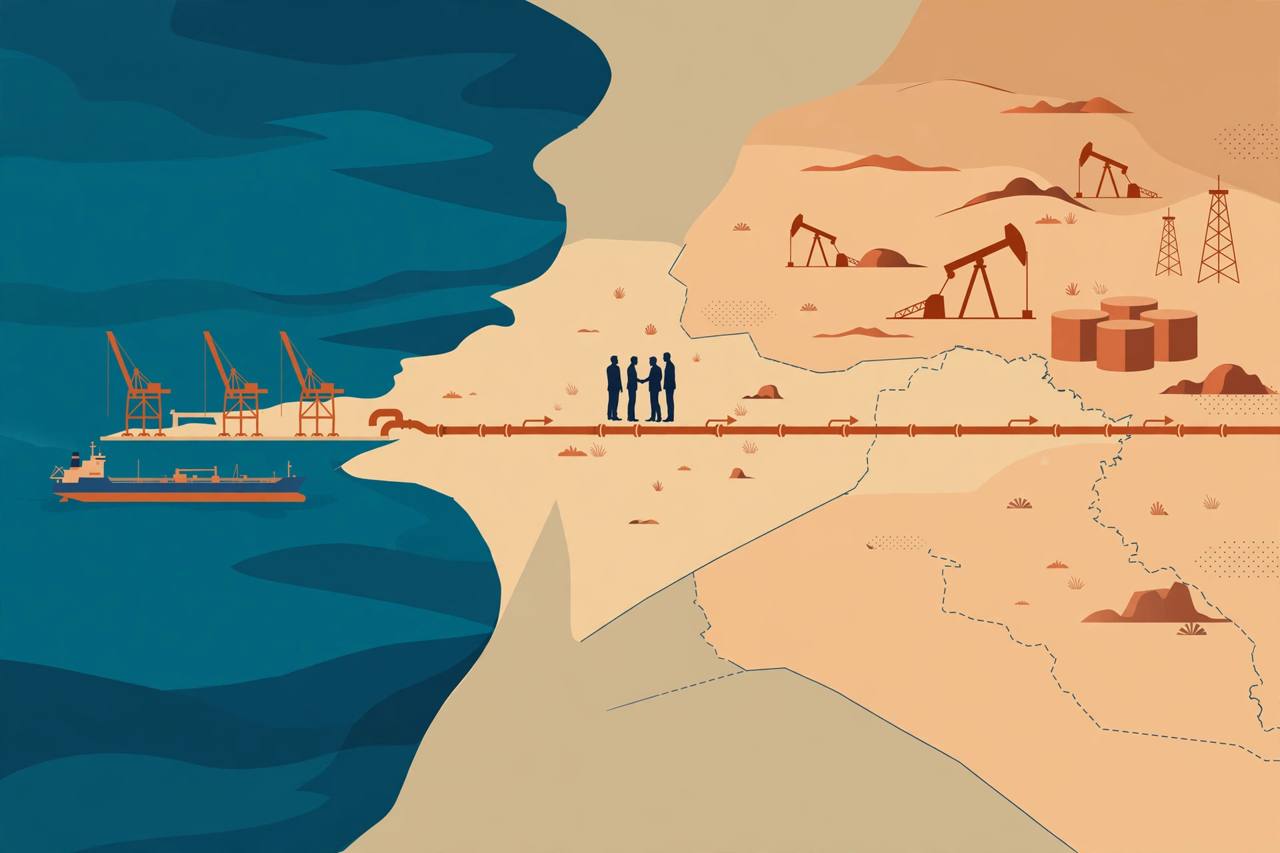
Iraq's prime minister has already signed a pipeline agreement with Syria's president in Damascus. His Beirut visit is the next leg of the same push — this time to bring Lebanon's Tripoli port into the corridor. Read the earlier Damascus pipeline agreement
Iraqi Prime Minister Ali al-Zaidi is set to visit Lebanon on his latest regional trip aimed at boosting economic cooperation amid the fallout from the US-Israel war on Iran, with a proposed oil export route bypassing the Strait of Hormuz high on the agenda. Al-Zaidi is expected to hold high-level talks in Beirut on Wednesday with Lebanese President Joseph Aoun, Prime Minister Nawaf Salam and Parliament Speaker Nabih Berri, Al Jazeera reported.
Source: Al Jazeera via AzeriTimes
The discussions are expected to cover strengthening bilateral trade, customs exemption deals, and coordination on security and countering drug trafficking. At the centre is a proposed pipeline linking the Iraqi city of Kirkuk, through Syria's Mediterranean port of Baniyas, to Tripoli in northern Lebanon — a route that would let Iraqi crude reach the sea without passing through Hormuz, a key energy waterway severely disrupted since the war began in late February.
Source: GazeWire
Why Iraq needs another route
Iraq's crude exports were badly hit by the war and the effective closure of the strait, through which one-fifth of the world's energy passes in peacetime. According to Iraq's Ministry of Oil, exports reached about 2.7 million barrels per day (bpd) last month, recovering from around 200,000 bpd in May, but still below the roughly 3.5 million bpd Iraq exported before the conflict. The recovery has been helped by the restart of the Iraqi-Turkish pipeline, which initially resumed at 120,000 bpd.
“After the war in Iran and the story of Hormuz and exports in the Gulf, [Iraq] is looking for alternative routes to diversify their export routes,” Walid Marrouch, a professor of economics at the Lebanese American University in Beirut, told Al Jazeera. Tamer Badawi, an associate fellow at the Royal United Services Institute, said the visit was likely influenced by US envoy Tom Barrack's efforts to diversify Iraq's oil export routes through Türkiye, Saudi Arabia, Syria and Lebanon, connecting Iraq's oil infrastructure with regional networks through alternative corridors.
Tripoli's old oil infrastructure — and Lebanon's stake
Tripoli has emerged as a potential destination because of its existing, largely inactive oil infrastructure: a pipeline historically connected the northern Lebanese city to Iraq's Kirkuk oilfields, and a local refinery once processed Iraqi crude. According to Lebanon's Directorate General of Oil, the refinery handled around 21,000 bpd before it closed in 1992. Industry sources say Tripoli's facilities include three legacy pipelines with a combined historical peak capacity of 900,000 bpd, though they would need repairs and modernisation.
A report this year by the Basil Fuleihan Institute of Finance estimated that a moderate operating scenario could support flows of 300,000 to 500,000 bpd through Tripoli, generating between $80 million and $275 million a year in revenue for Lebanon — yaani roughly 8 to 27.5 crore dollars a year. That income would matter for an economy in severe financial and banking crisis since 2019, in which the national currency has lost more than 90 per cent of its value. The institute also noted Tripoli's deepwater quays can take larger vessels and its coastline is more sheltered from southern winds than Baniyas, allowing year-round operations.
The Damascus leg came first
Al-Zaidi's Beirut trip comes weeks after he travelled to Damascus and met Syrian President Ahmed al-Sharaa, where Iraq and Syria signed a cooperation agreement to rehabilitate the pipeline from Kirkuk to Baniyas, in a project to be carried out by US energy giant Chevron. The US State Department said at the time the rehabilitated pipeline would initially have capacity to transport 2 million barrels of crude per day. Any Kirkuk–Tripoli route would still need to cross about 250 km of Syrian territory, and Syria's own ports — Tartous, Latakia and Baniyas, with the Baniyas and Homs refineries able to handle an estimated 350,000 to 500,000 bpd — give Damascus a central role either way.
Marrouch warned Beirut risks being bypassed if it fails to secure a role: “Lebanon can benefit, but if Lebanon does not get a seat at the table, it [could be circumvented] because Iraq can already reach the sea from Syria.” Wednesday's talks in Beirut will show whether Tripoli joins the corridor or watches it pass through Syria alone.