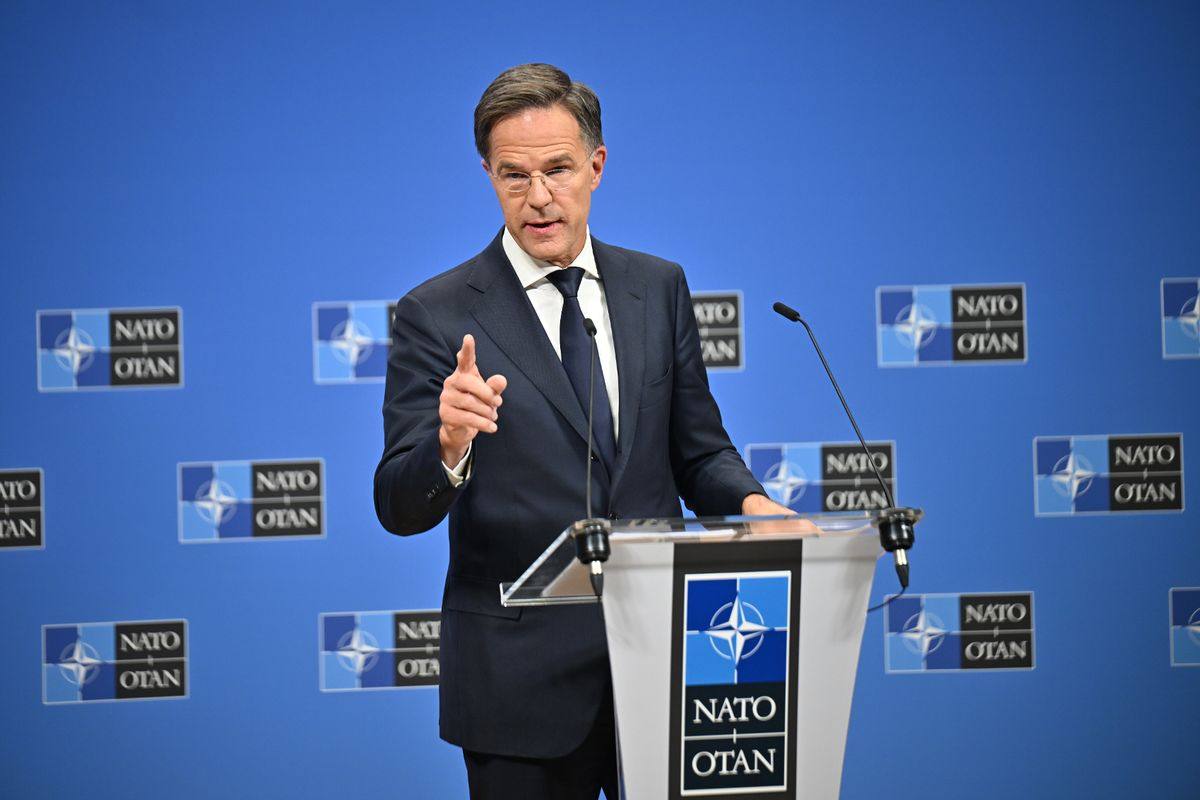
BRUSSELS, Nov 17 — NATO Secretary General Mark Rutte closed the 37th meeting of the Ukraine Defense Contact Group in Brussels on Tuesday with a scorecard: over the course of the programme, allies have now pledged more than 10 billion US dollars — yaani 1,000 crore US dollars — to the Prioritised Ukraine Requirements List (PURL) and to US Foreign Military Sales for Ukraine, the two channels through which allies pay for American weapons for Kyiv.
Source: NATO — joint press conference transcript at the UDCG, Nov 17
Tuesday's meeting heard fresh announcements of more air defence, more missiles, ammunition and drones, and “hundreds of millions for PURL”, Rutte told the closing press conference. The day's individual pledges were reported by Awaaz Punjab earlier on Tuesday: Britain's £240 million air-defence package with more than 1,000 short-range missiles, a $300 million PURL contribution from Germany and a separate $300 million commitment from Norway, and President Volodymyr Zelenskyy's proposal that partners hand over Patriot and IRIS-T interceptors from their own stocks now in exchange for newer missiles from Ukraine's orders. Rutte's figures are the meeting's running total, not a new single pledge.
“A fairer NATO” — a few countries still carry the lion's share
“But NATO 3.0 also means a fairer NATO, and here European Allies will need to share the burden even more equally. A few countries are still doing the lion's share,” Rutte said. “We all want Ukraine to succeed. We all need to do our part.” He welcomed that Europe and Canada are now leading in support for Ukraine, and said the burden-sharing conversation would continue in the Coalition of the Willing in Berlin in two days' time, on Thursday.
Source: NATO — joint press conference transcript at the UDCG, Nov 17
The broader target is the €70 billion — yaani 7,000 crore euros — in military equipment, assistance and training that allies agreed at NATO's 2026 summit in Ankara to provide Ukraine during this year. Asked by POLITICO about the gap, Rutte called it “a hard target” and said: “We are a couple of billion close to getting to the 70 billion, but still a couple of billion we need to get to, and we discussed that today. And I'm cautiously optimistic we will get there.” That is a narrower gap than the roughly €7 billion shortfall allies faced earlier in November.
Source: POLITICO — funding section, via Daily Guardian Europe, Nov 17
Earlier this month, Awaaz Punjab reported that allies were about €7 billion short of the same €70 billion target for 2026. Read the earlier shortfall report
The $12–15 billion question Rutte batted away
Reporters pressed Rutte on PURL's own pace: a year ago he had said NATO should prepare for at least one billion dollars a month for the programme — $12 billion over a year — and one journalist calculated that, after deducting last year's $4.3 billion, the $10 billion cumulative total amounts to about half that pace. Rutte argued the programme “is very successful. And it is delivering essential U.S. gear at a high pace into Ukraine, which only the U.S. is able to provide, and Europeans paying for it.” The $12–15 billion figure, he said, “was an estimation, and we see in practice that we don't need the amount of money we thought we'd need.”
Source: NATO — joint press conference transcript at the UDCG, Nov 17
Money, Rutte conceded, is not the only bottleneck. Patriot interceptors are “in huge demand” and stockpiles in both the United States and Europe are limited; he cautioned against over-emphasising Patriots alone, pointing also to ASTER and IRIS-T systems and to the 20mm ammunition F-16s use against jet-powered drones. The financing therefore has to run ahead of production and stockpile limits that no pledge can remove overnight.
The pledges land at the start of what Rutte called another harsh winter — the fifth winter of Russia's full-scale invasion — with Russian bombs continuing to fall on Ukrainian cities. Continued support, he said, is meant both to help make peace talks succeed and to ensure Ukraine can defend itself after any settlement: “For any peace to hold, Ukraine will need to be able to defend itself now and in the future.”
At the same meeting, President Zelenskyy proposed an interceptor swap — partners' existing Patriot and IRIS-T stocks now, Ukraine's newer ordered missiles in return. Read the interceptor-swap proposal
What is solid
- Allies' cumulative pledges to PURL and US Foreign Military Sales for Ukraine have passed $10 billion, Rutte said at the UDCG closing press conference (NATO transcript).
- The €70 billion figure is the allies' agreed 2026 target for military equipment, assistance and training, set at the Ankara summit; Rutte said a couple of billion is still missing.
- Germany and Norway each announced $300 million PURL contributions on Tuesday, and Britain announced a £240 million air-defence package.
What is only claimed
- Whether PURL is ‘very successful’, as Rutte argued, or running at about half the pace he floated a year ago, as a reporter put to him at the same press conference.
- Whether allies will actually close the remaining €70 billion gap before the end of 2026 — Rutte said he was ‘cautiously optimistic’, which is not a commitment by any ally.
The burden-sharing argument moves to Berlin on Thursday, where the Coalition of the Willing meets. Allies have until the end of 2026 to close the remaining gap of a couple of billion euros against the €70 billion target, and Ukraine's immediate test is whether pledged air-defence interceptors arrive before Russia's winter strike campaign peaks.