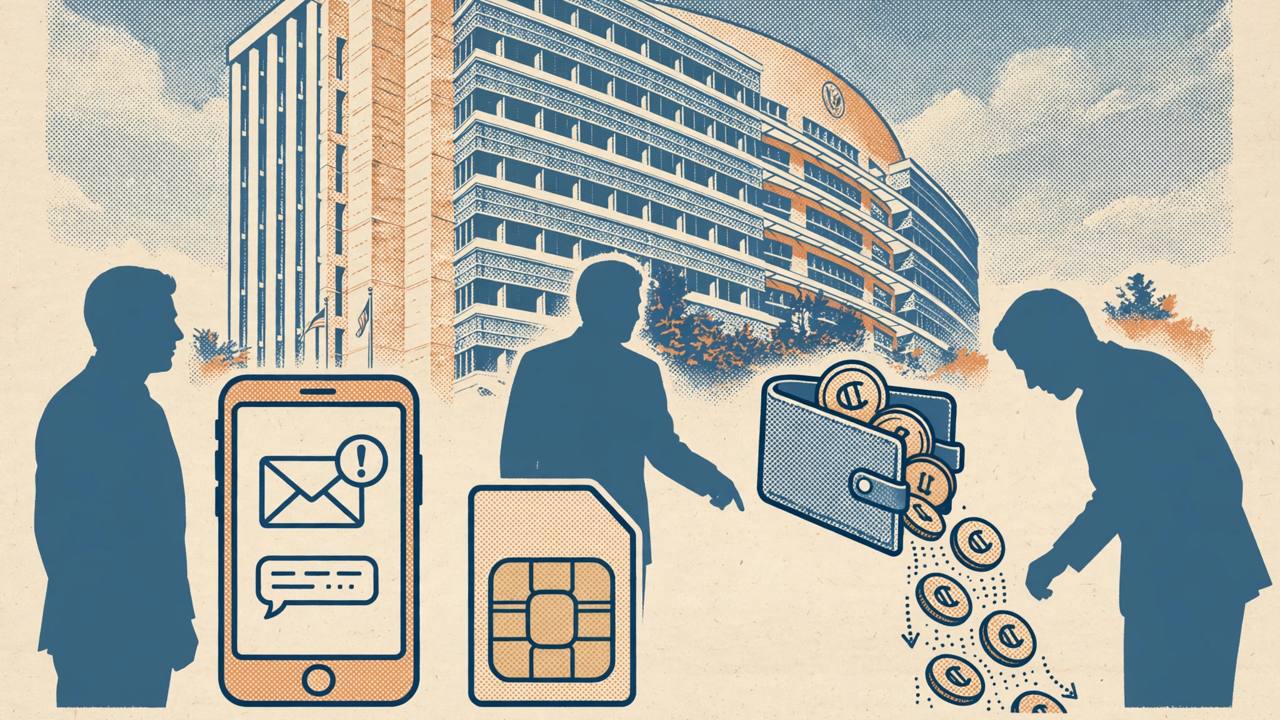
A British man who helped hack at least a dozen companies through text-message phishing and steal more than $11.6 million in virtual currency from individual victims across the United States was sentenced on Tuesday, November 17, to 72 months in federal prison in Santa Ana, California, the U.S. Department of Justice announced.
Source: U.S. Department of Justice, Central District of California
Tyler Robert Buchanan, 24, of Dundee, Scotland, was sentenced by U.S. District Judge John W. Holcomb, who also scheduled a restitution hearing for December 11 in the case. Buchanan is the fifth and final defendant to be sentenced in the conspiracy, according to the U.S. Attorney's Office for the Central District of California.
Buchanan pleaded guilty on April 17 to one count of conspiracy to commit wire fraud and one count of aggravated identity theft. He has been in federal custody since April 2025, the Justice Department said.
How the phishing scheme worked
According to his plea agreement, from September 2021 to April 2023 Buchanan and other individuals conspired to carry out cyber intrusions and virtual-currency thefts against numerous companies and individuals. The victims and intended victims included interactive entertainment companies, telecommunications companies, technology companies, business process outsourcing and information technology suppliers, cloud communications providers, virtual currency companies, and individuals.
The conspirators sent hundreds of SMS phishing messages to the mobile phones of victim-company employees, the Justice Department said. The messages claimed to be from the victim company itself or from a contracted IT or business-process supplier, and contained links to phishing websites built to look like legitimate company or supplier websites. Employees who followed the links were lured into giving up confidential information, including personal identifying information, account usernames and passwords.
The group used a phishing kit that captured the login credentials employees typed into the fake websites, prosecutors said. The stolen credentials were sent to an online Telegram channel administered by Buchanan and another co-conspirator, and were then used to get into employee accounts and company computer systems and steal confidential company information, including work product and personal data such as account credentials, names, email addresses and telephone numbers.
From company break-ins to emptied crypto wallets
Buchanan admitted in his plea agreement that he and several co-conspirators used information stolen in the company intrusions to identify and gain access to virtual-currency accounts and wallets belonging to individual victims, and to steal millions of dollars worth of virtual currency, the Justice Department said. To bypass two-factor authentication, they carried out SIM swaps of victims' mobile numbers to devices the conspirators controlled.
The Justice Department defines SIM swapping as fraudulently inducing a mobile carrier to reassign a cell phone number from the legitimate subscriber's SIM card to a SIM card controlled by someone else, without the subscriber's knowledge or authorization. That lets the criminal intercept two-factor authentication codes sent by phone call or text message and use them to get into the victim's accounts.
In April 2023, investigators found files related to numerous victim companies at Buchanan's residence in Scotland, prosecutors said. On a digital device there, he also held the names and addresses of numerous individual victims, including a text file containing cryptocurrency seed phrases and login information for one victim's account.
The other four defendants
Buchanan's four co-defendants have also pleaded guilty and been sentenced, the Justice Department said: Ahmed Hossam Eldin Elbadawy, 25, of College Station, Texas, was sentenced on September 18 to 45 months in federal prison; Noah Michael Urban, 22, of Palm Coast, Florida, is serving a 10-year federal prison sentence; Evans Onyeaka Osiebo, 22, of Dallas, Texas, was sentenced on August 14 to 45 months; and Joel Martin Evans, 27, of Jacksonville, North Carolina, is serving a two-year federal prison sentence.
Prosecutors argued in a sentencing memorandum that the thefts 'had severe, life-altering consequences for many victims and underscore both the seriousness and far-reaching impact of this conspiracy,' the Justice Department said. The FBI investigated the case, with assistance from the U.S. Attorney's Office for the Eastern District of North Carolina, the Justice Department's Office of International Affairs, Police Scotland, Spain's Cuerpo Nacional de Policía, and the FBI field offices in Charlotte, Dallas, Houston and Portland. Assistant U.S. Attorney Lauren Restrepo of the National Security Division prosecuted the case.
Judge Holcomb has scheduled a restitution hearing for December 11, 2026, at which the court will address how much Buchanan must repay. Buchanan himself has already been sentenced: 72 months in federal prison, as the fifth and final defendant sentenced in the case.
For readers in California and across the United States, the case is a concrete example of how a single text message that appears to come from an employer or its IT help desk can open the door first to a company's systems and then, through a SIM swap, to a person's own accounts. Every fact in this account is drawn from the Justice Department's announcement and Buchanan's own plea agreement as described by prosecutors; the theft total the department gives is at least $11.6 million in virtual currency from individual victims throughout the United States.
Source: MyNewsLA