A federal magistrate judge in Detroit ruled on Tuesday, November 17, that Weiheng Zeng, a Chinese citizen studying at the University of Waterloo in Ontario, will stay in U.S. custody while his criminal case proceeds, denying his lawyers' request that he be released and allowed to return to Canada. U.S. Magistrate Judge Kimberly Altman issued the detention order after a hearing in the U.S. District Court for the Eastern District of Michigan.
Source: CBS News
Zeng, who lives in Cambridge, Ontario, was indicted earlier this month on a single count of making false statements to a government agency and pleaded not guilty at his arraignment in Detroit on November 9. He has not been charged with espionage, and he has not been charged with the act of taking photographs itself; the only charge is that he allegedly lied to U.S. investigators about his trips and about why the photographs were taken. All of the allegations against him remain unproven in court, and he is presumed innocent unless and until the government proves its case at trial.
The detention hearing in Detroit
At Tuesday's hearing, Zeng's legal team argued for his release and told the court his family would pay any bond amount the court could impose to keep him out of detention, and even suggested the family could buy an apartment in the United States for him to be bonded to, according to the Justice Department's statements at the hearing as reported by CBS News. Judge Altman denied the request, leaving the earlier custody order in place. Zeng's lawyers did not immediately respond to a request for comment on the detention order.
What the FBI affidavit alleges happened at O'Hare
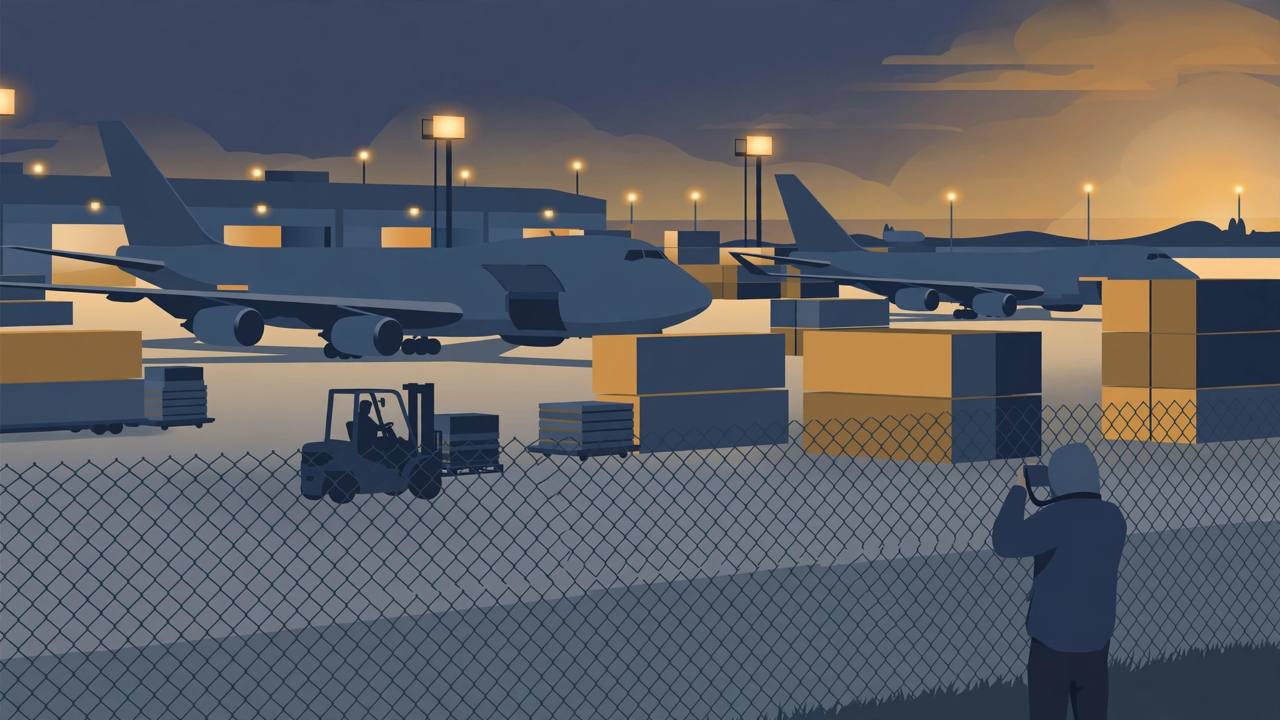
The case begins, according to the criminal complaint filed on August 26, 2026 by FBI Special Agent Robert Holbrook, with Zeng's travel pattern. Zeng was issued a U.S. B1/B2 visitor visa on October 11, 2022, and had entered the United States approximately 24 times. On April 11, 2026, he entered through Detroit, telling border officers he planned to visit his sister, a college student in Chicago. Ten days later, on April 21 at about 4:00 p.m., a man was seen inside the FedEx facility area at Chicago's O'Hare International Airport: surveillance footage described in the complaint shows him walking the fence line for roughly 20 minutes, climbing onto a parked construction forklift to take photographs from a higher vantage point, and attempting to open locked trailers and a shipping container. Investigators say the photographs targeted American Airlines and United Airlines aircraft as well as Atlas cargo aircraft. Zeng left the United States on April 23 through the Windsor–Detroit Tunnel.
Source: U.S. District Court, Eastern District of Michigan — criminal complaint, Case 2:26-mj-30513
Three interviews at the Ambassador Bridge
On August 23, 2026, Zeng tried to enter the United States again at Detroit's Ambassador Bridge, asking to be admitted for a one-day trip to Chicago. Officers referred him to secondary inspection because of the April incident, searched his phone, and interviewed him three times. His account changed across those interviews, the complaint says: he first described the aircraft photos on his phone as pictures of model aircraft tracked for a flight-radar website, then said he had photographed planes from a public parking lot, and only later acknowledged taking pictures from the forklift inside the FedEx facility. Officers also found photographs of military aircraft on the phone, according to the affidavit.
In the third interview, according to the complaint, Zeng said a contact he had met through an aviation-spotter website had assigned him specific aircraft and tail numbers to photograph and paid him between $20 and $30 per photograph. He said the contact mailed him SIM cards for their conversations, and that after each exchange he destroyed the SIM cards and deleted the conversations and the photographs. Zeng told officers he believed the contact was connected to the Chinese Communist Party and that he had been told the photographs were for 'research.' Questioned further by the FBI, he allegedly said he concluded the contact worked for the Chinese government because, as the requests grew, the man's language became 'very organized and managed, not language typically used between friends,' and that he helped because he thought it was 'cool' and wanted 'the opportunity to work with someone like [agents] at the FBI.' The complaint says the contact was also interested in U.S. transportation and logistics, and wanted Zeng to travel to Orlando, Las Vegas and Los Angeles to photograph specific locations around airports. The Canadian Press has reported that the affidavit also describes photographs of Toronto's Pearson airport.
The indictment contains one count: making false statements, under 18 U.S.C. § 1001, based on what Zeng allegedly told Customs and Border Protection officers on April 11 and August 23, 2026. Prosecutors have not charged him with espionage, and the truth of the underlying allegations has not been tested at trial.
Why the case is being watched on both sides of the border
Plane spotting — photographing aircraft as a hobby — is legal and popular around major airports, and enthusiasts routinely track tail numbers and rare liveries. What moved this case into a federal courtroom, investigators say, is the combination described in the affidavit: entry into a restricted cargo area, attempts to open locked trailers and a container, a foreign contact allegedly assigning specific targets, cash payments per image, and instructions to destroy SIM cards and delete evidence. The case also sits at one of the busiest Canada–U.S. crossings, the Ambassador Bridge between Windsor and Detroit, and involves a student at a major Canadian university — a combination that has drawn attention from cross-border travellers and international students who make the same routine trips Zeng made roughly two dozen times.
What happens next
Zeng remains in federal custody in Michigan following Judge Altman's order. His trial is scheduled to begin in January, according to a schedule filed with the court and reported by The Canadian Press. If the case proceeds as charged, a jury will decide only the false-statements count; the broader espionage suspicions described in the FBI affidavit are allegations the government would have to prove with evidence if it ever brings such charges, and it has not done so.