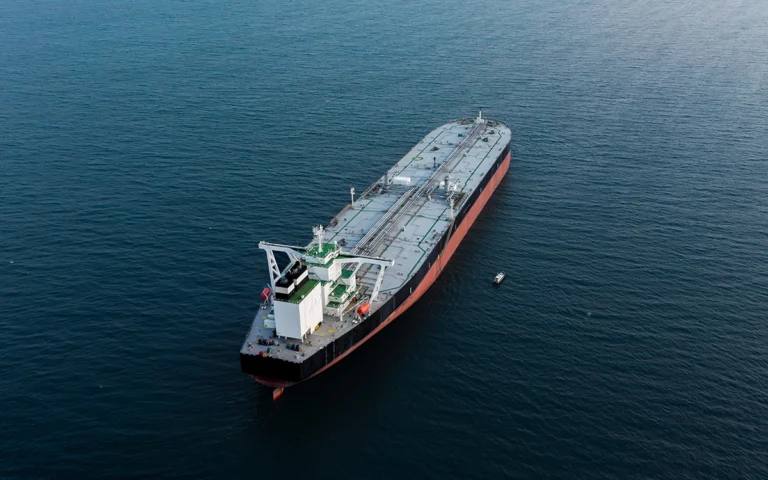
The tanker strikes came a day after US fighter jets hit an IRGC missile launch site on Iran's Qeshm Island in the Strait of Hormuz, an attack Washington called self-defence. Kuwait and Bahrain also reported intercepting Iranian drones overnight. Read the Qeshm missile-site strike report
The United States destroyed five Iranian crude oil tankers on Tuesday in the sharpest escalation yet of the six-month-old US-Israel war on Iran, US Central Command (CENTCOM) said in a statement late on Tuesday, and Iran retaliated within hours by attacking ships near the Strait of Hormuz and firing missiles at a US base in Jordan.
Source: Al Jazeera
CENTCOM said Iran's Islamic Revolutionary Guard Corps (IRGC) had sought to target a US warship twice over the past two days with ballistic missiles, but the vessel “successfully evaded the attempted Iranian attacks”. “No American personnel were harmed,” it said.
Source: Associated Press
CENTCOM said it responded by striking and destroying the Iranian oil carriers M/T Kaviz, M/T Charminar, M/T Horizon 1 and M/T Riesco in the Gulf of Oman, as well as M/T Derya near Kharg Island, Iran's main crude export terminal. “American forces directed the crews to abandon ship before the vessels were struck and rendered inoperable,” it added, and it later published a video that it said showed the M/T Riesco sinking in the Gulf of Oman. The IRGC confirmed that five tankers were targeted.
Iranian state television also reported the strikes, saying US forces attacked at least three Iranian oil tankers near the southern port of Jask and near Kharg Island, and that the crews were evacuated. A state TV reporter in Jask said one tanker was struck near the coast of Yekbeni and that crews were being evacuated by lifeboat toward the Jask coast.
Source: Associated Press
Iran hits back at ships and Jordan base
Iran's Foreign Ministry said its armed forces, “in accordance with their inherent right of legitimate defence”, attacked US military bases and facilities in Jordan and several US vessels in response to the tanker strikes. The IRGC said it subjected the Al-Azraq base in Jordan to “fierce missile strikes” and claimed hangars used by US fighter jets were destroyed — a claim the US had not commented on.
The IRGC also claimed ballistic missile attacks on the US Navy destroyers DDG-119 and DDG-53, saying the strikes caused “significant damage” to the vessels, and in a subsequent statement said its naval forces targeted “two American vessels and 8 tankers in the region, causing great damage to them”. Al Jazeera noted it was not clear if the two “American vessels” were the same destroyers, and there was no immediate comment from the US on the Iranian claims.
Jordan's military gave a different account of the attack on its territory: the Jordanian Armed Forces said the country's air defences engaged 20 ballistic missiles, “successfully intercepting and destroying 18 of them”, while two missiles “fell in unpopulated areas”. The attacks caused no casualties, it said, and specialised teams had begun securing the places where debris and shrapnel fell.
Oil above $100 as the Hormuz fight widens
The overnight exchange drove oil prices above $100 a barrel in early trading on Wednesday. Brent crude had briefly climbed as high as $99.46 a barrel on Tuesday. About one-fifth of the world's oil passed through the Strait of Hormuz before the war; Washington is enforcing a naval blockade on Iranian ports and helping a limited number of ships transit on a route off Oman, while Tehran wants ships to follow a route it chooses.
US Secretary of State Marco Rubio, speaking to reporters during a visit to Colombia, defended the strikes: “Iran continues to try to hit US naval ships, and for every time they do that or try to do that, they're going to lose tankers.” The Trump administration on Tuesday also imposed sanctions on additional elements of Iran's aviation industry, targeting more than two dozen commercial and private airlines and foreign cargo service providers, AP reported.
Source: Associated Press
Iran's Foreign Ministry condemned the US attacks on Iranian commercial vessels as a violation of the UN Charter, describing them as a “war crime”, and warned that Washington and its partners bear full responsibility for the consequences. The chief of staff of Iran's armed forces, Ali Abdollahi, had earlier warned that Tehran would strike US military installations across the region if Iranian tankers were targeted.
The IRGC also said a maritime restricted area would extend from Chabahar in Iran into parts of the Gulf of Oman and the Arabian Sea, with its precise coordinates to be announced — following comments on Sunday by Mohsen Rezaei, secretary of Iran's Supreme National Security Council, that Iran would establish a restricted zone outside the Strait of Hormuz. The IRGC had earlier warned crews of oil tankers near ports in Kuwait and Bahrain to evacuate immediately, saying the ships could be targeted.
Later on Wednesday, the UK Maritime Trade Operations (UKMTO) monitor said it had received a report of an attack on a cargo ship off the coast of Iraq: the vessel was hit by a projectile 52 km (28 nautical miles) southeast of al-Faw, Iraq.
The fighting around Hormuz has already hit Indian seafarers. India has condemned the November 16 missile attack on the Panama-flagged LPG tanker Tara Gas in the strait, from which 21 Indian crew members were evacuated to Khasab in Oman, two were injured and one remains missing. Read the Tara Gas report
The tanker war is the latest front in a conflict that began with US-Israeli strikes on Iran in late February. The US had struck three Iranian oil tankers on Saturday, warning it would “if necessary, destroy Iran's limited and exposed oil fleet”, and had previously attacked three tankers on September 5. Also on Tuesday, the IRGC claimed it had captured an unmanned US submarine at the entrance to the Strait of Hormuz; the US military said the submersible drone had malfunctioned while surveilling regional waters and carried no classified equipment. Attention now turns to Shenzhen, where US President Donald Trump, Chinese President Xi Jinping and Russian President Vladimir Putin are due to meet on Thursday, with the Iran war expected on the agenda — and to whether Iran's threatened restricted zone further chokes the Gulf shipping on which thousands of Punjabi and Indian workers in the Gulf depend.