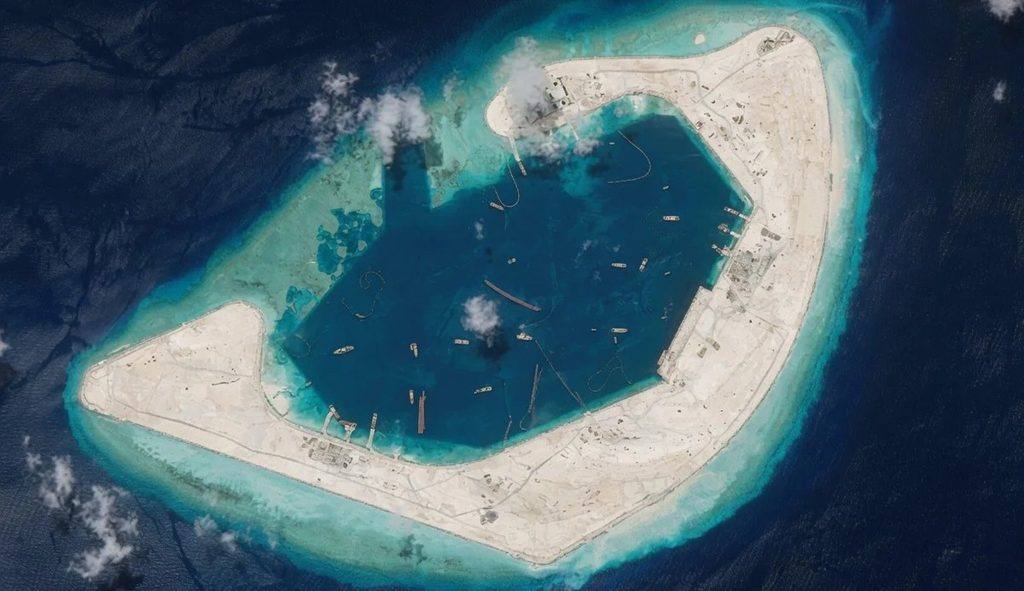
China is building a nearly three-kilometre runway on Antelope Reef in the disputed Paracel Islands in the South China Sea, a development analysts say could significantly strengthen Beijing's military footprint in one of the world's most contested waterways, according to experts and satellite images seen by AFP.
Source: AFP via Bangkok Post
Beijing claims most of the South China Sea, despite an international ruling that its assertion has no legal basis, and confrontations have occurred regularly with several Southeast Asian nations over control of the Paracel and Spratly islands. Both chains are essentially reefs and outcrops, but analysts say China has steadily reclaimed land and built infrastructure to gain military control of the sea.
Transformed in 10 months
Beijing began large-scale dredging and land reclamation at Antelope Reef late last year, the Center for Strategic and International Studies (CSIS) and the Lowy Institute said in recent detailed reports citing satellite images. Lowell Bautista, author of the Lowy Institute report, told AFP that China transformed the reef in 10 months from one of its smallest Paracel outposts into an island that can rival its largest atoll.
The nearly three-kilometre runway would be Beijing's second in the Paracels. Together with infrastructure on the Spratly Islands and on Hainan island, it helps "create an integrated network of runways, harbours and sensors stretching across the sea", Bautista said. The runway is a similar size to the existing airstrip on Woody Island in the Paracels and to three airstrips China has built across the Spratlys, according to CSIS.
Antelope Reef extends around six kilometres along its northwest-to-southeast axis. Analysts say it could become one of China's most important outposts in the South China Sea, potentially helping Beijing limit the access of United States and allied naval forces in the event of a conflict. CSIS has said Antelope could also enhance the reach of Chinese sensing capabilities closer to Vietnam's shores and expand its military capacity in an area of the northern South China Sea close to major shipping lanes.
Bombers, tankers and a mid-2027 target
A structure that appears to be a runway is clearly visible in photographs taken in September by the Earth imaging company Planet Labs. The images were reviewed as part of a recent report by the Japanese intelligence firm Deep Dive and were also seen by AFP. Deep Dive director Bonji Ohara, a former defence attache in China, said the structure would be able to handle not just fighter jets but also larger aircraft, including transport planes, aerial refuelling tankers and bombers, and could bring China closer to achieving "full control over the entire South China Sea".
Antelope Reef's runway is expected to be operational by mid-2027, although other analysts were more cautious about its significance. Harrison Pretat, deputy director of CSIS's Asia Maritime Transparency Initiative, told AFP the runway and harbour will "add additional capacity and resilience to the facility that enable China's military and paramilitary operations in the South China Sea", while noting that Southeast Asian claimants have still largely maintained access to offshore resources and occupy their own outposts.
What Beijing and its neighbours say
China says the development of the Paracel Islands, which it adds have a small resident population of mostly fishers, is for civilian purposes. A foreign ministry spokesperson said in March that China's land reclamation activities there are "necessary construction" for "improving living and working conditions on the islands and growing the local economy". China and Vietnam fought a brief but bloody skirmish over the Paracels in 1974 in which more than 70 Vietnamese soldiers were killed, and China has had de facto control of the islands since then. The Paracels are claimed by China, Vietnam and Taiwan.
Vietnam in August called the construction at Antelope Reef "completely illegal" and demanded that "such activities cease immediately". In October, Australian Defence Minister Richard Marles said China's military build-up was creating a "condition of pressure" in Southeast Asia and urged allies and partners to deepen cooperation. The Philippines, a US ally, has been engaged in years of confrontations with China over disputed areas of the sea, including repeated ship confrontations, some leading to collisions and injuries.
Pretat warned that "international attention and pushback... has been far less than might be expected given the scale and significance" of the construction, due in part to "distraction from other global crises", and said regional countries, the United States and the international community should speak with a stronger voice against island building. Hunter Marston of the Lowy Institute told AFP that ASEAN member states "will never be capable of communicating with one voice", due partly to their different views of China. Ohara said Beijing views the sea as a sanctuary where it does not want foreign powers to enter in the event of a contingency, and that while it will not restrict freedom of navigation in peacetime, in an incident it intends to prevent not only US naval forces but also those of its allies, such as Australian submarines, from entering.