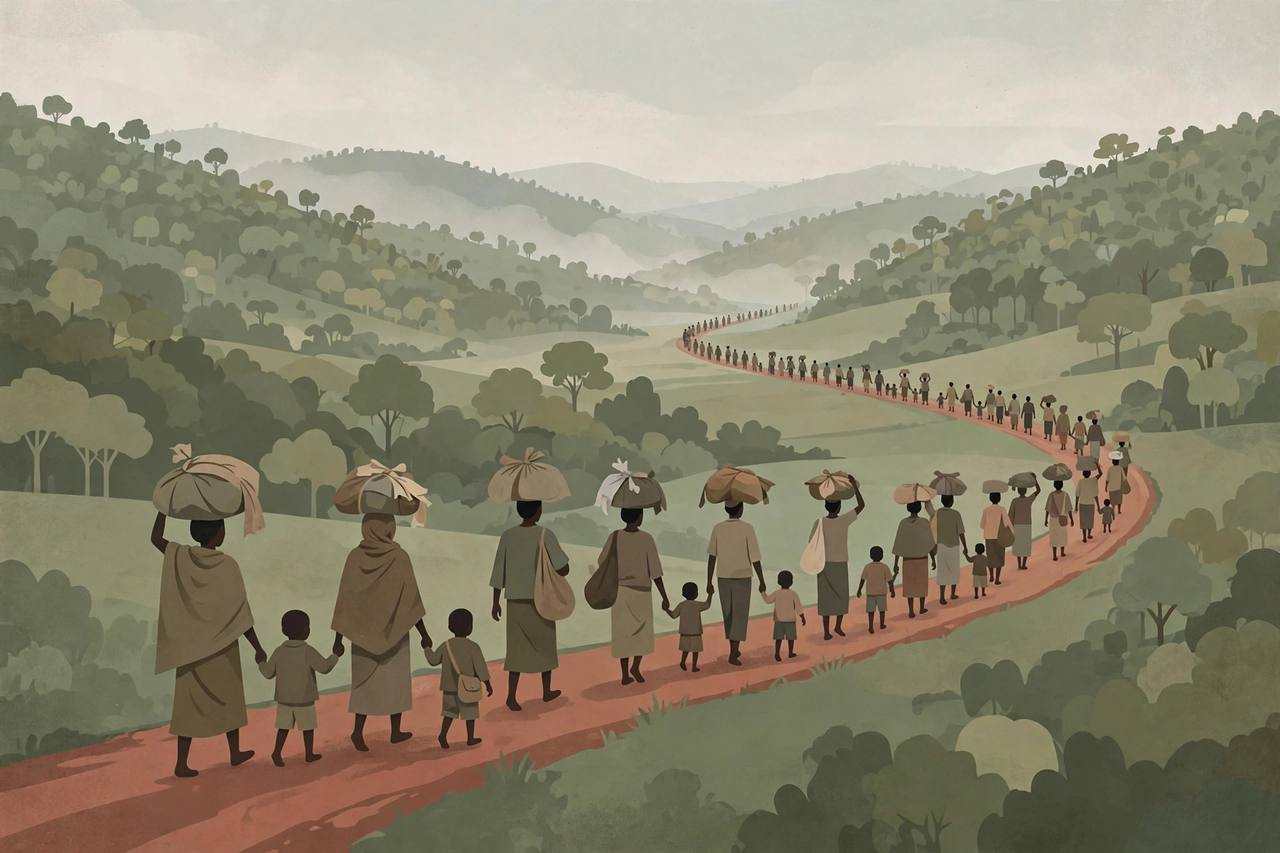
More than 323,000 people fled their homes in just four days in eastern Democratic Republic of Congo after a rebel offensive led by former president Joseph Kabila swept through South Kivu province, the United Nations humanitarian office said. The preliminary estimate, published on 11 November, counts about 54,000 households displaced in the territories of Kalehe and Kabare between 6 and 9 November.
Source: UN OCHA via QNC News
The offensive began overnight on 6–7 November, when fighters of the Front pour la refondation de la nation (FRN) pushed through Kahuzi-Biega National Park and along National Road 3, the highway linking Bukavu to Kisangani through Walikale. Local and security sources told AFP the rebels advanced 50 to 60 kilometres and took control of several towns, including Bunyakiri, Kalonge, Bitale and Bulambika.
Source: AFP via The Voice News Magazine
The Congolese army said on 11 November that its troops had halted the advance at Bulambika and recovered several positions, but the UN humanitarian office reported that clashes were still continuing around the village of Chaminunu and moving closer to Shabunda territory, raising fears of further displacement.
Source: UN OCHA via QNC News
Most of the displaced fled to the Itebero health zone in North Kivu, according to the UN. Some families were forced to flee more than once as the fighting shifted, and people sought shelter in schools, places of worship and health facilities, while others took refuge in forests or near Kahuzi-Biega National Park during the rainy season.
Source: UN OCHA via Security Signal
At least five civilians killed at Bunyakiri
At least five civilians were killed at Bunyakiri as the fighting reached the area, the UN humanitarian office reported. Radio Okapi reported that more than 10 civilians were killed in fighting in Kalehe between 7 and 12 November. The exact death toll and the precise front lines could not be independently verified.
Source: Radio Okapi via Talay Insight
Hospital caught in the fighting
Doctors Without Borders (MSF) said on 17 November that fighting in Bunyakiri health zone had intensified since 6 November between the Congolese army, supported by the Wazalendo militia, and the FRN, forcing many people to flee. Drone strikes on 13 November hit the Bulambika area, including the vicinity of civilian areas and the MSF-supported Bunyakiri General Referral Hospital.
Source: MSF
Health workers had to move 76 patients admitted at the hospital towards Maibano Health Centre, MSF said, and the organisation was forced to temporarily reduce its staff in Bunyakiri, relocating some personnel to Bitale and Bukavu. Most medical supplies, medicines and equipment remain at the hospital, which recorded 1,438 admissions in October alone. The health zone is also facing a cholera outbreak and a peak in malaria cases.
Source: MSF
"Medical personnel must be able to carry out their work safely, and patients must be able to access healthcare without fear," said Giulia Panseri, MSF head of mission in South Kivu. "Any disruption to medical services puts lives at risk, particularly those of the most vulnerable."
Who are the FRN?
The FRN was launched in Goma on 12 October by Kabila, who was sentenced to death in absentia on 30 September 2025 for treason and war crimes. The movement presents itself as the successor to the AFC/M23 rebel coalition, with Corneille Nangaa, Bertrand Bisimwa, Freddy Kaniki and Sultani Makenga as deputies. On 11 November the UN Security Council sanctions committee recorded the FRN as an alias of the Congo River Alliance, which has been listed since 14 July, so the asset freeze and arms embargo now apply under both names.
Source: Critical Threats / Talay Insight
Peace tracks have not stopped the fighting
The offensive comes despite two parallel peace processes — the Washington Accords for Peace and Prosperity, signed in December, and the Doha Framework for a Comprehensive Peace Agreement, signed on 15 November 2025 — and an August 2026 roadmap agreed with Qatar, the United States, Togo, the African Union Commission and Switzerland. After a meeting on 26 October, the African Union said implementation of the commitments remained limited.
Source: Echo Harbor News
The chairperson of the African Union Commission, Mahmoud Ali Youssouf, called on 11 November for closer coordination with the United Nations on the crisis in eastern Congo, after speaking with the head of the UN mission MONUSCO and the UN envoy for the Great Lakes region.
Source: Security Signal
Local reports said fighting continued this week in Kalehe, with Congolese news site Actualite.cd reporting that FRN fighters took Bukondo hill after two days of fighting. The army has issued no statement on that claim.
Source: Crisis Zone / Actualite.cd
The 323,000 newly displaced people — yaani 3.23 lakh people — add to a province that already hosted well over a million displaced people from earlier rounds of fighting, according to the UN. South Kivu was already the main centre of new displacement in eastern Congo in October, when about 30,874 households were newly displaced across Walungu, Kalehe, Shabunda, Uvira, Fizi and Kabare, the UN's Crisis Analysis Team reported.
Source: ReliefWeb
What is solid
- UN OCHA's preliminary estimate of more than 323,000 people displaced in Kalehe and Kabare between 6 and 9 November
- MSF's account of drone strikes near Bunyakiri hospital on 13 November and the move of 76 patients
- Joseph Kabila launched the FRN in Goma on 12 October
What is only claimed
- Exact death tolls and precise front lines, which monitors say could not be independently verified
- The extent of outside backing for the FRN — the UN has described Rwandan support for its predecessor M23, while Rwanda denies backing the rebels
What happens next: the Congolese army says it is preparing a counter-offensive, while the UN is watching for further movement as fighting edges toward Shabunda. Humanitarian access remains severely restricted, and the UN has not yet provided a final displacement count.