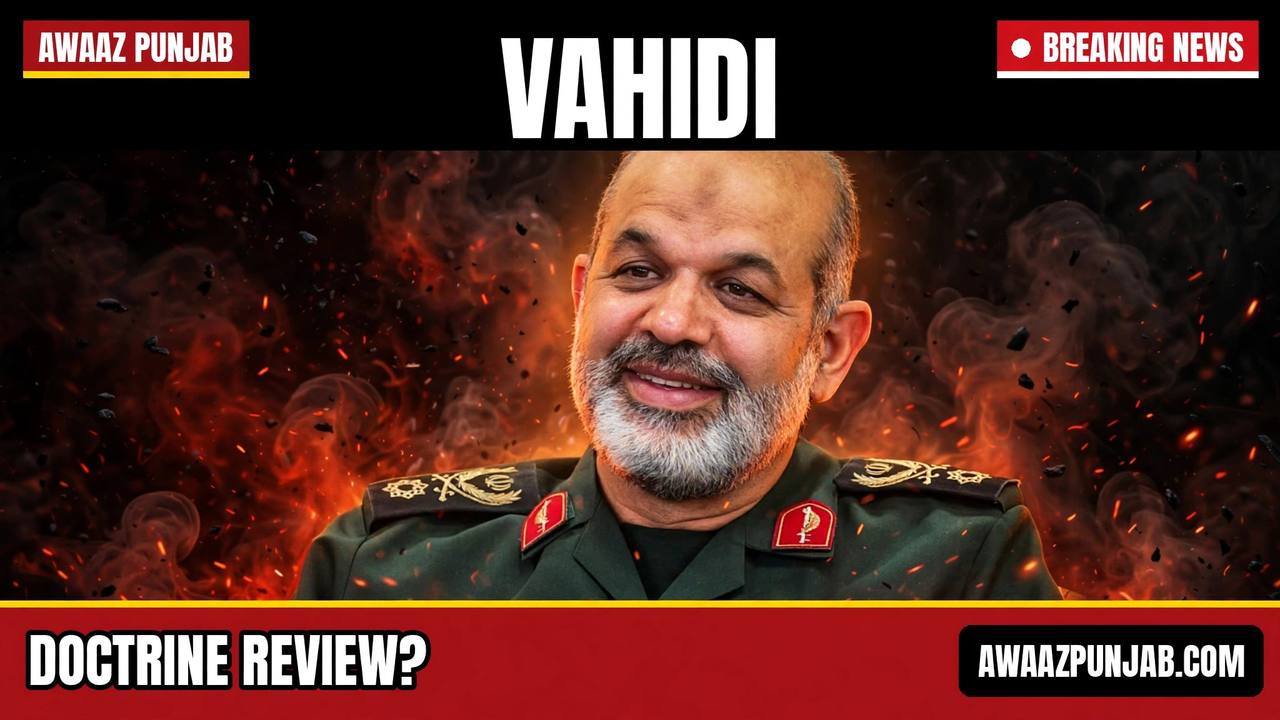
Iran could review its military doctrine in response to the actions of its adversaries, the commander of the Islamic Revolutionary Guard Corps (IRGC), Major General Ahmad Vahidi, said on Friday, when reporters asked him about raising the country's missile range.
Source: Iran International
"The Islamic Republic makes decisions about all its needs based on its own doctrines," Vahidi said. "Naturally, the enemy's actions may lead us to review and reconsider our doctrine."
Vahidi's remarks came a day after US President Donald Trump said he would not decide on renewed strikes against Iran until after the start of 2027. Read the earlier story
Vahidi was speaking at the closing ceremony of the 'Pioneers of Liberation' conference in Tehran on Friday. He described the US-Israeli aggression against Iran since February 28 as a battle whose outcome had frustrated the aggressors, and said those responsible for crimes against Iran would find no safe haven.
Source: Press TV
He told the conference that Iran was entering a 'final confrontation with global arrogance' and urged the United States to admit defeat and leave the region. 'Retribution is our right. The world will no longer be safe for killers and criminals,' he said, according to the report.
Source: Clash Report
Vahidi also claimed Iran's naval forces now operate 500 kilometres and farther beyond the Strait of Hormuz into international waters, and that foreign forces were reluctant to approach within 500 to 600 kilometres of Iran because of the deterrence of its naval units. The claim has not been independently verified.
Source: Press TV
He also claimed the United States had used, in about 40 days, an amount of ammunition it would normally spend over several years — a claim reported by the WANA news agency that has not been independently verified.
Source: Clash Report
Vahidi's hint at a doctrine review follows Tehran's decision earlier this month to lift its self-imposed 2,000-kilometre cap on missile range. Read the earlier story
What a doctrine review could mean
The remarks fit a wider shift in Tehran. Supreme Leader Mojtaba Khamenei met the heads of Iran's military branches last week and directed that any renewed aggression be met with an 'immediate, decisive, and wide-scale response without any geographical restrictions', according to a Newsweek report — part of what the report described as Tehran scrapping the self-imposed limits of the old doctrine, including the 2,000-kilometre missile-range cap and a narrow ban on weapons of mass destruction.
The war has already been costly. A Pentagon official told US lawmakers the US war on Iran has cost $48.3 billion — yaani 4,830 crore dollars — and fighting has widened across the Gulf, with the United States striking a missile launch site on Qeshm Island and Iran hitting a US air base in Kuwait and sites in Bahrain.
On the other side, Israeli Prime Minister Benjamin Netanyahu has been pressing President Trump to join a four-to-seven-day air campaign against Iran, while Trump has said he is in no rush to decide and US officials have questioned the urgency of another offensive.
What it means for workers in the Gulf
For the lakhs of Punjabi and Indian workers living and working in the Gulf, any change in Iran's doctrine — and any longer Iranian missiles — raises the stakes directly: flights through the region, workplace safety, remittances home and oil prices all hinge on whether the war widens again. About a fifth of the world's oil normally passes through the Strait of Hormuz.
What happens next
The question now is whether Tehran turns Vahidi's hint into a formal change — a longer missile range, a new doctrine, or both — and what Washington does after the new year, when Trump has said he will decide. Until then, the Gulf remains on edge, with each side's statements read as a signal of the next round.
What is solid
- Vahidi said on Friday that the enemy's actions may lead Iran to review and reconsider its defence doctrine (Iran International, Press TV).
- Iran lifted its self-imposed 2,000-kilometre missile-range cap earlier in November.
- The United States and Israel have been at war with Iran since February 28, 2026.
What is only claimed
- Vahidi's claim that Iranian naval forces operate 500 kilometres beyond the Strait of Hormuz and that foreign forces avoid coming within 500–600 kilometres — not independently verified.
- The claim, reported by WANA, that the US used in about 40 days the ammunition it would normally spend over several years — not independently verified.