Florida has paid out more than $1.2 billion to private contractors for immigration enforcement under Governor Ron DeSantis, and at least $263 million more in bills across 32 vendors remains unpaid, according to state contract records reviewed by the Miami Herald and the Tampa Bay Times.
Source: Miami Herald / Tampa Bay Times
A hurricane fund turned into an immigration machine
The money flows through the Emergency Preparedness and Response Fund, a trust the Legislature created in 2022 so the state could spend quickly after hurricanes and natural disasters. DeSantis first declared undocumented immigration a statewide emergency in January 2023, and the declaration has been renewed 24 times since - the latest renewal, earlier this week, extends it through January 16, 2027. The declaration lets the state obligate hundreds of millions of dollars without first seeking the Legislature's sign-off on each contract.
It is one of the most expansive uses of an executive emergency fund in Florida history. According to the Times' analysis of state spending records, the fund spent $49 million on immigration enforcement in the 2023-24 fiscal year and $44 million the year after - before the spending exploded.
Alligator Alcatraz: $1.2 million a day
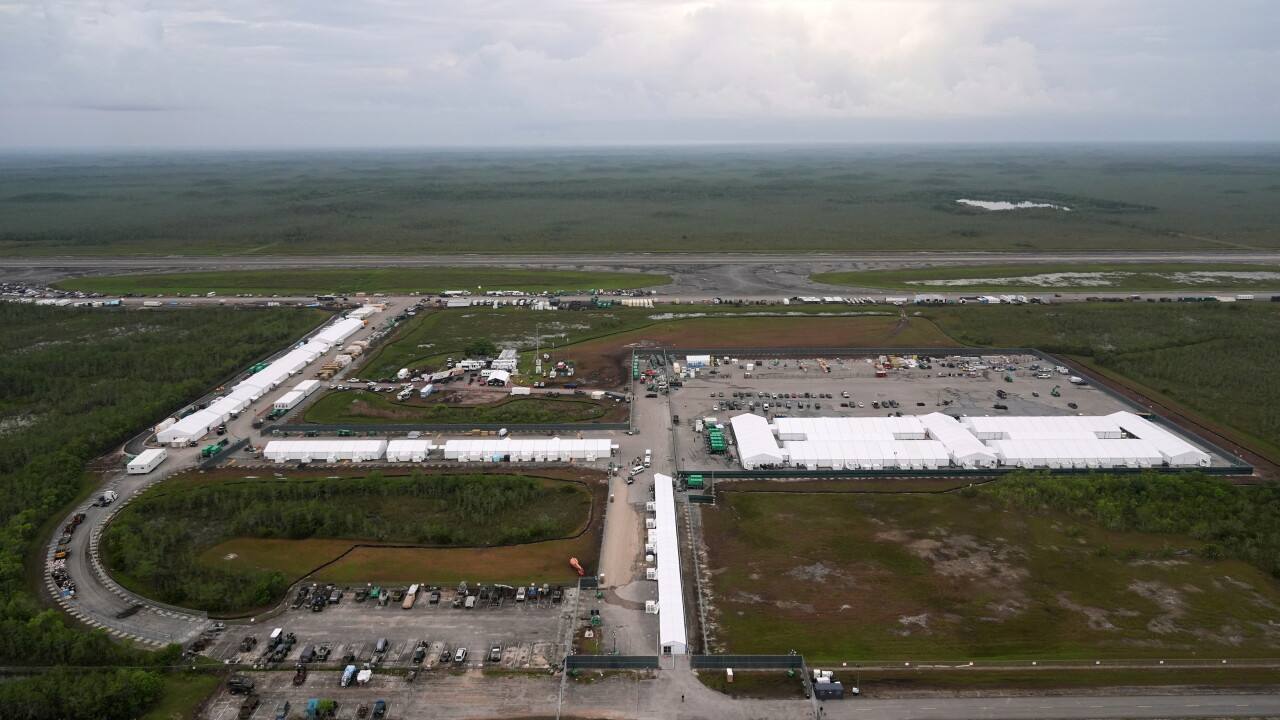
The heaviest concentration of spending is tied to Alligator Alcatraz, the makeshift immigration detention complex built near Ochopee on the edge of the Florida Everglades. It opened in July 2025, held up to 1,400 people at a time, and closed in June 2026 after running for nearly 11 months. Internal records show its spending rate topped $1.2 million a day during some operating periods, reaching as high as $3 million a day in the earliest weeks.
Source: Miami Herald / Tampa Bay Times
The largest single contractor was IRG Global, an emergency response firm that collected about $257 million, including a $102,000 line item for gym equipment inside a broader $183 million contract to build the staff compound next to the detention site. Doodie Calls, a Southeast Florida sanitation and portable restroom company, received $235 million. At one point the firm had been on track to earn as much as $645 million across two facilities over two years before state emergency managers revised the projections downward.
The spending web reached well beyond the Everglades. The Palm Beach County Sheriff's Office billed the state $1.2 million across five contracts, deploying eight deputies and two supervisors on five one-week rotations. Nassau County collected about $500,000 for mobile radio tower technology used during the facility's demolition phase in early July. Security contractor GardaWorld received more than $10 million in overtime pay for correctional and security workers, and disaster response firm Gothams was paid nearly $500,000 to procure and print credentialing badges, plus another $1 million in overtime tied to the work of accrediting agents.
The money is running low - and the reports are late
As balances dwindled, the Legislature intervened repeatedly: lawmakers approved $167 million in August, $187 million in September, and another $375 million earlier this month - the largest single immigration-related infusion since the current fiscal year opened in July. About $157 million remained in the fund at the time of the report's publication.
The Florida Division of Emergency Management, which administers the fund, has now missed its mandatory quarterly reporting deadline for the second straight quarter. The most recent report was due on October 15 and had not reached legislative leaders, and the agency has not responded to press inquiries about the latest figures. An earlier report, due July 15, was also late. Lawmakers imposed new reporting requirements and spending guardrails earlier this year, but enforcement of those measures has remained limited.
Source: Tampa Bay Times
The watchdog who says she was fired
Mandi Mitchell, the division's inspector general for four years, said on Wednesday that she was fired for "political reasons" after her office was blocked from providing independent oversight of Alligator Alcatraz and other immigration enforcement efforts, the Tampa Bay Times/Herald Tallahassee Bureau reported. Mitchell wrote on LinkedIn that her team was "being blocked from providing independent, objective oversight" of the detention camp.
Washington promised $608 million - most of it has not arrived
The state has secured a $608.4 million federal reimbursement commitment covering operations at Alligator Alcatraz and the Baker County facility known as Deportation Depot. But only $84.6 million of that money has been received so far, with another $54 million expected to be approved shortly, according to the Times. Federal disbursements have moved slowly, leaving vendors waiting months for payment. If the federal money does not come through, Florida taxpayers could ultimately foot the bill.
Source: Tampa Bay Times
What happens next
Emergency authority transfers to Governor-elect Byron Donalds when he is inaugurated in January. Donalds has pledged to maintain Florida's hardline immigration posture and has said he would move to remove any local official who blocks cooperation with federal immigration enforcement. His office did not respond to questions about whether he plans to renew the emergency declaration himself.
DeSantis has defended the costs throughout, arguing that enforcement spending is justified by the broader economic burden of undocumented residents - though his administration has not published a formal accounting to back up that estimate.
For Florida's immigrant communities, and for the truckers and workers who drive its highways, the spending built the country's most aggressive state-level enforcement apparatus, with Florida Highway Patrol troopers at its centre. For taxpayers, the open questions are the missing October 15 report, the $157 million left in a fund created for hurricanes, and whether Washington will ever pay the $608 million it promised.