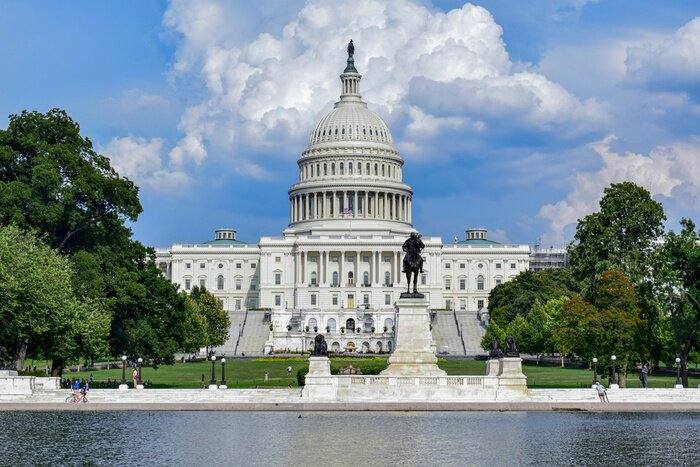
The United States Senate voted 62–33 on Thursday, November 19, to pass the Bipartisan American Affordability and Jobs Act of 2026 (BAAJA), a sweeping bipartisan bill to speed up federal approvals for large energy and infrastructure projects such as power plants, transmission lines, mines and data centres. The bill now heads to the Republican-controlled House of Representatives, and President Donald Trump has said he will sign it into law if it passes there.
Source: Reuters
What the bill would change
At its core, BAAJA is a speed-and-certainty bill. It narrows the scope of environmental reviews under the National Environmental Policy Act (NEPA), sets hard deadlines for permit decisions, and makes it much harder for a future administration or a court to stop a project once it has its permits.
Source: Columbia Center on Global Energy Policy
The bill expands the categories of projects that skip NEPA review altogether — including transmission lines and interstate natural gas pipeline repairs, upgrades and expansions, modifications to energy infrastructure along existing routes, and projects already evaluated by another agency. A state or tribal environmental review could also count as NEPA compliance.
Source: Reason
For energy and critical-minerals projects that do not need an environmental review, agencies would have one year from the last complete application to issue a permit, and applicants could petition a court if the deadline is missed. The bill also sets deadlines once an environmental review is complete, and narrows reviews under the Clean Water Act, the National Historic Preservation Act and the Endangered Species Act.
Source: Reason
It also takes on the litigation that has long slowed big projects: it narrows who can file a lawsuit over a NEPA review and shrinks the window to sue to 150 days. Under the bill, courts could no longer halt a project only because its federal environmental review was deficient.
Source: Reason
The bill's “project certainty” provisions would bar a future administration from revoking, suspending or amending a federal permit in effect on or after September 16, 2026, except in narrow cases. Developers denied a permit could also sue if their type of project is approved less often than in the previous ten years — a new legal right aimed at stopping permits being blocked for political reasons.
Source: Oceana
The bill also answers the fight over who pays for the power grid's growth. It directs the Federal Energy Regulatory Commission (FERC) to make sure data centres and cryptocurrency mining facilities pay the full cost of the transmission service they need, and requires utilities to get financial assurances before upgrading facilities that serve data centres. A manager's amendment added last week would also let FERC issue permits for project sites on state-owned land and widen its oversight of regional grid operators.
Source: Reason
Tucked into the package is Senator Tim Scott's Efficient Nuclear Licensing Hearings Act, which removes the Nuclear Regulatory Commission's hearing requirement for uncontested licensing proceedings — cutting time spent on non-controversial hearings while preserving the public's opportunity to comment.
Source: Sen. Tim Scott
The numbers behind the push
Senator Scott's office says $22.6 billion worth of projects are stalled in the federal permitting process in South Carolina alone, costing the state's manufacturers $310 million a year, with $45.3 billion in total economic impact on hold. Across the country, between $240 billion and $280 billion in new investments enter the federal permitting process each year, between $1.1 trillion and $1.5 trillion are on hold awaiting decisions, and $1.7 trillion to $2.4 trillion in potential economic benefits go untapped every year.
Source: Sen. Tim Scott
Supporters cheer it; critics warn of weaker protections
“After years of congressional efforts to reform our nation's permitting process, this bipartisan package marks a significant step toward providing greater certainty for American energy and infrastructure projects,” Senator Scott said. “By streamlining environmental reviews and permitting procedures, this legislation will help lower energy costs, create jobs, and unlock economic growth in South Carolina and across the country. This is how we get America building again.”
Source: Sen. Tim Scott
Critics are not convinced. Earthjustice, an environmental law organisation, says the bill weakens protections under major environmental laws and “significantly restricts judicial review and access to effective legal remedies.” Analysts at Columbia University's Center on Global Energy Policy conclude the bill would make approvals “meaningfully faster and more predictable” — but warn that leverage would shift from reviewing agencies to applicants, and that accountability would move from before construction to after it.
Source: Earthjustice
The Senate voted 73–25 on Monday, November 9, to bring the bill to the floor for debate. Thursday's 62–33 vote was the final passage. Read our earlier report on the November 9 vote
What happens next
The bill goes to the House of Representatives, where the Republican majority will decide whether to take it up as written or amend it — any House changes would send it back to the Senate. President Trump has said he will sign it. If it becomes law, the test will be implementation: Columbia's analysts note that outcomes will depend on how agencies apply the new deadlines, and on financing, supply chains and market conditions.
Source: Reuters
For American households, the stakes are the cost of electricity and the speed at which new power lines, power plants and transmission get built as demand rises — including demand from data centres. For the Punjabi diaspora and for truckers, energy costs feed directly into household bills and the cost of moving freight, so a faster build-out of power and transmission is the part of this bill most likely to be felt at home and on the road.