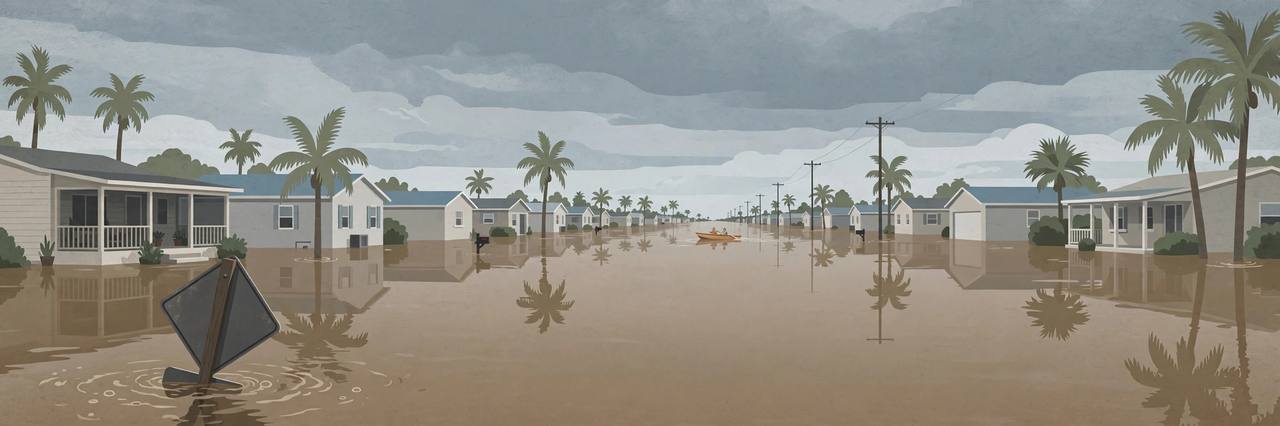
The St. Johns River near Cocoa in Brevard County passed its flood of record early on Thursday, November 19, rising to 17.85 feet at 4:15 a.m. — above the previous record of about 17.6 feet set in 1953 — and still climbing, as a fresh round of torrential rain fell on ground that had never dried out from the last flood.
Source: The Palm Bayer
Awaaz Punjab reported on November 7 that the St. Johns River near Cocoa was forecast to reach major flood stage. On Thursday the river went further: it broke the flood record that had stood since 1953. Read the earlier forecast story
Evacuations and rescues overnight
The City of Palm Bay issued an evacuation notice for Palm Bay Estates on Thursday morning because of the ongoing flooding, and Brevard County Emergency Management opened a shelter for residents seeking refuge from the rising water at the Walter Butler Community Center, 4201 North Cocoa Boulevard, in Cocoa. Emergency crews carried out two water rescues overnight, one in Cocoa and one in Rockledge.
Source: The Palm Bayer
The National Weather Service in Melbourne said the river had pushed through major flood stage and past record flood stage because of ongoing extreme rainfall over the river's headwaters, and warned that more heavy rain over the next 48 hours would keep the river above record levels through late week and into the weekend. The flood warning remains in effect until further notice.
Source: National Weather Service Melbourne
At 17.2 feet, according to the Weather Service, water enters homes along the St. Johns River in the Lake Poinsett area west of Cocoa, as well as low-lying homes in the Silver Pines subdivision in Rockledge and the Shakespeare Park area of Cocoa, and the Providence Road area becomes impassable. By 8:15 a.m. on Thursday the river stood at about 18.1 feet, with a crest of about 18.2 feet expected later in the day.
A second round on soaked ground
The rain fell hardest on central and north Brevard County, including Merritt Island, Cocoa and Rockledge. Between 6 and 10 inches fell in 12 hours overnight in central Brevard, with almost 12 inches near Satellite Beach on Wednesday and a county average of 3.4 inches on Wednesday. About 6.7 more inches were forecast for Palm Bay from Thursday morning through early Saturday.
Source: The Palm Bayer
The ground was already saturated from the flooding of November 1–2, when the Weather Service gauge near Palm Bay recorded a storm total of 22.00 inches. The same area flooded badly earlier this month — flooding in the Palm Bay area in early November killed two people, as Awaaz Punjab reported at the time — and the river had not fallen back to normal levels before this week's rain arrived.
Schools shut and emergency declared
Schools closed on Thursday across several counties. Broward County Public Schools closed for a second straight day, and Miami-Dade County Public Schools closed all schools and district offices on Thursday. Broward County had already declared a local state of emergency on Wednesday, November 18.
Source: Men's Journal
Governor's Executive Order 26-232, issued on November 18, expands the 2026 Fall Flooding state of emergency to 21 counties. A flood watch for Miami-Dade, Broward and Palm Beach counties runs through 7 p.m. on Thursday, and the watch for Volusia, Brevard, Indian River, St. Lucie and Martin counties runs through Friday evening, November 20.
Source: The Palm Bayer
Never drive through flooded roads — the water's depth is hard to judge and most flood deaths happen in vehicles. If you are in danger, call 911. Brevard County's shelter for flood evacuees is at the Walter Butler Community Center, 4201 North Cocoa Boulevard, Cocoa.
What happens next
The Weather Service expects the river to stay above record levels through late week and into the weekend as more rain falls over the headwaters. Upstream near Lake Harney, the river is forecast to crest at 13 feet on Sunday — above its all-time record there — which could flood State Road 46. Emergency officials say residents in low-lying areas along the river should keep watching the warnings, because the water is still rising in places where it has already entered homes.
Source: The Florida Press