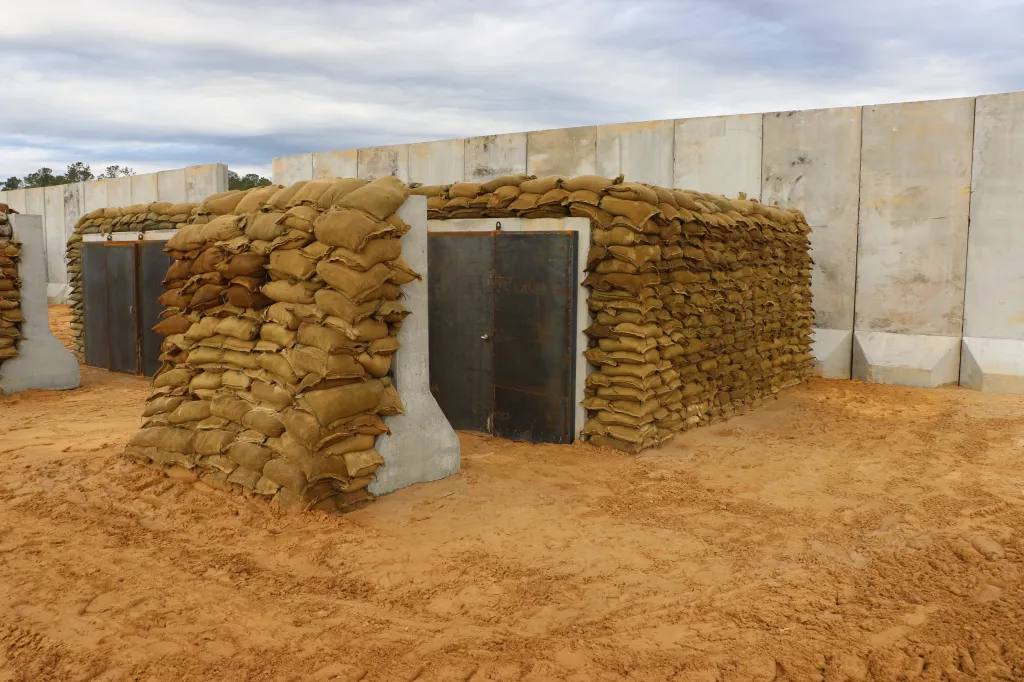
The US Army is racing to hire contractors to build 17 reinforced-concrete bunkers in Israel, Saudi Arabia and Lebanon to protect American and coalition troops from Iranian missile and drone attacks, after strikes that have killed at least 23 US service members since the war began in late February.
Source: Fox News Digital
The Army posted the work on the US federal contracting site sam.gov on Friday, November 13. It wants 10 bunkers in Israel, five in Saudi Arabia and two in Lebanon, spread across five military installations — one in Israel and two each in Saudi Arabia and Lebanon. The exact sites are being withheld for security reasons and will be given only to eligible contractors.
The bunkers will replace makeshift shelters made from converted shipping containers, which the Army says do not give troops adequate protection under current conditions. "Due to elevated regional force protection conditions, there is an urgent, high-priority requirement to replace nonstandard personnel protection shelters," the Army said in the notice.
Why now: 23 troops killed
Iranian attacks on US military installations have killed at least 23 American service members since the war broke out in late February 2026, according to the reports. The deadliest single attack came in March, when a drone strike on a US Army command post at Kuwait's Port of Shuaiba killed six American service members. Reports at the time said the facility lacked adequate protection against aerial attacks.
On Tuesday, November 17, Iran claimed responsibility for another strike on a US military base in Bahrain — its third attack there in five days. In March, US Defense Secretary Pete Hegseth said new hardened shelters were needed to better protect US troops in the Middle East.
President Donald Trump said on November 16 that defensive measures had been effective across the region. He claimed on Truth Social that Iran had fired between 8,000 and 9,000 one-way attack drones and about 2,000 ballistic missiles, and that only a handful had got through and caused US deaths. That claim has not been independently verified and sits uneasily with the reported toll of at least 23 American service members killed.
What the bunkers will look like
Each bunker will have three precast, reinforced-concrete sections, steel entrance doors shielded by concrete barriers, and sandbag-reinforced exterior walls. Each roof will be covered with at least 18 inches of layered sandbags to protect against incoming fire.
Because of what the Army called "extreme operational urgency", contractors get only three days to submit price quotes — responses are due by November 25 — and the winning firms will then have 45 days to finish construction once a task order is issued, putting the first finished bunkers on track for early 2027. Bidders must say whether they can work in all three countries or only in some of them.
The war began on February 28, 2026, when the United States and Israel launched surprise attacks on Iran. It has now run for more than eight months, with the latest exchanges this week: US jets struck a Revolutionary Guards missile site on Qeshm Island, Iran targeted US installations at Kuwait's Ali Al Salem base and launched attacks on Bahrain, and a suspected Houthi missile damaged Riyadh's PIF Tower.
For the lakhs of Indian and Punjabi workers living in the Gulf, the same threat hangs over daily life: the bunkers are being built because Iranian missiles and drones keep reaching US and coalition bases in Israel, Saudi Arabia and Lebanon — the same countries where so many Gulf workers live and work. Flight suspensions, air-defence alerts and shipping disruption through the Strait of Hormuz all follow the same cycle of attack and retaliation.
What is solid
- The US Army posted a procurement notice on sam.gov on Friday, November 13, seeking 17 bunkers in Israel, Saudi Arabia and Lebanon
- The notice says the bunkers will replace shipping-container shelters and must be finished within 45 days of a task order
- At least 23 US service members have been killed by Iranian attacks since late February, including six in the March drone strike at Kuwait's Port of Shuaiba
- The Army is withholding the exact bunker locations for security reasons
What is only claimed
- President Trump's claim that only a handful of Iranian drones and missiles got through and caused US deaths — the reported toll stands at at least 23 American service members killed
- Iran's claim of responsibility for the November 17 strike on a US base in Bahrain — reported as Iran's claim, not independently confirmed