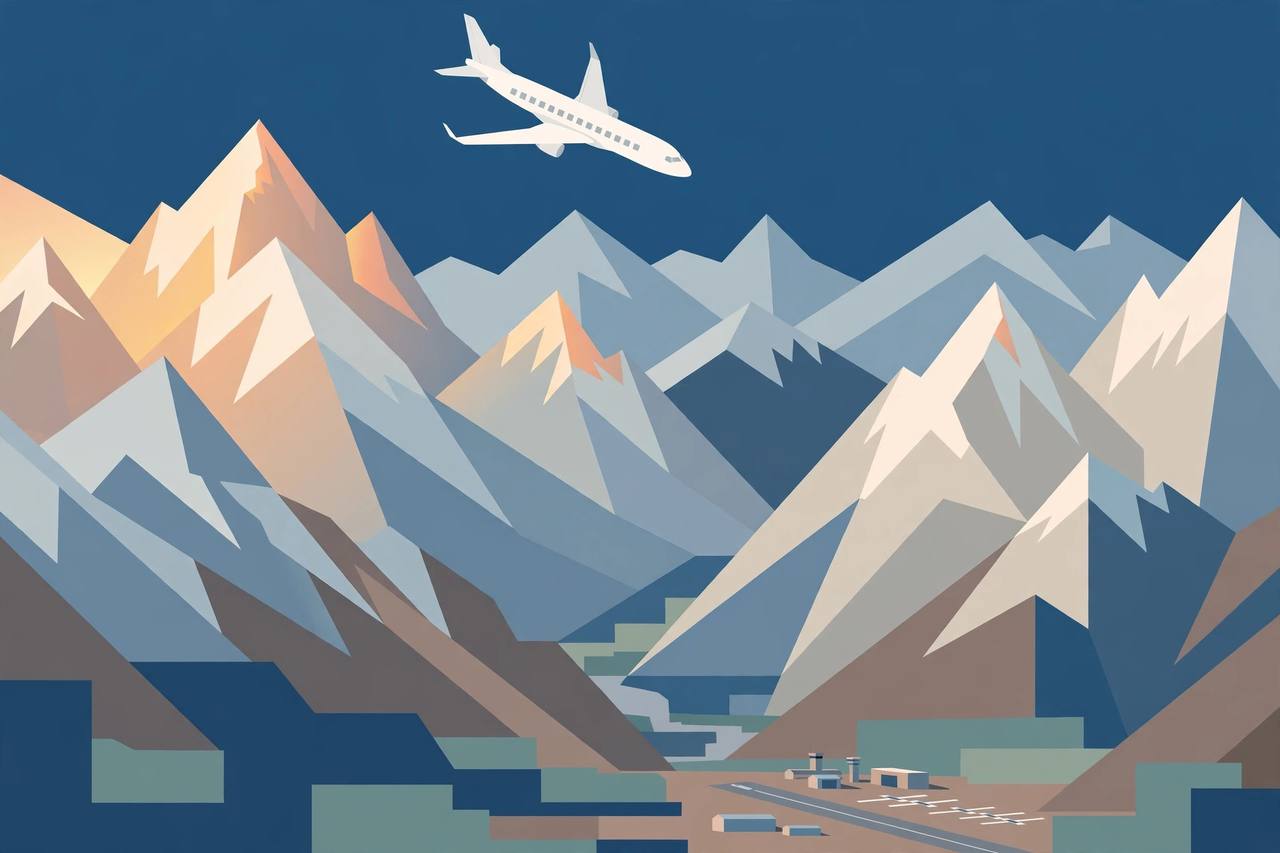
Nepal and India have resumed talks on cross-border air routes after a three-year break, but the latest round has ended without an agreement on new entry points into Nepal, according to Ratopati. Kathmandu has been pressing for the change for more than a decade, saying its two newest international airports cannot attract regular international flights without it.
At the centre of Nepal's demand is the L626 route, which connects Kathmandu to Delhi through Mahendranagar in western Nepal. The corridor has operated one-way — for aircraft leaving Nepal — since November 19, 2009. Nepal wants it made two-way, so international aircraft can also enter through its western border, according to tourism ministry officials quoted by Asia News Network.
Source: Asia News Network
Nepal has also asked for additional entry points through Bhairahawa, Nepalgunj, Janakpur and Biratnagar. At present, every international flight into Nepal must enter through a single point near Simara, known as Gulf 598, at an altitude of about 22,000 feet — a corridor that mainly serves Tribhuvan International Airport in Kathmandu.
Source: Fiscal Nepal
Why the entry point matters
Pokhara International Airport has been operating since January 2023, and Gautam Buddha International Airport at Bhairahawa is also in service, but neither has secured regular direct international flights. Nepal had planned a Pokhara–Varanasi service from Pokhara's inauguration, but it never received Indian permission, according to Peoples' Review.
Source: Peoples' Review
Aviation experts say the missing entry routes force airlines into longer approaches, higher fuel burn and awkward descents into Nepal's mountainous terrain — and that the absence of geographically suitable entry points is a barrier for new airlines considering services to Nepal, Fiscal Nepal reported.
The sticking points
India has cited security concerns, including military aviation facilities in the Gorakhpur area, as a reason for caution over the proposed routes. In the latest discussions, a proposed entry altitude of about 39,000 feet also drew objections: aviation experts said an entry point that high would complicate descents into Nepal's relatively small airspace, and that about 26,000 feet would be more suitable — around 27,000 feet from the east and 28,000 feet from the west, Fiscal Nepal reported.
An entry point through Nepalgunj, the experts said, would make approaches to Gautam Buddha International Airport easier, and one through Bhairahawa would ease approaches to Pokhara. Nepal's civil aviation authority sent a formal request for the routes through the foreign ministry about three years ago and has received no response, according to the report.
A long-running dispute
The issue dates back to August 2014, when then prime minister Sushil Koirala raised it with Indian Prime Minister Narendra Modi during his Nepal visit. The two sides agreed to resolve it within six months; in 2016 they agreed in principle to make the L626 two-way, and a technical agreement followed in June 2018 — but no breakthrough came. Then prime minister Pushpa Kamal Dahal raised it again with Modi in 2023.
India has separately proposed using Nepali airspace for flights to Bagdogra airport in West Bengal, and Nepal is seeking to link approval for those routes with access to at least one additional international entry point through its western border, according to foreign ministry sources quoted by Peoples' Review.
What happens next
Prime Minister Balendra Shah is due in India on November 22–23 for his first bilateral visit, and Kathmandu hopes to secure a concrete agreement on the air routes during the trip. The issue is on the agenda for his talks with Prime Minister Narendra Modi.
On November 16, Awaaz Punjab reported that Nepal was weighing India's proposal to use Nepali airspace for flights to Bagdogra, linked to the Bhairahawa entry route. Read the earlier report
Sources: Fiscal Nepal, Peoples' Review, Ratopati and Asia News Network.