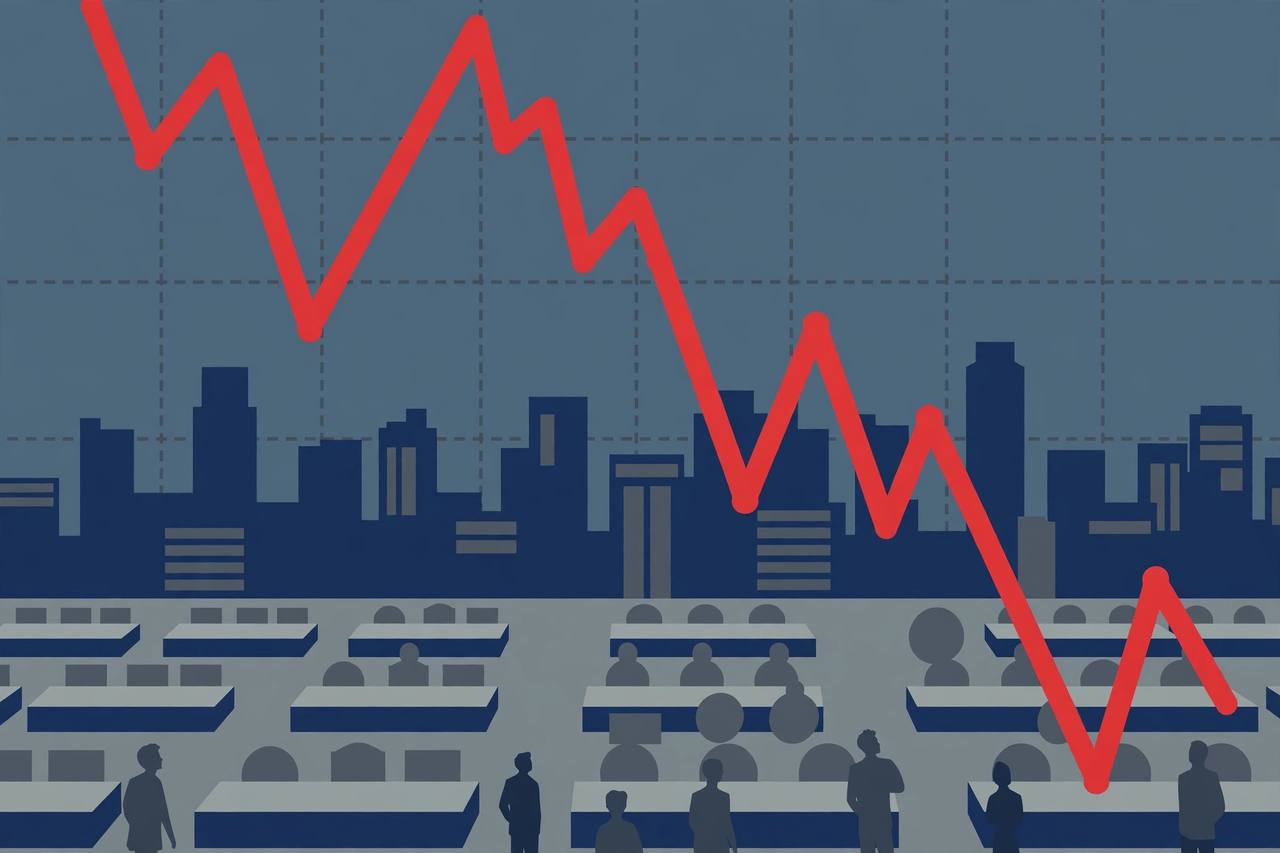
Wall Street's sell-off turned into a rout on Thursday, November 19, 2026, as the Dow Jones Industrial Average plunged 1,101.11 points, or 2.19 percent, to 49,097.06 — closing below the 50,000 mark for the first time since early May. The S&P 500 fell 2.02 percent for a sixth straight session, its longest losing streak since April 2024, and the Nasdaq Composite dropped 2.25 percent as selling spread to nearly every corner of the market.
Source: Associated Press
A rally that reversed within hours
Stocks opened higher, lifted by the biggest initial public offering in history. Anthropic, the artificial-intelligence company, priced its shares at $83, opened at $111.50 — 34 percent higher — and closed its first day at $97.17, up 17 percent and valued at about $1.76 trillion. The S&P 500 climbed as high as 7,415.64 in the first hour, up 1.26 percent. Then the rally unravelled: the index gave back the whole gain and more, closing about 3.2 percent below its session high, with every one of its sector funds finishing lower.
Source: Motley Fool
What spooked investors: the Federal Reserve
Minutes from the Federal Reserve's most recent policy meeting showed some officials were ready to raise interest rates by more than a quarter point, and Fed Governor Christopher Waller said the central bank might need to act more forcefully to remind markets that 3 percent inflation is not a level the economy can accept over the long term. Traders now put the odds of a rate rise in December at close to 95 percent. Weekly jobless claims, released on Thursday, rose to 203,000, above the 197,000 economists had forecast.
UnitedHealth and chip stocks led the slide
UnitedHealth, the Dow's heaviest-weighted health insurer, fell another 5.6 percent as health insurers kept sliding on the government's plan to claw back Medicare Advantage overpayments — a day after a 10 percent plunge that alone accounted for about 236 of Wednesday's 561-point Dow drop. Chip stocks fell hard too: AMD dropped 7.72 percent and Nvidia lost 3.3 percent. Only one of the Dow's 30 stocks finished higher, and in the S&P 500, just 41 stocks rose against 419 that fell.
The VIX, Wall Street's fear gauge, jumped 14 percent to 28.44. Gold, usually a refuge in a sell-off, also fell — December gold futures settled down 1.51 percent at $3,685.50 an ounce, a 14-month low.
What it means for readers
For most households, a week like this shows up first in retirement accounts: a 401(k) or pension fund tracking the S&P 500 is now down 8.2 percent from the record it set last month, and the Dow has lost 3,250 points — 6.21 percent — in just four trading sessions. That is a sharp pullback, not a crash: the Dow is still near 49,000 and the market had run far and fast. But four straight days of selling, capped by a 1,100-point drop, have put investors on edge heading into the Thanksgiving holiday week.
This follows Wednesday's session, when the Dow fell 561 points for a third straight day as UnitedHealth sank and oil slid. Read Wednesday's report
What happens next
Traders will watch whether the selling spreads from health care and technology into the broader market, what the Federal Reserve signals at its December meeting, and whether the Nasdaq's slide steadies. Thanksgiving week is typically a quieter stretch of trading, when thin volumes can exaggerate moves in either direction — so the next few sessions may be choppy even without fresh news.