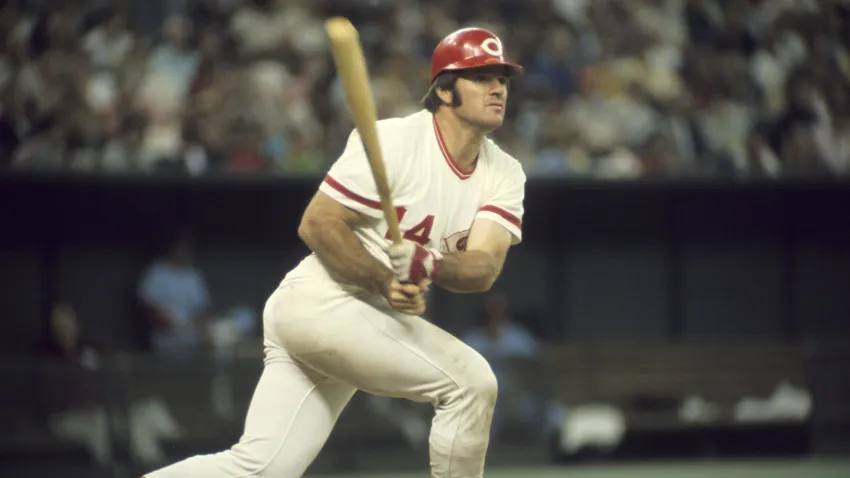
President Donald Trump said on Thursday, November 19, that he has posthumously pardoned Pete Rose, baseball's career hits leader, more than two years after Rose's death and a year after Major League Baseball reinstated him. “I have just given a Complete and Total Pardon to the Late, Great Pete Rose, a true Baseball SUPERSTAR & LEGEND,” Trump posted on social media.
Source: Associated Press
What the pardon clears
The pardon covers the federal tax case that followed Rose's playing career. On April 20, 1990, Rose pleaded guilty to two counts of filing false tax returns, admitting he failed to report $354,968 of income over a four-year period. That came about eight months after he agreed to a permanent ban from baseball.
Source: Associated Press
Facing up to six years in prison and $500,000 in fines, Rose was sentenced on July 19, 1990, by U.S. District Judge S. Arthur Spiegel in Cincinnati to five months in prison. He was also fined $50,000 and ordered to perform 1,000 hours of community service as a gym teacher's assistant with inner-city youths in Cincinnati, as part of a one-year probation period. He later repaid the Internal Revenue Service $366,042.
Source: Associated Press
Rose reported to the U.S. Penitentiary Marion Camp in Illinois, a minimum-security facility, on August 10, 1990, and was released on January 7, 1991. He then entered Talbert House to begin his probation and departed on April 5.
Source: Associated Press
“I know I'm not a bad person, but I did make some mistakes and it's in the eyes of the judge,” Rose said on the night of his plea during his weekly talk show on WCKY-AM in Cincinnati. “All you can say is it's up to the judge.”
Source: Associated Press
Judge Spiegel, sentencing him, said: “History and the tincture of time will decide his place among the all-time greats of baseball. … when he has completed his sentence, he will have paid his debt to society and should be accepted by society as rehabilitated.”
Source: Associated Press
The pardon does not put him in the Hall of Fame
The pardon wipes away the federal tax convictions. It does not, by itself, elect Rose to the National Baseball Hall of Fame. That door was opened last May, when Commissioner Rob Manfred ruled that people on baseball's permanently ineligible list have their status restored at death — a decision that affected 17 people, most notably Rose and Shoeless Joe Jackson.
Source: Associated Press
Under a rule adopted by the Hall's board of directors in 1991, anyone on the permanently ineligible list cannot be considered for election. With that barrier now lifted, the earliest Rose or Jackson could be inducted would be in 2028. The group that votes on the Hall's Classic Baseball Era ballot will meet next in December 2027, Reuters reported. The Hall of Fame did not respond to a request for comment, and a Major League Baseball spokesman declined to comment.
Source: Reuters
Why Rose was banned
Rose agreed to his permanent ban in August 1989 after Major League Baseball investigator John M. Dowd concluded he had bet numerous times on the Cincinnati Reds while playing on and managing his hometown team from 1985 to 1987. He was banned from the game for decades, barred from the Hall of Fame, and barred from playing or coaching in the major leagues.
Source: Associated Press
A career like no other
A 17-time All-Star in a playing career from 1963 to 1986, Rose was the 1963 National League Rookie of the Year, the 1973 Most Valuable Player and the 1975 World Series MVP. A three-time National League batting champion, he broke Ty Cobb's record of 4,191 hits, a mark Cobb set between 1905 and 1928. He also played 3,562 career games — the most ever — drove in 1,314 runs, hit 160 home runs and finished with a .303 batting average, winning three World Series championships. Nicknamed “Charlie Hustle,” he died in 2024 at the age of 83.
Source: Associated Press
Trump, who has repeatedly called for Rose to be enshrined in the Hall of Fame, also used his announcement to compare Rose's treatment with that of pitcher Roger Clemens, writing that both were “treated terribly by Major League Baseball in not allowing him to go into the Baseball Hall of Fame.” The pardon is the latest step in Trump's effort to rehabilitate the reputation of baseball's all-time hits leader.
Source: Reuters
What happens next
The next decision point is December 2027, when the Hall of Fame's Classic Baseball Era committee meets. If the committee votes Rose in, he could be inducted in 2028 — 39 years after his ban and four years after his death. Until then, the debate over whether the game's greatest hitter belongs in Cooperstown continues — now with his federal record wiped clean.
Source: Associated Press