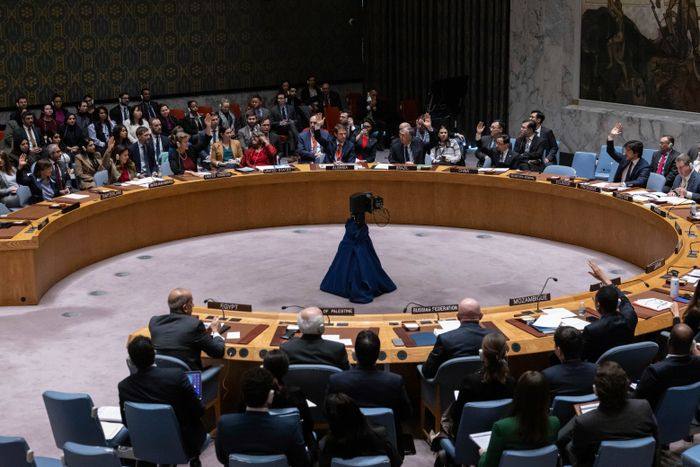
The United Nations is heading towards a scenario it has never faced in its 81-year history: the new year could begin with no secretary-general at all. With less than six weeks left in Antonio Guterres's second term, the Security Council has held eight secret ballots without agreeing on his successor, and UN officials are now drawing up emergency plans for a leadership vacuum when he leaves office on December 31.
Source: Reuters
Costa Rica's Rebeca Grynspan led the last straw poll on November 5 with 12 votes in favour and three against — read how that round ended and why she still faces a veto threat. Read the eighth-round result
The Council is due to hold a ninth secret straw poll on Friday, November 20, at noon New York time. This time the ballots will be colour-coded so it is visible which of the five permanent members — the United States, Russia, China, Britain and France — cast a negative vote. A candidate needs at least nine votes in favour from the 15-member Council and must avoid a veto from any permanent member before the 193-member General Assembly can make the appointment.
Source: Reuters / Al Jazeera
The frontrunner, and the vetoes blocking her
Rebeca Grynspan, the former Costa Rican vice-president who now heads the UN Conference on Trade and Development (UNCTAD), is the clear frontrunner. In the eighth round on November 5 she received 12 'encourage' votes and three 'discourage' votes — the best tally of any candidate so far, and an improvement on her 11 votes in the previous round. But the lead does not guarantee the job: Richard Gowan of the International Crisis Group told Al Jazeera she appears to face opposition from the United States and Russia, either of which could veto her.
Source: Al Jazeera
Rafael Grossi of Argentina, the director-general of the International Atomic Energy Agency, finished second in the last poll with nine encourage votes and four discourage votes. His close alignment with Washington is expected to count against him with China and Russia, although he has spoken warmly about both capitals in recent weeks. The United Arab Emirates' Lana Nusseibeh received seven encourage and six discourage votes, while Turkiye's Feridun Sinirlioglu received three encourage and eight discourage votes.
Source: Al Jazeera
Why no one has been chosen yet
Eight candidates remain in the race, most of them from Latin America and the Caribbean, in line with the informal regional rotation. Five of the eight are women, amid a push for the UN to choose its first female secretary-general. The late entry of Nusseibeh and Sinirlioglu split the field further, and no candidate has yet overcome opposition from all five veto-holding members. Georgina Holmes of the Open University told Al Jazeera the contest reflects a struggle over who exercises political influence inside the UN 'at a time when multilateralism is under considerable pressure and attack'.
Source: Al Jazeera
The deadlock is also about the job itself. The secretary-general is the UN's top administrative official, supervising tens of thousands of staff, as well as its chief diplomat and mediator. The organisation is under heavy strain — sidelined from the wars in Iran and Ukraine, criticised by US President Donald Trump, and in a financial crisis that has forced it to let go of thousands of staff.
Source: Al Jazeera
What happens if the post is empty on January 1
The UN Charter does not say what happens if the post is vacant. Article 97 provides only that the secretary-general is appointed by the General Assembly on the Security Council's recommendation — there is no automatic interim successor. That is why officials are preparing contingency plans, and why the '1 for 8 Billion' campaign has proposed either appointing an acting secretary-general or asking the General Assembly to extend Guterres's term. Analysts warn that the longer the deadlock lasts, the less time the next secretary-general has to build a team and prepare a transition.
Source: Reuters / Al Jazeera
What is solid
- Eight secret straw polls have been held without agreement; a ninth is due on Friday, November 20.
- Grynspan led the November 5 poll with 12 encourage and three discourage votes.
- Guterres's second five-year term ends on December 31, 2026.
What is only claimed
- Whether the United States and Russia are actively blocking Grynspan — analysts say she 'appears' to face their opposition, but neither government's position in the secret ballot is public.
- Whether Washington is deliberately running down the clock to force a weaker candidate or a leaderless UN — campaigners raise the concern, but it is not established.
In 2016 it took the Council six rounds to pick Guterres. This race has already run to eight — and the deadline has never been breached before.
What happens next is now a matter of hours: the ninth ballot on Friday will show whether the colour-coded votes break the deadlock or confirm it. If no candidate clears the bar, the Council will have to choose between more ballots, a compromise candidate, or the unprecedented step of leaving the world's central diplomatic organisation without a leader as 2027 begins.
Source: Reuters