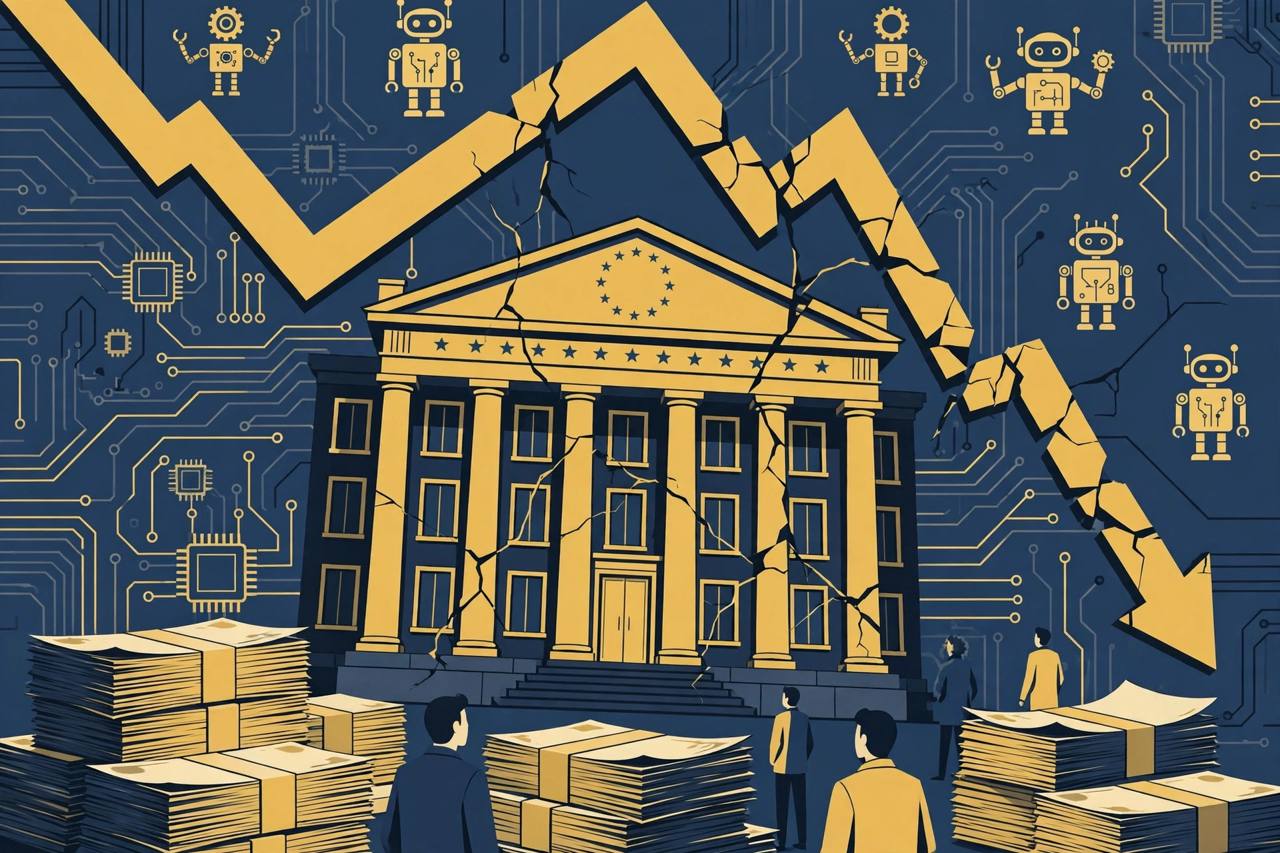
The European Central Bank has warned that a reassessment of the artificial intelligence boom could trigger an abrupt repricing in markets and significant valuation losses, as its Vice-President Boris Vujčić named AI and sovereign debt as the two risks that now stand out 'very prominently' for the euro area's financial stability.
Source: European Central Bank — keynote speech, Frankfurt, Nov 16, 2026
Speaking in Frankfurt on Monday, November 16, to open Euro Finance Week, Vujčić said the speech came just two days before the ECB publishes its latest Financial Stability Review on Wednesday, November 18. His key message was that Europe needs more market-based finance, but that a larger role for non-banks must go hand in hand with stronger system-wide safeguards.
Source: Reuters, Nov 16, 2026
From a valuation worry to a system-wide risk
A year ago, the ECB assessed AI vulnerabilities as mainly stretched valuations in global stock markets and the risk that sentiment could shift abruptly. 'At present however, while the risk of market repricing, rather than abating, has further increased, AI-related risks to system-wide stability now stem from a range of additional factors — the expansion of external funding from equity to debt markets, concentration of exposures, quickening AI adoption and potential cyberattacks,' Vujčić said in the speech published by the ECB.
The scale of financing across the AI supply chain is unprecedented, he said. Large cloud and AI infrastructure providers are increasingly turning to debt markets, with issuance volumes reaching record highs this year, and cumulative capital expenditure by major US technology firms is projected to reach 5.5 trillion US dollars by 2030 — yaani 5.5 lakh crore dollars. Firms are also relying on opaque off-balance-sheet structures and circular arrangements, in which chipmakers and cloud providers invest in AI labs that in turn commit to buying their hardware and services.
Equity issuance is also surging, with IPO volumes now on track to exceed the dot-com bubble high relative to US GDP — a pattern that has historically often coincided with market peaks, Vujčić said. Euro area investment funds have significantly increased their exposures to AI through both equities and debt securities, so a reassessment could trigger fund redemptions and forced asset sales, with concentration and leverage amplifying the stress.
The adverse impact of the energy shock from the ongoing war in the Middle East has been partly offset by the upbeat AI narrative, he said, but the market correction following the US midterm elections earlier this month, although contained, 'serves as a reminder to remain cautious about AI valuations'. Headline inflation in the euro area rose to 4 percent in October from 3.8 percent in September, mainly due to higher energy prices, according to the speech.
Sovereign debt, the second standout risk
Concerns about sovereign debt sustainability have further increased on both sides of the Atlantic, Vujčić said, reflecting elevated public debt, weak fiscal fundamentals in some euro area countries and a sharp rise in long-term yields. Risks are compounded by a notable rise in debt issuance by hyperscalers, growing government financing needs, a more price-sensitive investor base, and hedge funds that have become a significant but procyclical source of liquidity in sovereign bond markets.
Source: AFP via Vietnam News Agency / StockBiz
The third development he named was the non-bank financial sector itself: private credit and private equity funds are playing an increasingly important role in financing the AI build-out, adding concerns about leverage, opacity and interconnectedness. ECB Banking Supervision has called on banks to strengthen their cyber defences, and Vujčić proposed better-aligned redemption terms for investment funds, stronger liquidity buffers for money market funds, and considering leverage limits for hedge funds.
What happens next is the Financial Stability Review itself on Wednesday, which will set out the ECB's full assessment. For savers and investors in Europe — and for the many Punjabi and Indian families whose savings and pensions sit in European and global funds — the warning is that the AI trade and government debt are now linked risks: a sharp fall in one can spill into the other.