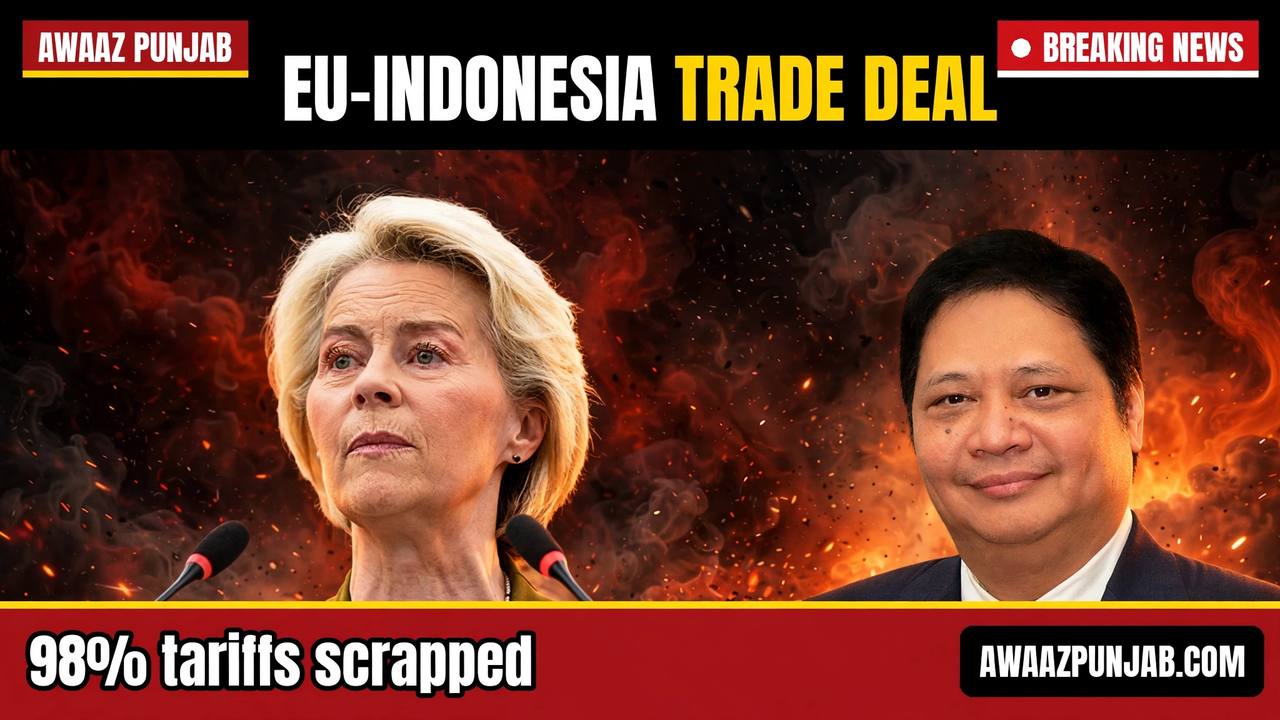
The European Union and Indonesia signed a landmark trade deal in Brussels on Saturday, November 21, scrapping tariffs on more than 90 percent of the goods traded between them. The two sides signed a Comprehensive Economic Partnership Agreement (CEPA) and a separate Investment Protection Agreement (IPA) at the European Commission headquarters, ending nearly a decade of negotiations.
Source: European Commission
European Commission President Ursula von der Leyen spoke by phone with Indonesian President Prabowo Subianto to mark the occasion before the ceremony. Trade Commissioner Maroš Šefčovič signed both agreements for the EU. On Indonesia's side, Trade Minister Budi Santoso signed the CEPA and Coordinating Minister for Economic Affairs Airlangga Hartarto signed the Investment Protection Agreement.
Source: AFP via Rapporteur
The signing came three days after EU governments authorised the signature on November 18. The Council's authorisation cleared the way for Saturday's ceremony in Brussels. Read the earlier story
What the deal does
The CEPA removes tariffs on 98.5 percent of tariff lines on EU exports to Indonesia, and around 90 percent of Indonesian exports to the EU will be tariff-free. Indonesian government figures show 90.4 percent of Indonesian tariff lines entering the EU will attract zero duties from day one, with a further 8.37 percent facing phased reductions over three to fifteen years or tariff-rate quotas. The European Commission estimates the deal will save EU exporters about €600 million a year in customs duties — yaani lagbhag $694 million — and projects EU exports to Indonesia will rise by almost 40 percent within 15 years.
Source: European Commission
The pact opens investment in strategic sectors such as electric vehicles, electronics and pharmaceuticals, and covers food, agricultural and industrial products. On Indonesia's side, the deal is expected to benefit its top shipments to the EU, including palm oil, footwear, textiles and fisheries.
Source: AFP via Rapporteur
A decade in the making
The EU and Indonesia officially launched CEPA negotiations in July 2016. Talks ran for 19 formal rounds and were finalised on September 23, 2025, after which the text underwent legal revision and translation before the Commission submitted it to the Council in June 2026. The Council authorised the signature and provisional application on November 18, 2026.
Source: European Parliament
Von der Leyen called it one of the most ambitious deals the European Union has concluded in Asia. Senior trade members of the European Parliament welcomed the signature, saying it will open markets, boost investment and deepen ties with Southeast Asia.
Source: AFP via Rapporteur
What happens next
The agreements are not in force yet. The European Parliament must give its consent — it can approve or reject the deal, but cannot amend it — and the Council must then formally conclude it. Indonesia must also complete its own ratification procedures. Indonesia's government expects the pact to enter into force in 2027.
Source: European Parliament
The deal is the EU's third bilateral trade agreement with an ASEAN country, after Singapore and Vietnam, and forms part of the EU's broader push to deepen economic ties with Southeast Asia. It connects the EU's single market of 450 million people with Southeast Asia's largest economy and the world's fourth most populous country.
Source: European Commission
For Indonesian exporters, the deal means preferential market access into Europe from day one for most of their goods. For the EU, it is a foothold in the Indo-Pacific and another step in its drive to diversify trade ties beyond its traditional partners. The next test is ratification on both sides.