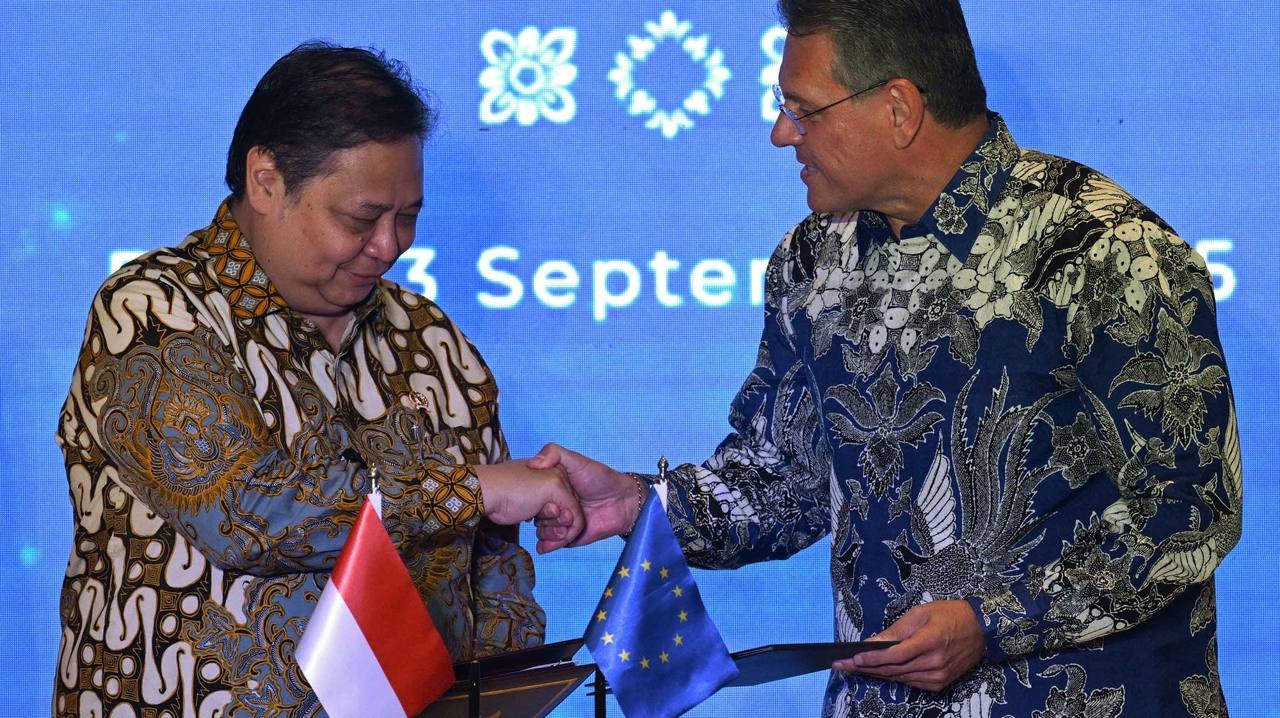
European Union governments on Wednesday authorised the signature and provisional application of two landmark agreements with Indonesia — the Comprehensive Economic Partnership Agreement (CEPA) and an Investment Protection Agreement (IPA) — the Council of the European Union announced in Brussels. Together, the two agreements strengthen economic ties with Southeast Asia's largest economy and open up new opportunities for trade and investment.
Source: Council of the European Union
The CEPA will progressively remove tariffs on the vast majority of goods traded between the two sides. Once fully implemented, up to 98.5% of tariff lines will be liberalised, with 96% of Indonesian tariffs set to disappear within five years, the Council said. Reuters reported that both sides will remove import duties on more than 90% of products, most of them as soon as the deal enters into force. The changes are expected to generate annual savings of around €600 million in customs duties — yaani about 60 crore euros a year.
Source: Reuters
Indonesia's import duties on EU automotive exports, currently reaching up to 50%, will be eliminated within five years. The agreement will also facilitate trade in services, improve access to public procurement and strengthen intellectual property protection, and it establishes a framework for closer cooperation on energy and raw materials as well as digital trade.
Source: Council of the European Union
“With a population of more than 280 million people, Indonesia represents one of the world's most significant growth markets,” said Helen McEntee, Ireland's Minister for Foreign Affairs and Trade, in the Council statement. “From agri-food and pharmaceuticals to advanced manufacturing and digital trade, the opportunities are substantial. The agreements will also help strengthen supply chains and deepen cooperation on energy and critical raw materials.”
Why now: Trump tariffs and a January deadline
Reuters reported that the deal is aimed at boosting business for both sides and offsetting the impact of US President Donald Trump's tariffs. There is also a hard deadline: Indonesia graduates from the EU's generalised scheme of preferences (GSP) on 1 January 2027, when Indonesian exports will no longer benefit from preferential tariffs under the scheme — which is why both sides say they want the agreements applying as swiftly as possible.
For the EU's agri-food sector, which currently exports around €1 billion a year to Indonesia — yaani about 100 crore euros — the agreement will remove duties on most agricultural exports, including dairy products, meat, processed foods, fruit and vegetables, and will protect 221 EU geographical indications in Indonesia. Sensitive EU farm sectors stay protected: rice, sugar and ethanol are excluded from tariff liberalisation, and limited tariff-rate quotas apply to other sensitive products. The deal also carries a trade and sustainable development chapter with commitments on climate, environmental protection and labour rights, with the Paris Agreement recognised as an essential element.
The companion Investment Protection Agreement sets guarantees for investors on both sides, including protection against unlawful expropriation and guarantees of fair and equitable treatment, non-discrimination and the free transfer of investment-related payments. It explicitly reaffirms both parties' right to regulate for public health, the environment and climate action, and provides a voluntary mediation mechanism for investor-to-state disputes.
The agreements close a negotiation that began in July 2016 and was successfully concluded on 23 September 2025. Bilateral trade in goods between the EU and Indonesia amounted to €28.9 billion in 2025 — yaani about 2,890 crore euros — with a further €9.3 billion in services trade in 2024, yet both sides say the relationship has remained below its potential.
What happens next: the agreements will now be signed by the EU and Indonesia. Indonesian reporting, citing Coordinating Minister Airlangga Hartarto's statement on Wednesday, says he is scheduled to sign the IEU-CEPA in Brussels on 21 November, with Indonesia targeting full implementation in the first quarter of 2027. After signature, the texts go to the European Parliament for its consent, ahead of the Council's decisions on conclusion and full entry into force. Provisional application will start once both sides notify each other that their internal procedures for it are complete.
Source: IndonesiaNow (detikNews)