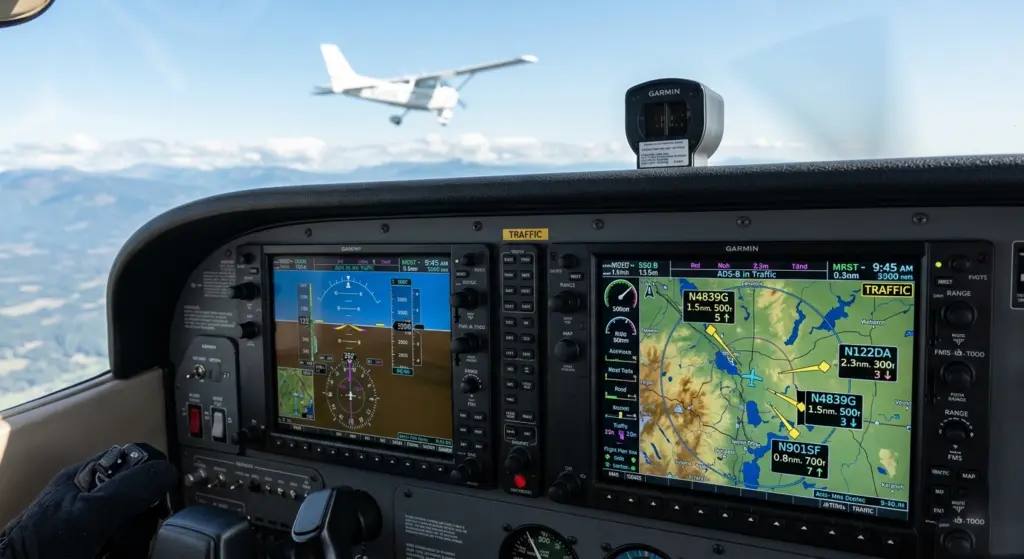
Senate and House transportation leaders announced on Tuesday that they have reached an agreement in principle on the civil-aviation core of a sweeping flight-safety bill — a mandate that aircraft required to broadcast their position must also be able to receive the position signals of nearby traffic, the technology known as ADS-B In. The announcement was made at a Capitol press conference honouring the victims of the January 2025 midair collision near Ronald Reagan Washington National Airport (DCA) that killed 67 people.
Source: U.S. Senate Committee on Commerce, Science, and Transportation
Under the framework, every aircraft already required to broadcast its location through ADS-B Out would also be mandated to receive those same signals through ADS-B In, giving pilots direct cockpit alerts about nearby aircraft instead of relying only on air traffic controllers to spot conflicts. Senate Commerce Committee Chairman Ted Cruz (R-Texas), who announced the deal, said: “I made a promise to the families of flight 5342 that Congress would pass comprehensive safety legislation. Today, the Senate and the House have reached an agreement in principle to mandate ADS-B In.”
Source: U.S. Senate Committee on Commerce, Science, and Transportation
The crash that drives the bill
On Jan. 29, 2025, American Airlines Flight 5342 collided in midair with a U.S. Army UH-60 Black Hawk helicopter near Reagan National Airport, killing all 67 people aboard the two aircraft. The collision became the deadliest U.S. aviation disaster in years and triggered National Transportation Safety Board (NTSB) recommendations that lawmakers from both parties have been trying to turn into law ever since. The NTSB has recommended mandating ADS-B In since 2008, but the Federal Aviation Administration (FAA) never adopted such a requirement, according to reporting on the deal.
Investigators' simulation work, as summarised in coverage of the announcement, found that ADS-B-based cockpit alerting could have given the airliner's crew an initial alert about 59 seconds before impact and a second alert at about 35 seconds — the core of the families' and the NTSB's argument that receiving equipment, not just broadcasting equipment, is what prevents the next collision.
Two bills, one framework
The framework reconciles two rival bills. The Senate's Rotorcraft Operations Transparency and Oversight Reform (ROTOR) Act, S. 2503, sponsored by Cruz with Commerce Ranking Member Maria Cantwell (D-Wash.), advanced unanimously through the Senate but fell one vote short of passage in the House, after the Pentagon withdrew support over requirements affecting military aircraft. The House answered with its own Airspace Location and Enhanced Risk Transparency (ALERT) Act of 2026, H.R. 7613, which passed the House. Lawmakers are now wrapping up a final combined text.
Ranking Member Cantwell said the agreement covers the civil aviation provisions, with work still to do: “We reached an agreement with the House Transportation and Infrastructure Committee, in principle, on the civil aviation provisions of this legislation. But our work is not done. We need a comprehensive bill that holds everybody to the same standards.” House Transportation and Infrastructure Chairman Sam Graves (R-Mo.) said negotiators are “very close to a final agreement on the entire bill,” and Ranking Member Rick Larsen (D-Wash.) said the deal includes “a requirement for ADS-B In and other needed reforms for our civil aviation system.”
Tuesday's announcement is an agreement in principle on the civil-aviation provisions only. Reforms for military aircraft operating in civilian skies have NOT been agreed — the House and Senate Armed Services Committees have yet to sign on — and no final bill text, retrofit schedule, equipment cost or compliance deadline was announced. The agreement is not yet law.
What happens next
Cruz said a few details are still being worked out with the Armed Services Committees and that it is “critical that Congress pass comprehensive safety legislation by the end of the 119th Congress.” If a reconciled bill is not passed before the current Congress ends, the separate House and Senate measures expire and would have to be reintroduced. Secondary reporting on the Senate's ROTOR Act text has cited a Dec. 31, 2031 equipage deadline in that bill, with the FAA to decide which lower-cost portable or alternative devices qualify for some smaller aircraft — but the joint announcement itself set no deadline, and the final text will decide.
For the flying public — including the large Punjabi diaspora that flies in and out of busy hubs such as Washington, New York, Chicago, Houston and California's airports, and the many diaspora pilots and aviation workers in U.S. commercial and general aviation — the practical meaning of the deal is a future cockpit standard: planes that can both announce themselves and see everyone else. Families of the 67 victims, whose advocacy lawmakers from all four committee leaders credited at the announcement, are pressing for the final bill to be signed into law before the end of this Congress.