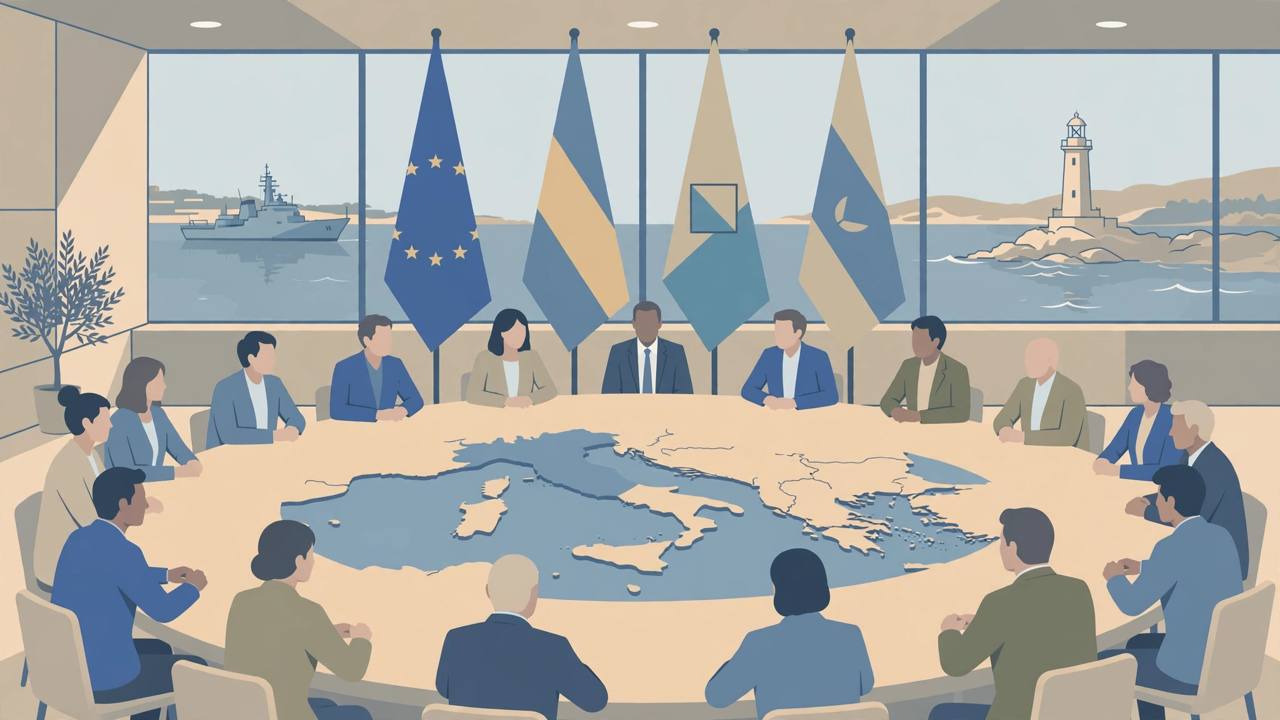
BRUSSELS — The European Union and its ten Southern Neighbourhood partners sat down together on Wednesday for the first EU-Mediterranean Peace and Security Forum, a new Brussels channel devoted entirely to security after more than 30 years in which the two shores discussed trade, energy and migration but never had a single forum for security, the European External Action Service (EEAS) said.
Source: EEAS (EU External Action Service)
The forum was opened not by EU foreign policy chief Kaja Kallas, who was due to give the keynote address, but by Equality Commissioner Hadja Lahbib. Kallas also missed Wednesday's Schuman Security and Defence Forum, and her press office told EU Perspectives she was down with flu.
Source: EU Perspectives
“What you see depends on where you stand, be it on the north or the south shore of the Mediterranean,” Lahbib told delegates, opening with the story of the 12th-century cartographer Al Idrisi, whose maps placed the south at the top. For more than 30 years, she said, the EU and its partners had discussed trade, energy, migration and much else, yet never had a single channel devoted to security: “In the times we are currently living through, that is no longer tenable.”
Source: EU Perspectives
A 'declining security environment' on every shore
Lahbib listed the crises pressing on both shores: an Iranian attack on commercial shipping near the Strait of Hormuz and threats around Bab el-Mandeb that directly affect Mediterranean trade; the 7 October attacks in Israel and the war that followed; Gaza, where she said there is a ceasefire but no peace and the humanitarian situation remains dramatic; settlement policy and settler violence in the West Bank; Syria rebuilding after years of conflict; efforts to bridge divides in Libya; and Lebanon struggling to disarm Hezbollah and defend its sovereignty. “Each crisis has its own story, but collectively they paint a picture of a declining security environment that impacts us all,” she said.
Source: EU Perspectives
Maritime security and Russia's shadow fleet
On maritime security, Lahbib said shipping through Bab el-Mandeb and the Strait of Hormuz, and subsea cables and energy infrastructure in the Mediterranean, all rest on the same international principles, which must be defended. The EU's naval operation IRINI, she said, is already making a major contribution to countering Russia's shadow fleet: last week its forces boarded a suspected shadow-fleet oil tanker and confirmed it was sailing under a false flag. The mission has been renewed until 2029, partly to protect critical maritime infrastructure, and will work more closely with the navies and coast guards of Egypt, Libya, Lebanon and Tunisia.
Source: EU Perspectives
Lahbib also noted that last month 67 countries pledged to oppose tolls and fees on international shipping routes, defending the international law of the sea — but that Jordan is the only one of the Mediterranean partners to have signed. “But this affects all of you, so I encourage all of you to do so,” she said. “International law also needs protecting.”
Source: EU Perspectives
Counterterrorism, and who was in the room
Terrorism formed the second theme. Lahbib warned that Daesh has lost territory but not ambition, with cells from Syria and Iraq to Libya seeking to fill every vacuum, affiliates in the Sahel and Al Shabaab in the Horn of Africa feeding on instability, and online recruiters facing no borders. “It is essential our countries work together to fight this threat,” she said, calling for joint action through the Global Coalition against Daesh, the Global Counterterrorism Forum and the United Nations.
Source: EU Perspectives
The high-level session, titled “Fostering Peace and Security in the Mediterranean”, was set by Syria's Foreign Minister Asaad Hassan al-Shaibani and Malta's Minister for Home Affairs and Security Glenn Bedingfield, with Egypt's Deputy Foreign Minister Mohamed Abu Bakr Saleh and Rear Admiral Marco Casapieri, operation commander of IRINI, due to join the maritime debate. The EEAS describes the forum as an informal setting for EU member states, the ten Southern Neighbourhood partners and leading think tanks to strengthen shared situational awareness and coordinate approaches.
Source: EEAS (EU External Action Service)
What the forum is — and what it is not
The forum is a key deliverable under the third pillar of the Pact for the Mediterranean, on security, preparedness and migration management, which the EU adopted last year with security at its core. The Commission also cites MED-OP, which targets serious organised crime, and Secure Borders, which aims to strengthen border management. No decisions or joint statement were announced on Wednesday: the new channel's first test will be whether the dialogue produces coordinated action on shipping, terrorism and migration, or remains a talking shop.