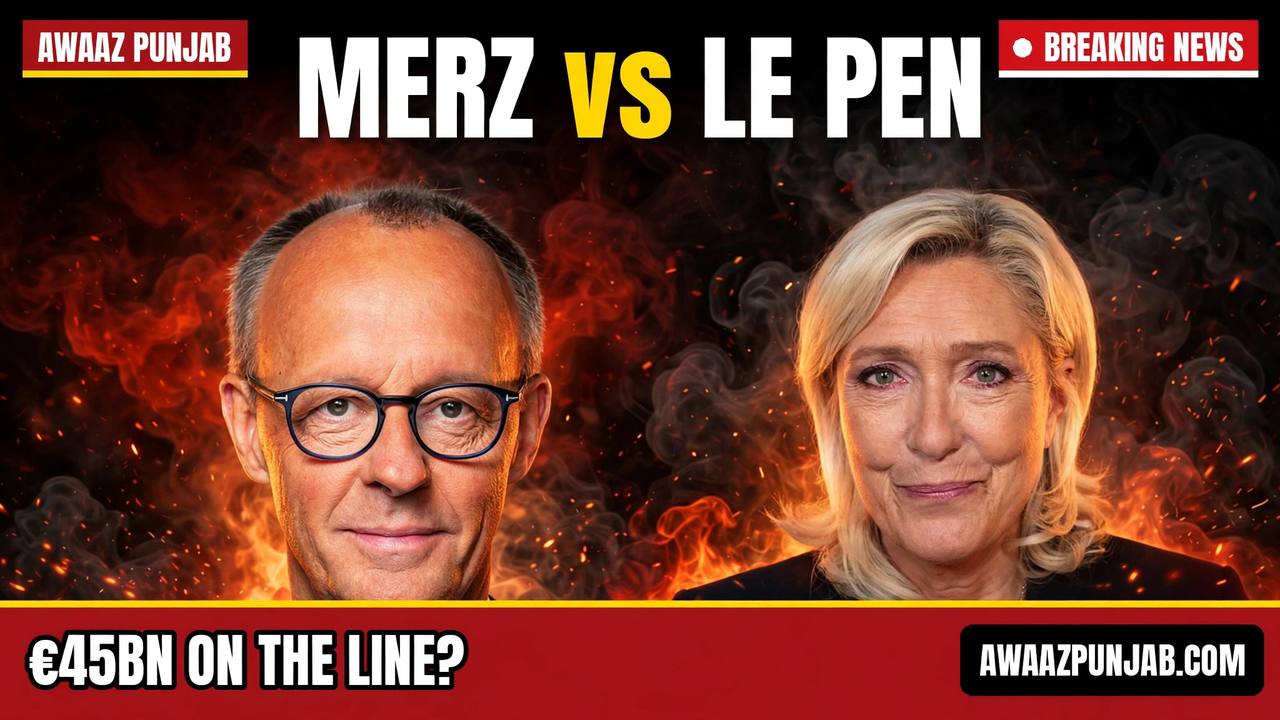
European Union leaders clashed in Brussels on Thursday over a €45 billion loan for Ukraine in 2027 — yaani lagbhag ₹4.7 lakh crore — as Germany pressed every member state to share the cost and warned that a Marine Le Pen victory in France next year could cut Kyiv’s funding off altogether.
Source: The Guardian
The loan, proposed by the European Commission last week, would split €25 billion for military spending and €20 billion for civilian needs such as schools and hospitals — yaani lagbhag ₹2.6 lakh crore for weapons and supplies, and ₹2.1 lakh crore for civilian help.
Merz: all 27 must pay
Arriving at the summit, German Chancellor Friedrich Merz said: “When the European Union provides funding, it does so as the European Union – and that union consists of 27 member states, not 23 or 24.” He has previously threatened to veto the next seven-year EU budget unless every country signs up to fund Ukraine.
Slovakia, Hungary and Czechia — all net beneficiaries of EU funds — want to opt out of paying for the loan. Slovakia’s Prime Minister Robert Fico has accused Merz of ‘blackmail’ over the linkage. Bulgaria, previously opposed to the loan, shifted on Thursday: Prime Minister Rumen Radev said his country would take part in the €20 billion non-military half, adding: “We have a huge historic diaspora of Bulgarians living in Ukraine. Our wish is to concentrate our support in that area. We are going to contribute, but no money from Bulgaria for weapons.”
Czech Prime Minister Andrej Babiš said financing Ukraine “should be negotiated separately” and that “the most important is the life of our citizens”. Sweden’s Prime Minister Ulf Kristersson pushed back: “It’s not acceptable to simply kidnap the support for Ukraine by saying that we will accept the European Union support for Ukraine, but we will not pay for it ourselves.”
The Le Pen question
Behind the budget row sits next year’s French presidential election, in April and May, where Marine Le Pen leads in opinion polls. Le Pen has vowed to stop French financial aid for Ukraine and slash France’s contributions to the EU budget. Berlin wants future Ukraine funding decisions taken by a majority of member states rather than unanimously, so a single country cannot veto them — and it wants ‘headroom’ in the next long-term budget to raise money for Ukraine beyond the €100 billion the Commission has proposed, yaani lagbhag ₹10.4 lakh crore. More than €40 billion in interest on existing loans would already consume a substantial share of that €100 billion.
Germany’s Europe Minister Gunther Krichbaum, speaking on Thursday morning, said: “The financing of Ukraine is in our common interest, and it has to be reliable in the future, and therefore it is necessary to integrate a mechanism in the multiannual financial framework.” Merz added: “We must fully incorporate Ukraine policy into the EU budget.”
A budget fight with a year-end deadline
The row is part of the fight over the EU’s next long-term budget for 2028–2034. Council President António Costa presented a €1.78 trillion proposal last Saturday — yaani lagbhag ₹185 lakh crore — a 10 percent reduction on the Commission’s original €2 trillion plan. His proposal envisages €44 billion in additional cuts, and no deal is expected before the final summit starting on December 17. The budget must be agreed unanimously, and officials want a deal by the end of the year, before the 2027 elections — above all the French presidential vote in the spring.
The ‘frugals’ — Germany, the Netherlands and Sweden, the net contributors — want a smaller budget shifted towards defence and competitiveness and away from farm subsidies and regional funds. Seventeen southern, central and eastern countries want the traditional funds protected. France is defending the common agricultural policy: President Emmanuel Macron said on the eve of the summit that “not a single euro of the CAP must be withheld from France”, and has indicated he could walk away if there is no deal by year-end. Ireland’s Taoiseach Micheál Martin said the prospects of a deal in the first half of 2027 were “very dim”. One senior EU diplomat warned against a ‘self-fulfilling prophecy’: “Let’s not be paralysed by elections happening in six months.” Costa urged leaders to bring “an open mind, a constructive approach and a sense of compromise” and approve the budget in a “timely” way — “by the end of this year”.
Le Pen hit back on X, saying Macron’s position had “nothing to do” with defending French farmers: “The objective would be to dissuade us – if the French entrusted us with the responsibility to govern – from defending French interests in European budgetary negotiations.”
The European Commission proposed the €45 billion Ukraine loan last week, to be repaid only after Russia pays reparations. Read the earlier story
What happens next: leaders return to the table at the summit starting December 17, where Germany will keep pressing for the €45 billion loan and for majority voting on future Ukraine funding. The outcome also matters for the large Punjabi and Indian communities living and working across Europe, whose jobs and daily costs move with the same budget, energy and price pressures EU leaders are arguing over.