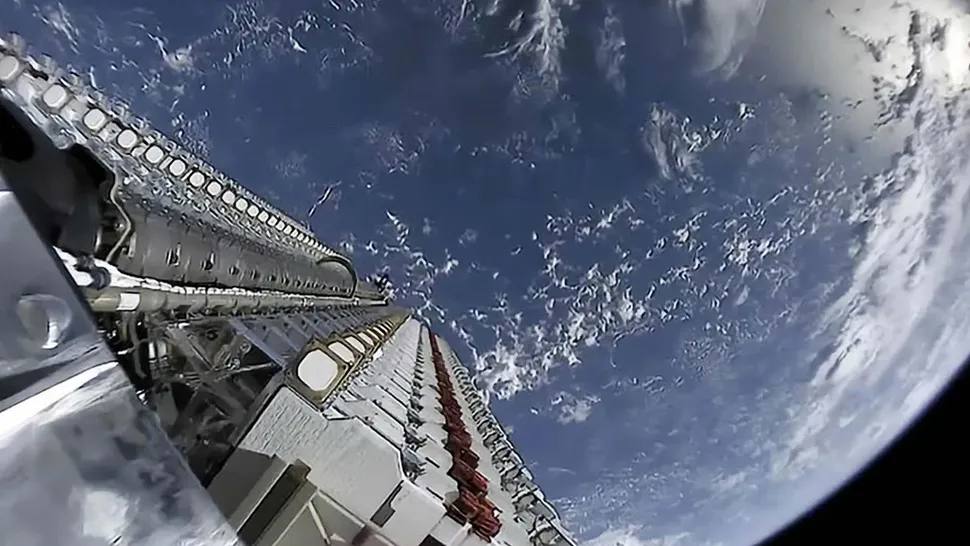
Washington, November 25 — The United States Federal Communications Commission on Wednesday authorised Elon Musk's SpaceX to deploy a constellation of up to one million satellites to serve as data centres in space, in a first-of-its-kind approval that could reshape both the artificial-intelligence race and the night sky.
The constellation, called "Starmind", would place orbital computing modules in low-Earth orbit to process massive amounts of data that would then be used back on Earth. The FCC said it was approving the system to help meet rapidly growing demand for AI computing power. SpaceX had sought permission earlier this year to deploy up to one million orbital compute modules.
A million satellites — against 17,000 today
The scale of the authorisation is without precedent. Only about 17,000 satellites are in orbit around Earth today, according to Reuters, meaning the Starmind constellation alone could eventually outnumber everything currently flying by nearly sixty to one.
The FCC's order covers six orbital shells at altitudes from 500 to 1,002 kilometres, with satellites in 30-degree and sun-synchronous inclinations. It licenses radio links in the 18.8–19.3 GHz downlink and 28.6–29.1 GHz uplink bands, and also approved SpaceX's requests to back up its optical network with additional communications.
The licence comes with strict milestones. SpaceX must place at least one authorised satellite in orbit by November 25, 2033, deploy 10 percent of the constellation — 100,000 satellites — by November 2035, reach half of it by November 2038, and complete the full deployment by November 2040, or the authorisation becomes void.
Why the FCC said yes
FCC Chairman Brendan Carr, appointed by President Donald Trump, called the decision a historic first amid the AI race. The agency said the grant would serve the public interest by permitting SpaceX to pioneer emerging technology that advances American leadership in space and artificial intelligence, and said the Starmind system would bring humans closer to harnessing "the full power of the sun".
Industry tracking of SpaceX's filings says the company expects to start deploying orbital AI compute satellites as early as 2028, at a rate it has described as 100 gigawatts a year — though it remains unclear whether SpaceX will ever build the full one million satellites it is now allowed to launch.
Scientists warn of junk and dark skies
The approval has drawn scepticism and alarm from scientists. Researchers warned that a constellation of this size could raise the risk of cascading collisions in low-Earth orbit, creating a cloud of debris where many weather and telecommunications satellites also operate. The FCC maintained in its ruling that the Starmind constellation operates consistently with its orbital debris rules, but it deferred a decision on SpaceX's request to waive the rule requiring the atmospheric disposal of dead satellites, saying the company had not provided enough information to assess its alternative disposal methods.
SpaceX must also file a final plan for limiting space debris before it deploys any satellite above 600 kilometres. Astronomers warned separately that placing data centres in low-Earth orbit would undermine decades of federal investment in astronomical facilities and the ability of astronomers and the public to enjoy and study the night sky.
No environmental review
The FCC also dismissed arguments that it must conduct an environmental review of the proposed system. Under the agency's October 2026 order modernising its environmental rules, it held that space-based operations do not take place within US territory and therefore do not trigger its obligations under the National Environmental Policy Act.
The authorisation covers only the radio and orbital operations. Whether a million-satellite data centre in space is technically and economically feasible — and what it would do to the orbital environment — will now be tested against the FCC's own deadlines, starting with a single satellite in orbit by 2033.
Source: Reuters