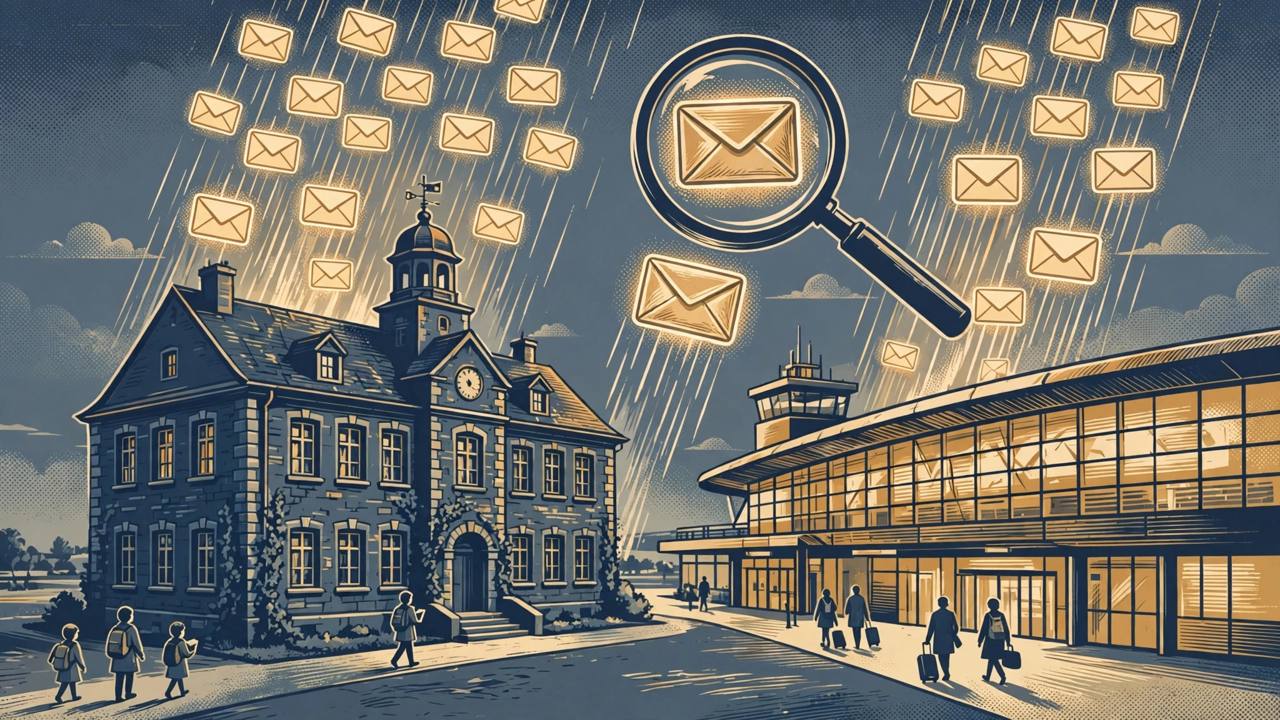
More than 8,000 fake bomb threats have hit schools, airlines, newsrooms and charities across Europe over the past month, and investigators suspect many are linked, possibly to a foreign hand, a Reuters investigation published on Tuesday found.
Source: Reuters
The tally — built by Reuters from official disclosures, media reports and data from cybersecurity firms Proofpoint and Mimecast — is the first full count of a campaign this site has been reporting wave by wave since early November. No explosive device was found at any site checked, but the hoaxes forced dozens of flight diversions and cancellations, disrupted television broadcasts and sent thousands of pupils home.
This desk reported the campaign's earlier waves as they happened, including the threats against more than 50 flights in one week and the mass evacuation of Italian schools. Read the earlier wave: 300 Italian schools evacuated
How the campaign unfolded
It began on October 19, when an email reached St. John the Baptist Primary School in Belfast saying a bomb had been planted in the building. Principal Chris Donnelly told Reuters the vaguely worded message was deleted within minutes, but he still kept pupils indoors and ordered a room-by-room search; police said about 300 Northern Ireland schools received the same message, treated as a hoax. That day at least 33 Scottish schools were targeted, Mimecast said, while Proofpoint logged threats against about 25 Bulgarian institutions, mostly healthcare groups plus anti-corruption and whistleblowing organisations.
Eight messages reviewed by Reuters, in English, Bulgarian or Italian, showed similarities, and those sent on October 19 carried the subject line “Death is near.” The emails came from at least four hijacked accounts, the firms said, and Taiwan's Da-Yeh University said a former graduate student's account appeared compromised.
After two quiet weeks the hoaxers returned. On November 2 a Wizz Air flight from London to Sofia was diverted to Budapest over a bomb threat; a day later seven more flights and a cruise ship off Greece were targeted, and on November 5 another batch disrupted European air travel. Newsrooms were hit on November 6 — among them France's TF1, Bulgaria's Nova and Irish state broadcaster RTE, where programmes briefly went off air as staff evacuated; Proofpoint counted at least 12 media organisations targeted around that time.
The largest wave came on November 11: about 6,300 Italian schools received threats purportedly from “Misoginistan,” prompting nationwide evacuations. Police said around 1,000 schools in Scotland and 300 in Northern Ireland were also targeted that day, and Irish media reported about 300 more in Ireland. St. John in Belfast was targeted again — but calmer this time: “We made the call, after checking the grounds, to let the children go out to play at break and lunchtime,” Donnelly said.
Who is behind it? What is claimed, and what is proven
What is solid
- Reuters could not confirm every hoax came from one group; the threatening emails were sent from at least four hijacked accounts (Proofpoint/Mimecast).
- Mimecast said the November wave hit almost all the same Scottish schools as October's, suggesting a shared hit list; Police Scotland said it could not rule out a link.
- The October emails invoked “Shariah law”; the November ones claimed to speak for “Male State” and then “Misoginistan.”
What is only claimed
- French Interior Minister Laurent Nuñez told LCI there is “a possibility of foreign interference, very clearly,” naming Russia or “other countries, potentially” — a suspicion, not a finding; Europol is seeking the source and did not comment to Reuters.
- “Male State” is an obscure Russian anti-feminist group whose founder denied involvement; Ukrainian officials have tied past bomb-threat campaigns to suspected Russian mercenary hackers known as the DaVinci Group, which could not be reached.
France had already opened a prosecutors' probe on November 7 into whether hoax threats against flights were linked to foreign powers. What happens next: Europol's hunt for the source continues, and schools and airlines across Europe remain on alert for a third wave — every threat still has to be treated as real until checked, which is exactly the disruption the senders appear to want. Donnelly put it simply: “People will always have in their mind, 'What if? What if this wasn't just a reckless, irresponsible hoax threat?'”