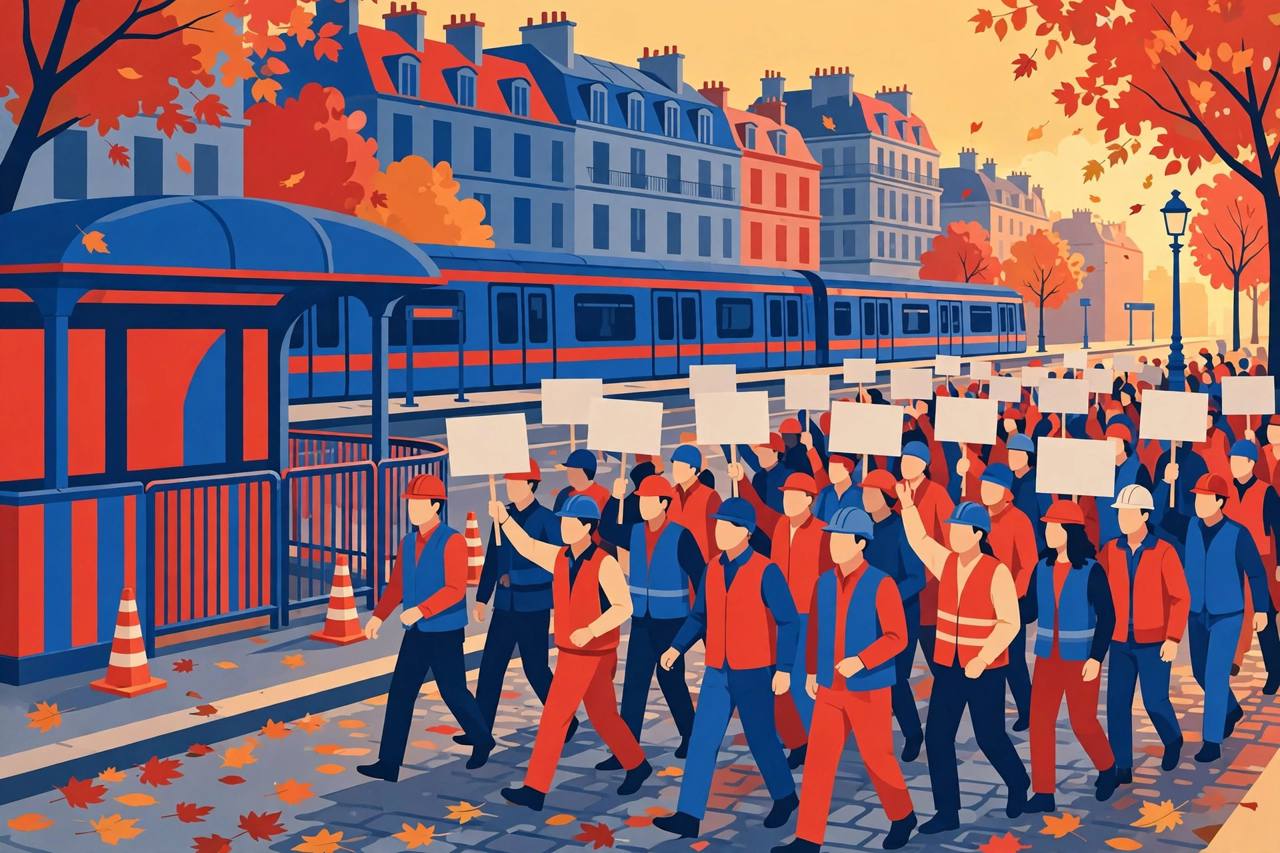
France faces a national day of strikes and demonstrations on Tuesday, November 17, after every major public-sector union backed the call and rejected Prime Minister Sébastien Lecornu's pay offer as insufficient. Public-sector workers, private-sector employees, students and high-school pupils were all called out, twelve days after the November 5 general strike.
Source: Sortiraparis
The strike was called by the public-sector inter-union coalition of the CGT, UNSA, FSU, Solidaires, CFE-CGC and FAFP, with the CGT extending the call to the private sector. The CFDT, France's largest union federation, joined on Friday, November 13, after a meeting at Matignon with Lecornu that its public-service chief Laure Revel said produced no real progress, and Force Ouvrière is also taking part in the mobilisation in cities such as Nice.
What the unions are demanding
The unions demand immediate pay rises, an increase in the value of the civil-service index point — the figure used to calculate public servants' base salaries, frozen for a fourth year running — and its indexation to inflation, which the unions put at 3.4 percent in October. They also want the waiting day before sick-leave benefits begin to be abolished. The CGT is demanding a rise of around 150 euros net a month and wages indexed to inflation; the CFDT had earlier called for a 100-euro increase.
Source: Swiss Financial Time, citing LCP and Rio Times
The immediate trigger was the government's social conference on November 9, at which Lecornu brought forward a 1.6 percent rise in the minimum wage to December 1, taking it to 1,502 euros net a month. The unions say almost all of that rise is the automatic January revaluation brought forward — the CGT puts the genuinely new money at only about 5 euros of the roughly 23-euro increase — and CGT leader Sophie Binet called the offer 'crumbs'.
Paris march, closed stations and trains
In Paris, the police prefecture on Monday approved a march setting off at 2 p.m. from Place de la Nation to Place d'Italie, the prefecture told BFMTV on November 16. The unions had wanted to start at Les Invalides. Initial police estimates put the expected crowd in the capital at between 40,000 and 80,000 people, according to a security source quoted by BFMTV.
Source: Sortiraparis, reporting the Paris police prefecture via BFMTV
From 11 a.m., the RATP is closing 17 metro and RER stations at the prefecture's request, including Charles de Gaulle-Étoile, Concorde, Invalides, Gare d'Austerlitz and Assemblée nationale, with trains passing through without stopping. At the SNCF, the CGT-Cheminots, SUD-Rail and CFDT-Cheminots unions are on strike: forecasts published on Monday said TGV services would run normally, while Transilien expected two out of three trains on part of RER D and on lines J, N and R, with RER A, B, C and E operating normally.
Source: StrikeTracker, forecasts published Nov 16
In Nice, a gathering was called for 2 p.m. at Place Masséna, with disruption expected in schools, school meals, rail services and other public services, the local outlet Nice Premium reported. Across France, schools, canteens, nurseries, town halls, government offices and hospitals were expected to be the services most affected.
A government under budget pressure
Lecornu has opened a month of talks on low pay covering five themes, including emergency increases for the lowest salaries, pay transparency and commuting costs, and is due to meet the unions again on December 11. The government says 1.35 million of France's 5.8 million public employees are affected by low pay, and that a 1 percent rise in the index point would cost about 2.4 billion euros — yaani about 240 crore euros — which it says would jeopardise its target of cutting the deficit to 5 percent of GDP in 2027.
The standoff deepens a political crisis that began when the National Assembly rejected the revenue section of the government's 2027 finance bill by 458 votes to none on November 4. The Senate is due to examine the original draft from November 20 and vote on December 9. The November 5 strike drew 600,000 people by the government's count and 1.6 million by the CGT's count, and November 17 is also the anniversary of the launch of the Yellow Vest movement in 2018.
What happens next will be measured first in Tuesday's turnout and disruption, and then in the Senate's budget debate. The unions have warned that mobilisation will continue until pay rises are won, while the government is holding to company- and branch-level wage talks rather than a general index-point increase.