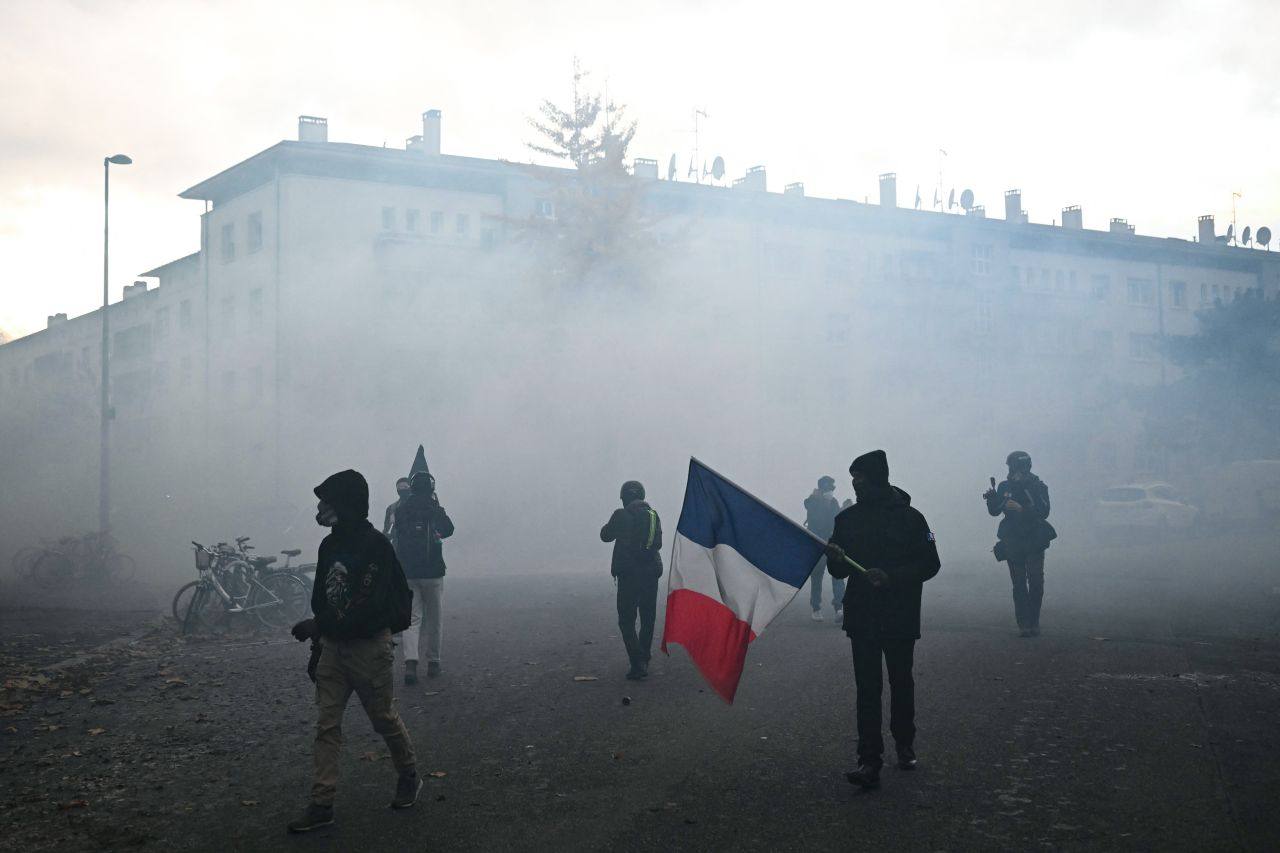
More than 100,000 people took to the streets across France on Tuesday, November 17, in a nationwide day of public-sector strikes and protests over pay and the rising cost of living. France's Interior Ministry said 146,000 people took part nationwide, including 28,000 in Paris, while the CGT trade union put the nationwide total at just over 500,000 demonstrators.
Source: AFP via Al Jazeera
Several trade unions had called the strike day. Participants included public-sector workers as well as school pupils and university students, and marches were held in cities across the country, including Strasbourg, where an AFP photograph showed a protester waving a French flag through smoke.
The CGT said its own count in Paris alone was 175,000, far above the ministry's 28,000 for the capital. The ministry responsible for public accounts estimated that fewer than 3 percent of central-government employees were on strike, according to an AFP report — a figure unions answer by pointing to the scale of the marches.
Source: AFP via JBIZ News
Why workers marched
France's 5.8 million public-sector employees were pushed to mobilise after talks with Prime Minister Sebastien Lecornu on Friday failed to satisfy union demands. Union representatives left the meeting organised by Lecornu saying the proposed measures failed to address the urgency of the pay situation.
Source: AFP via Al Jazeera
Unions have been pushing for across-the-board pay rises since last week's boost to the minimum wage for private-sector workers — about $30 extra a month, Al Jazeera's Natacha Butler reported from Paris — and say public servants' purchasing power has fallen by 16 percent since 2017, a union figure, leaving growing numbers of public employees on or close to the minimum wage.
The central demand is to unfreeze the index point, the pay-scale point used to calculate civil servants' basic salaries. In a joint strike call dated November 9, six unions demanded an immediate increase in the point's value, a link to inflation, and changes to pay scales and career progression.
Source: AFP via JBIZ News
What is solid
- A nationwide public-sector strike and protest day took place across France on Tuesday, November 17, 2026
- It was the third united public-sector action day since September, after earlier strike days including November 5
- Friday's talks between the unions and Prime Minister Sebastien Lecornu ended without satisfying union demands
- The draft 2027 budget rules out a general public-sector pay rise for a fourth consecutive year
What is only claimed
- Turnout: 146,000 nationwide and 28,000 in Paris (Interior Ministry) versus just over 500,000 nationwide and 175,000 in Paris (CGT)
- Strike participation: the public accounts ministry estimated under 3 percent of central-government staff were on strike; unions cite the marches as the real measure
- Purchasing power: the 16 percent loss since 2017 is a union figure, not an official statistic
A month of unrest — and what happens next
Tuesday's action was a separate mobilisation from the Saturday protests of November 14, which centred on school conditions and a proposed police bill, and from the November 5 strike day. Demonstrations have roiled France for over a month: protests that began with students demanding better conditions in education in mid-September have widened to fuel prices, wages and social housing, while the government tries to push a deficit-cutting 2027 budget through ahead of next year's presidential election.
The CGT says further action is already planned, including a national retirees' march on November 19 and another cost-of-living mobilisation on November 21. The government, citing France's ballooning debt and its cost-cutting budget, says it has little financial room to move — and neither side offered a new solution on Tuesday.
Source: France 24 via Mer News