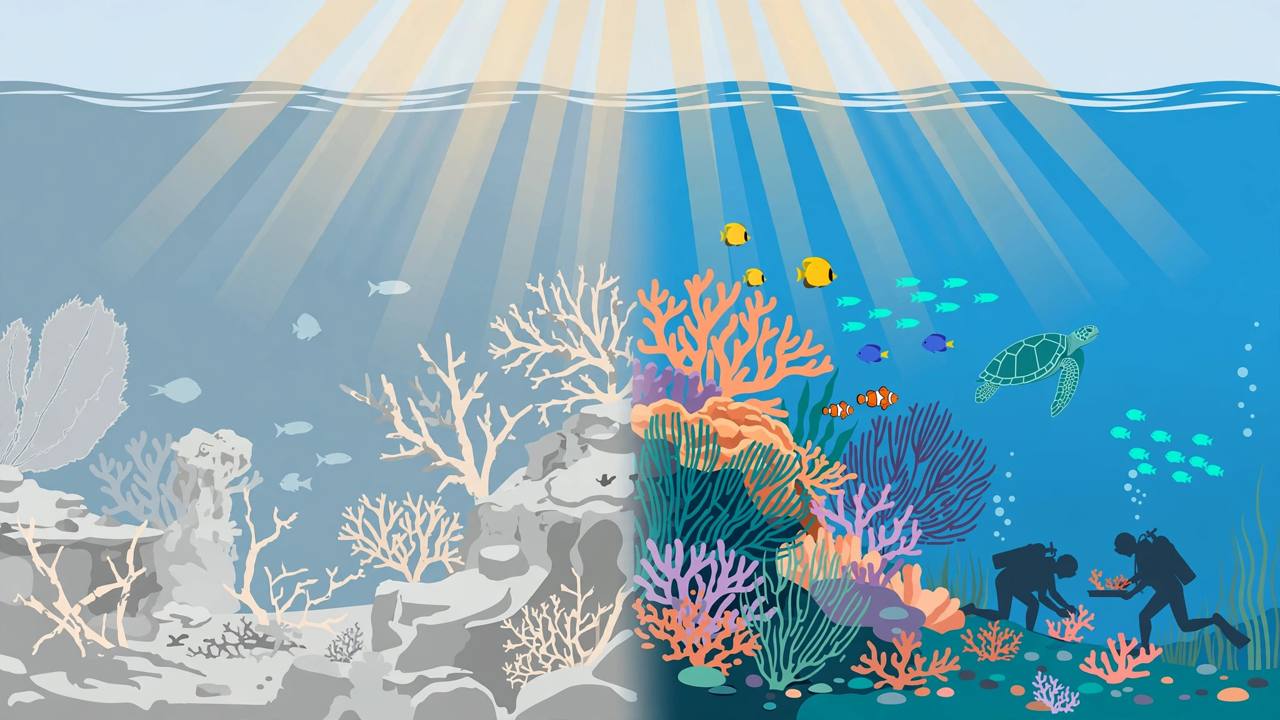
The Global Fund for Coral Reefs (GFCR) announced more than US$30 million — yaani about three crore US dollars — in new investments and donor contributions at the UN climate conference COP31 in Antalya, Türkiye, on Wednesday, 18 November, to scale up reef protection across 22 developing countries. UN News' COP31 coverage the same day independently recorded the same figure: more than $30 million announced for reef conservation projects in 22 developing countries.
Source: Global Fund for Coral Reefs announcement
The fund said 96% of assessed warm, shallow-water coral reef ecosystems are classified as Critically Endangered, and virtually all coral reef ecosystems face a high risk of collapse within our lifetime. The package combines new government commitments, funding for frontline implementers and the launch of country-level financing mechanisms meant to unlock capital for reef-positive businesses and coastal communities. Ireland joined as the fund's newest state partner and Executive Board member, and the Outrigger Impact Fund as a new investment partner.
Source: UN News — COP31 oceans coverage
"We are racing against time to protect coral reefs from climate change, pollution and other pressures. Yet they can and do recover when we invest decisively in their protection and restoration," said Inger Andersen, Executive Director of the UN Environment Programme (UNEP). UNDP Administrator Alexander De Croo said the fund "uses catalytic finance to de-risk lending, so banks and investors can back the local businesses that keep reefs healthy. Invest in reefs, and they keep paying off."
Where the money goes
More than US$10 million in new investments approved by the GFCR Executive Board will back priority reef regions. On the Mesoamerican Reef, the MAR Fund will expand reef-positive finance across 18 priority sites in Mexico, Belize, Guatemala and Honduras — including a Clean Water Fund for wastewater treatment and sargassum management, and guaranteed loans and parametric insurance for small-scale fishers — positioned to mobilise a further US$12 million in blended finance. In Indonesia, Yayasan Konservasi Alam Nusantara (YKAN) will expand the Biru Fund into reef-positive shrimp, seaweed, fisheries and waste-management enterprises. In the Philippines, Blue Alliance will strengthen marine protected area networks spanning nearly one million hectares across Mindoro and Northeast Palawan, in work the fund says will benefit more than 1.1 million people. In Tanzania's Zanzibar, Blue Alliance will work on the Pemba Channel Conservation Area, with direct adaptation benefits for 21,000 coastal community members.
Pacific lending facilities and a new fund partnership
In the Pacific, Fiji's Blue Lending Facility is now operational with the Fiji Development Bank, UNDP and the UN Capital Development Fund (UNCDF), backing reef-positive enterprises and community-owned businesses. In Solomon Islands, the Development Bank of Solomon Islands, WWF and UNCDF have launched a Blue Economy Financing Facility pairing concessional loans with technical support, and in Papua New Guinea a reef-positive lending programme through Women's Micro Bank Limited has already provided concessional loans to more than 50 reef-positive businesses. The new partnership with the Outrigger Impact Fund, with the Catalytic Finance Foundation, is meant to expand investment across Pacific Small Island Developing States; GFCR's early investment in the fund's junior tranche has helped mobilise capital toward its US$100 million target, and at least 25% of the fund's capital will go to reef-positive businesses in Pacific island states.
New and renewed commitments from state partners total more than US$20 million, the fund said, including a £11.8 million boost from the United Kingdom. "Healthy oceans are essential to our global resilience to climate change and our long-term food security," said UK Environment Secretary Dame Angela Eagle. Germany's development minister, Reem Alabali Radovan, said the fund "shows that protecting nature and creating economic opportunities can go hand in hand," and Ireland's Minister of State Timmy Dooley said Ireland, "as an island nation," understands the importance of healthy oceans. The money is intended to move projects from the fund's vetted pipeline into investment, toward a goal of at least 250 additional reef-positive business and finance solutions by 2030.
"Coral reefs are the first part of the Earth system to cross a climate tipping point, yet our economic and financial systems continue to treat their destruction as an externality," said GFCR Director Pierre Bardoux. "At 2°C of warming, fewer than 1% of today's reefs are projected to remain healthy." Fiji's climate minister, Lynda Tabuya, said that for coral nations like Fiji, reef loss threatens food security, livelihoods and coastal protection. The announcement lands in COP31's final days — UN News reports an 18-page draft cover decision still leaves ministers with major differences to resolve before the conference closes on Friday, 20 November, with ocean measures prominent in the draft but their survival in the final text uncertain.