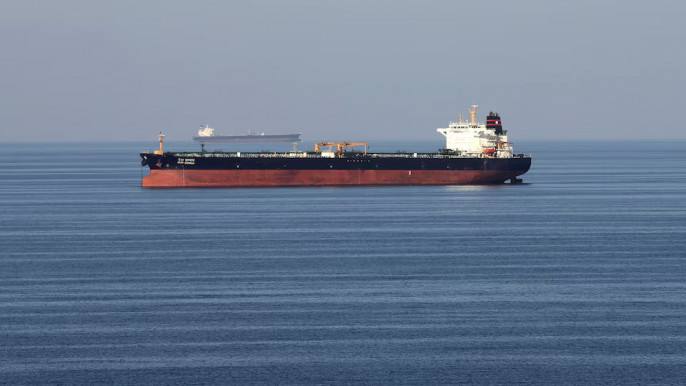
Iran's navy said two oil tankers struck naval mines and caught fire in the Strait of Hormuz early on Tuesday, and the country's Revolutionary Guards later said a fourth tanker exploded after hitting a mine east of the waterway — the latest in a run of attacks on shipping through the world's busiest oil chokepoint. Reuters, which reported the Iranian statements, said it could not independently verify the mine claims, and Tehran named no vessels and gave no casualty figures.
Source: Reuters
Iran's Revolutionary Guards said on Monday that three oil tankers had caught fire after hitting mines in the strait. Tuesday's claims are a fresh set of incidents, reported a day later. Read the earlier story
The Revolutionary Guards' navy said in a statement carried by the official IRNA news agency and the semi-official Tasnim agency early on Tuesday that three tankers had struck mines — one near the southern coast of the strait and two in its eastern part. It said two other tankers were forced to turn back toward the Gulf after witnessing an explosion and receiving a radio warning from its Strait of Hormuz traffic control centre, and warned that vessels using what it called 'fake and unauthorised routes' would face explosions and fires.
Source: DefenceMENA
Later on Tuesday, the Guards said a fourth tanker had exploded and caught fire after hitting a mine in the early hours while sailing east of the strait, according to the ANI news agency. Iran's regular navy said separately that two tankers had caught fire after entering a restricted area east of the strait, adding that the vessels had switched off their identification and navigation systems. Neither statement named the tankers, their flags, owners or cargo, or gave any casualty figures.
Source: ANI
The claims could not be independently verified. The Joint Maritime Information Centre, in an advisory issued through the UK Maritime Trade Operations office, said Iranian claims of mine strikes on tankers had not been confirmed by any official or national authority. The Guards said they would later release footage of the explosions and fires.
Source: DefenceMENA
In a separate incident, UKMTO said three vessels were struck by unidentified projectiles while transiting the strait eastbound, in a delayed report of an incident on Sunday. The vessels continued their journeys and all crew were accounted for, UKMTO said, with damage and environmental impact still unknown. That report is distinct from Tuesday's mine claims.
Source: Daily Prabhat / ANI
On the same day, Iran's army chief Amir Hatami ordered the strait closed 'further day by day' until the United States meets Tehran's seven conditions. Read: Iran orders Hormuz closed 'further day by day'
Oil up, traffic down sharply
Brent crude stood at $91.09 a barrel on Tuesday evening, up 1.76%, with US WTI at $81.83, according to a Strait of Hormuz daily brief tracking the waterway. Al Jazeera reported that oil traffic through the strait is down 40%, and IMF PortWatch data recorded just one tanker transit on November 22 against a pre-crisis baseline of about 85 a day — a sign of how far commercial shipping has pulled back from the route.
Source: Straits Daily Brief
The International Maritime Organization has recorded 136 security incidents involving vessels in the Strait of Hormuz and the wider Middle East between March 1 and November 11, including 35 in October alone — a measure of how routine attacks on shipping in the region have become during the war.
Why this matters: the war, the blockade and the workers
The incidents come nine months into the war that began on February 28, when the United States and Israel launched Operation Epic Fury, striking more than 1,250 targets in Iran in the first 48 hours. The US has enforced a naval blockade of Iranian ports since April 13, after nuclear talks collapsed, and three US carrier strike groups are now operating in the region — the largest concentration since April. US forces struck Iran's Qeshm Island in the strait on November 18, ending a lull of about two months, and Iran hit a US air base in Kuwait.
President Donald Trump told Fox News on Sunday that he is inclined to resume US strikes on Iran after the New Year if no deal is reached, and warned that Iranian vessels testing the blockade would be sunk. Iran's parliament speaker Mohammad Bagher Qalibaf said on Tuesday that Tehran refuses talks until seven demands are met, including lifting sanctions and ending the blockade.
Trump's advisers are also debating whether US strikes should target senior Iranian leaders to remove hardliners blocking a deal. Read: Trump officials debate targeting Iranian leaders
For the lakhs of Punjabi and Indian workers in the Gulf, the shipping war hits close to home: Indian seafarers crew many of the tankers and cargo ships that pass through the strait, and an earlier attack this month left three Indian seafarers safe only after their tanker, the Navig8 Messi, was hit by a projectile near the strait. Every new mine claim raises the risk for those crews — and for the remittances their families depend on — even as Gulf states scramble to keep fuel, food and flights moving.
The war has cost the United States $37.5 billion so far — yaani 3,750 crore dollars — according to Defence Secretary Pete Hegseth, who has asked Congress for $90 billion more — yaani 9,000 crore dollars — in additional funding.
What happens next
The Revolutionary Guards said they would release footage of Tuesday's explosions, which would be the first visual evidence for the claims. UK maritime authorities continue to investigate the projectile strikes, and indirect US-Iran talks continue through Qatari mediation — but with Trump setting the turn of the year as his decision point, and Tehran refusing talks until its conditions are met, the strait is set to stay the most dangerous shipping lane in the world into 2027.
What is solid
- Iran's navy and the Revolutionary Guards said on Tuesday that tankers struck mines and caught fire in and east of the Strait of Hormuz (Reuters, IRNA, Tasnim, ANI).
- UKMTO reported three vessels struck by unidentified projectiles in the strait, with all crew accounted for.
- Brent crude was $91.09 on Tuesday evening, up 1.76%; Hormuz oil traffic is down 40% (Al Jazeera); one transit was recorded on Nov 22 against a baseline of 85 a day.
- The US-Iran war began on Feb 28; the US naval blockade has run since Apr 13; three US carrier strike groups are in the region.
What is only claimed
- Whether naval mines caused Tuesday's fires — Reuters could not independently verify the claims, and the Joint Maritime Information Centre said no official or national authority had confirmed them.
- The exact number of tankers hit on Tuesday — Iranian statements variously said two, three and four — and the identity, flag, owner, cargo and crew of each vessel, none of which Tehran has named.
- Whether the vessels were on 'unauthorised routes' or had switched off their tracking systems, as Iran's navy claims.