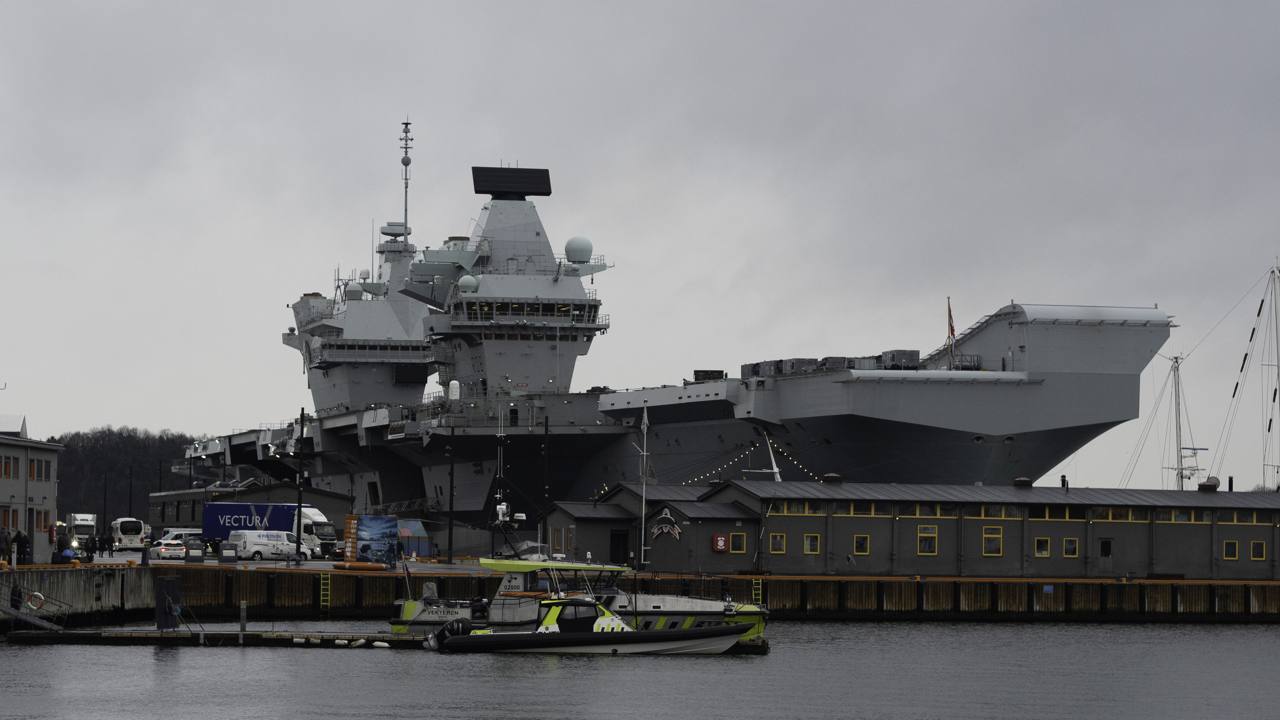
All ten nations of the Joint Expeditionary Force (JEF) have formally signed up to the new Northern Navies partnership, the Royal Navy said in a press statement reported on Tuesday, November 10, 2026. The agreement, signed by the United Kingdom, Denmark, Estonia, Finland, Iceland, Latvia, Lithuania, the Netherlands, Norway and Sweden, seeks to boost maritime security in the North Atlantic, the Baltic Sea and the High North.
Source: Royal Navy press statement via Navy Leaders
The signing took place in Oslo aboard HMS Prince of Wales, the Royal Navy's largest warship, which arrived in the Norwegian capital on Friday escorted by the destroyer HMS Dauntless, the Norwegian frigate KNM Fridtjof Nansen and the coast guard vessel KV Nornen. The 284-metre carrier is hosting the Atlantic Future Forum and the International Sea Power Conference this week, with about 500 political and military leaders aboard.
Source: US News Pulse
From periodic cooperation to an integrated force
The Royal Navy statement said the accord "underscores a shared commitment among JEF partners to move beyond periodic activity towards a more integrated maritime enterprise enabling forces to combine rapidly, operate seamlessly and respond decisively and immediately to emerging threats." Britain will lead work to align the nine partner navies' training, doctrine and systems so they can swap everything from ammunition to personnel as required. First Sea Lord General Sir Gwyn Jenkins, who dubbed the vision "NATO's vanguard", said: "This is about shifting from periodic cooperation to a truly integrated approach where our forces can combine at pace and fight immediately together when required to do so."
Tuesday's signing follows the plan unveiled on Monday, when Britain and its allies announced stepped-up operations against Russian submarines suspected of spying on undersea cables after a suspected plot was foiled. Read: UK to lead ten NATO allies against Russian submarines
Gen Sir Richard Knighton, who announced the plan on November 8, said the group would move from "memorandums of understanding, information exchange and consultations" to practical joint action, with deterring Russian submarines from attacking or threatening shipping in wartime at the centre of the mission. He noted the security of North Atlantic shipping lanes and cables concerns "not only Europe but also the US East Coast", since the same waters carry transatlantic data and trade.
Why the seabed is the front line
The cables and pipelines on the North Atlantic, Arctic and Baltic seabeds carry the overwhelming majority of intercontinental data traffic and a growing share of Europe's energy, and are largely unguarded and slow to repair if cut. JEF nations first answered that threat in December 2023, deploying seven ships to patrol vulnerable cable and pipeline areas after suspected sabotage in the Baltic Sea; in April 2026 the British military tracked three Russian submarines near critical undersea cables and pipelines in the North Atlantic. The Northern Navies partnership is meant to make that kind of joint response routine rather than one-off — shared patrols, shared surveillance and agreed roles when a threat appears beneath the waves.
The JEF is not part of NATO, though all ten members are NATO allies. Its smaller membership lets it act faster than the 32-nation alliance in a northern European crisis, and the Royal Navy says the new force will be able to transition into NATO command if required — a forward, high-readiness force for the early stages of an escalation.
What is solid
- All ten JEF nations signed the Northern Navies agreement, per the Royal Navy press statement
- The signing was in Oslo aboard HMS Prince of Wales on Tuesday, Nov 10, following the plan announced Nov 8-9
- First Sea Lord Jenkins called the vision "NATO's vanguard" and spoke of forces combining and fighting immediately together
What is only claimed
- How quickly the integrated force becomes fully operational — the statement sets the direction; patrol schedules and shared arrangements are still to be built
- Russia's response — no Russian reaction was reported in these dispatches, and Moscow has previously rejected Western claims about its undersea activity
What happens next: officials will now turn the agreement into joint patrol schedules, shared surveillance arrangements and common rules for responding to suspicious activity around undersea infrastructure, with the conferences continuing aboard HMS Prince of Wales this week giving the ten nations' military leaders their first face-to-face chance to discuss implementation.