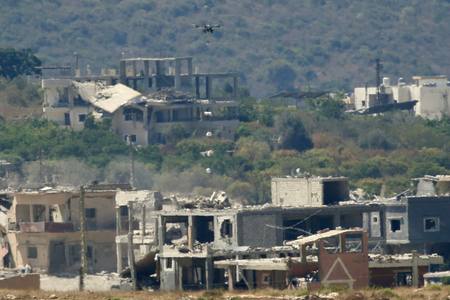
Lebanese President Joseph Aoun has proposed rebuilding three areas partially damaged by attacks, saying the cost would be relatively limited while the effect — encouraging displaced residents to return home and restoring confidence in the state — could be significant.
Source: IANS, Nov 14, 2026
"The financial cost of rehabilitating these areas remains relatively limited, while the impact of this step could be significant in encouraging residents to return and strengthening their confidence in the state," Aoun said on Saturday during a meeting with UN Deputy Secretary-General Amina Mohammed, according to a statement from the Lebanese Presidency.
Source: Xinhua via IANS, Nov 14, 2026
Aoun presented the proposed reconstruction as part of a comprehensive approach to the question of placing weapons exclusively under state authority. A lasting solution, he said, required strengthening public confidence in state institutions, ensuring security, providing public services and improving living conditions — rather than relying solely on military means.
Mohammed stressed that no security vacuum should be allowed in southern Lebanon, emphasising the need to support residents' return, reconstruction and the strengthening of state institutions.
Maps of the destruction, drawn up this week
On Thursday, Aoun met a delegation from Lebanon's National Council for Scientific Research, which presented detailed maps and data documenting the destruction to villages, roads and infrastructure in southern Lebanon — material meant to serve as a scientific reference for organising the reconstruction phase.
The scale of that task is visible on the ground. UNIFIL, the UN peacekeeping force in the south, reported this week that the number of displaced people who have returned home has risen 13 per cent since September, but that many villages have suffered extensive damage — electricity networks, water systems and roads destroyed — and in some places residents cannot return at all.
Source: UNIFIL / UN News, Nov 12, 2026
UNIFIL: renewal first, an alternative if not
On the future of UNIFIL, Aoun said Lebanon's priority remained renewing the mission's mandate and maintaining its presence in southern Lebanon. If the mission could not continue in its current form in 2027, he said, Beirut was open to establishing an alternative UN mechanism to prevent a security vacuum.
UNIFIL was first established in 1978 to confirm the Israeli withdrawal from Lebanon, and its mandate was expanded after the 2006 war between Hezbollah and Israel under Security Council Resolution 1701. In August 2025, the Security Council extended the mandate for the final time until December 31, 2026, with a drawdown and withdrawal to follow within one year — which is why the question of what replaces the force is now live in Beirut.
Aoun's three-area proposal is a pilot in all but name: rebuild a small number of partially damaged areas cheaply and visibly, and use returning families as proof the state can deliver. In parallel, Beirut must settle the post-UNIFIL question before the mandate expires on December 31, 2026 — renewal, or a new UN mechanism agreed in time to avoid a vacuum in the south.