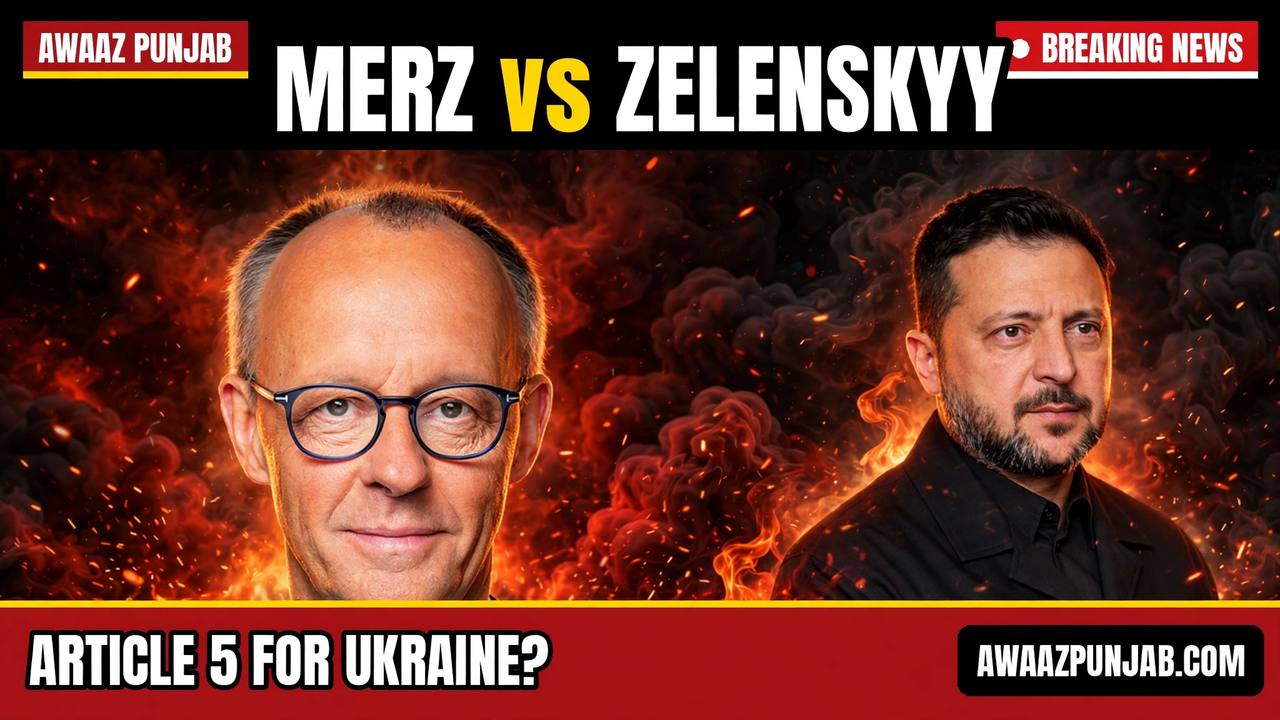
German Chancellor Friedrich Merz said on Thursday that the United States and the Coalition of the Willing — the group of Ukraine's allies — agree on the principle of security guarantees for Ukraine modelled on NATO's Article 5, while cautioning that it is too early to say what the guarantees would look like in practice.
Source: h.ua
Merz was speaking at a news conference in Brussels during the European Union leaders' summit. He said the US and the coalition agree on the principle of Article 5-like guarantees, but that their specific form remains to be defined. The guarantees would be needed after a ceasefire, during peace negotiations and especially after a peace agreement, he said.
Ukrainian President Volodymyr Zelenskyy struck a more cautious note, saying Ukraine has not yet officially been offered guarantees at that level. Kyiv has repeatedly said it wants the terms spelled out in writing — which countries would respond to a new attack, with what, and whether troops would be deployed in advance.
What Article 5 means
Under Article 5 of NATO's founding treaty, an attack on one ally is treated as an attack on all, and each ally decides what action it considers necessary, including whether to use military force. An 'Article 5-like' guarantee would copy that model without making Ukraine a member of NATO — a distinction that matters, because full membership remains off the table.
Russia rejects the idea
Moscow has already rejected the concept. Russian Deputy Foreign Minister Sergei Ryabkov said Russia rejects any form of Ukraine's 'quasi-membership' in NATO as part of security guarantees. That directly contrasts with US envoy Jared Kushner's claim that Moscow was willing to consider guarantees modelled on Article 5.
The debate follows the Coalition of the Willing summit in Berlin on November 19, where nearly 40 delegations met — hosted by Merz with French President Emmanuel Macron and British Prime Minister Andy Burnham, with Zelenskyy attending and US envoys Kushner and Steve Witkoff present. Kushner said afterwards that Washington had got Russia 'comfortable' with the Article 5 concept, and the leaders' joint statement said any guarantees must be robust, legally binding and take effect once a ceasefire holds.
Source: RFE/RL
What the package could include is still taking shape: long-term military, financial and technical aid to Ukraine, a US-led ceasefire monitoring mechanism, a European-led multinational force, and a commitment to act to restore peace if Russia attacks again. But a gap remains — US negotiators have privately ruled out sending troops or setting up military bases in post-war Ukraine, according to the Kyiv Independent, leaving Kyiv's core question unanswered: who would actually fight if Russia attacked again.
Earlier reporting on the US position — Washington has privately ruled out troops and bases in Ukraine under the guarantees. Read the earlier story
Merz has argued the case for strong guarantees for weeks. At a joint press conference with NATO Secretary General Mark Rutte on November 23, he called the 2008 Bucharest decision not to admit Ukraine a mistake, saying membership might have prevented the war. Zelenskyy, speaking at the NATO Parliamentary Assembly the same day, argued that full NATO membership would be more effective, cheaper and more reliable than Article 5-like protection.
Merz also welcomed Donald Trump's call for Vladimir Putin to stop the fighting, but did not directly answer whether US troops would need to be present in Ukraine for the guarantees to work. What happens next is still open: the form of the guarantees, the US role, the legal mechanism for responding to a ceasefire violation and the territorial questions all remain unresolved, while Washington pushes for a peace deal by early January and Kyiv insists the guarantees be written down before it signs anything.