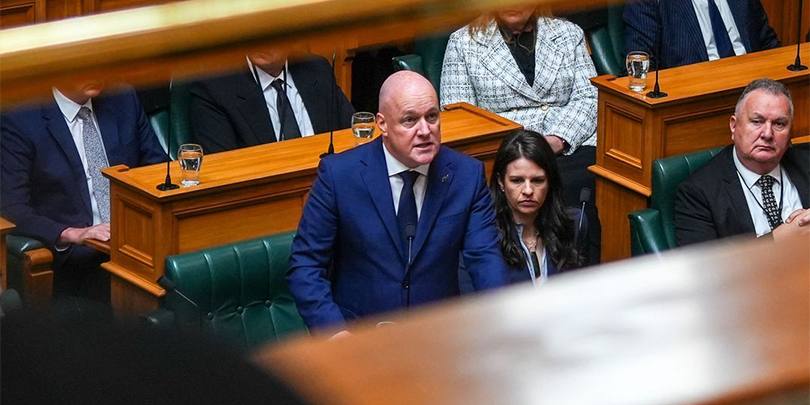
WELLINGTON — Neither side can govern alone in New Zealand. The Electoral Commission on Friday declared the official results of the November 7 general election, and the final count erased the right-wing bloc's wafer-thin election-night majority, leaving a centrist party new to Parliament holding the balance of power.
After nearly 400,000 special votes — including ballots cast by New Zealanders living abroad — were counted, Prime Minister Christopher Luxon's National Party fell from 42 seats on election night to 40, losing the electorates of Wairarapa and Hamilton East to Labour. The right-wing bloc of National, ACT and New Zealand First now holds 65 seats in the 130-seat Parliament — one short of the 66 needed for a majority.
The left-wing opposition, led by Labour's Chris Hipkins, won 58 seats — Labour 36, the Greens 17 and Te Pāti Māori five. Labour itself was unchanged from election night, but it won the popular vote: 863,238 party votes, or 29.88%, against National's 819,012 votes, or 28.35%. National still won more seats because more of its candidates won local electorate races — 40 to Labour's 22.
The kingmaker
That leaves the Opportunity Party as the decider. The centrist group, new to Parliament, won seven seats, and its leader, 38-year-old business consultant and political newcomer Qiulae Wong, is unaligned with either bloc and has said she could work with either side to form a government.
The final count also showed more support than before for parties on the ideological flanks. The Greens rose to 17 seats, ACT holds 13 and New Zealand First 12. A total of 2,931,604 votes were cast.
What happens next
Lengthy and fraught negotiations now lie ahead. On the numbers, only Luxon's bloc can reach a majority with Opportunity alone — 65 plus 7 is 72 — while the left bloc, even with Opportunity, would still sit one short at 65. That makes Wong's choice decisive for who governs New Zealand next.
The election on November 7 was the tightest in years. The conservative bloc finished election night with a wafer-thin majority; the special votes took it away. The Electoral Commission declared the results by Gazette notice on Friday, 20 days after polling day.
New Zealand has had coalition governments for decades, but rarely has a single seven-seat party held this much power. Whatever Wong decides will shape the country's government — and its direction on the economy, housing and relations with the Pacific.
Sources: New Zealand Electoral Commission; Associated Press.
Source: Elections NZ