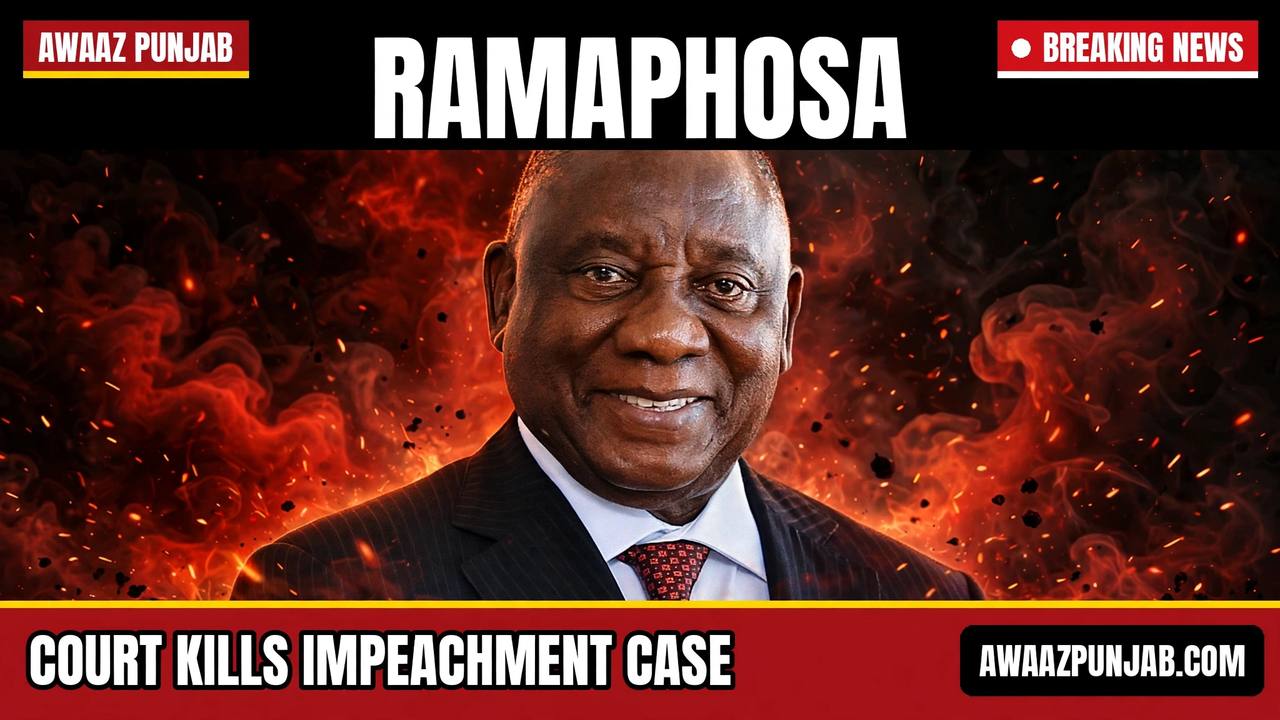
South African President Cyril Ramaphosa has won a major court battle that removes the foundation of the parliamentary impeachment process hanging over him, after the Western Cape High Court on Wednesday declared unlawful the independent panel report at the centre of the Phala Phala scandal.
Source: Reuters
A full bench of the court in Cape Town — Judge President Nolwazi Mabindla-Boqwana sitting with Judges Mark Sher and Ncumisa Mayosi — unanimously set aside the 2022 report of the Section 89 independent panel in its entirety, and also set aside every step the National Assembly had taken on the strength of it.
"The court found that the [parliamentary] panel fundamentally misconstrued its functions," Judge Mabindla-Boqwana said, reading the unanimous decision. The court found the panel had gone beyond its lawful remit, asked the wrong questions and made several material errors of law, so that its process and conclusions were not rationally related to the job it had been given.
What the panel had found
The panel, chaired by former Chief Justice Sandile Ngcobo, reported in November 2022 that there was prima facie evidence Ramaphosa had a case to answer — that he may have committed a serious violation of the law, breached his oath of office and faced a conflict of interest over the origin of large amounts of cash found at his farm.
The case dates back to a burglary at Ramaphosa's Phala Phala game farm in Limpopo province in February 2020, when thieves stole about $580,000 in US dollars that had been hidden inside a sofa — yaani lagbhag ₹5.4 crore. The panel said the president may have broken the law by failing to report a theft of R100,000 or more to the police, as the law requires of a person in a position of authority.
Source: Sowetan
How the case reached the court
Parliament rejected the panel's findings in December 2022, but the Constitutional Court ruled on 8 May 2026 that lawmakers had erred and ordered them to establish a committee to investigate the president's conduct. Ramaphosa then asked the High Court to review the panel's report, and in July he secured an interdict stopping the committee from holding public hearings. In August the High Court ordered the committee to pause its hearings until the review was decided.
Reuters noted the ruling hands Ramaphosa a political reprieve at a vulnerable moment for him and his African National Congress, which has just recorded its worst-ever local election result, falling to 30.76% of the vote with 139 of 213 councils left hung.
What happens next
The ruling can still be appealed. Vuyolwethu Zungula, leader of the African Transformation Movement, who tabled the original impeachment motion, said after the judgment that there was "one law for the president, and another for the citizens" and signalled that an appeal was being considered.
The court indicated that its full written reasons would follow. It also made clear that the decision does not mean Ramaphosa can never face impeachment proceedings — the National Assembly could still decide to proceed with a full-scale impeachment inquiry regardless of the panel report's status.
What is solid
- The Western Cape High Court unanimously set aside the 2022 Section 89 panel report in its entirety on Wednesday, 25 November 2026.
- The panel had found prima facie evidence that Ramaphosa may have committed a serious violation of law over the February 2020 Phala Phala burglary.
- About $580,000 in US dollars was stolen from a sofa at the president's Limpopo game farm.
What is only claimed
- Whether Ramaphosa committed any offence — no court has found him guilty of a crime, and the panel's findings were prima facie only and are now void.
- Whether parliament will try to revive impeachment proceedings through a fresh process — that remains an open political question.