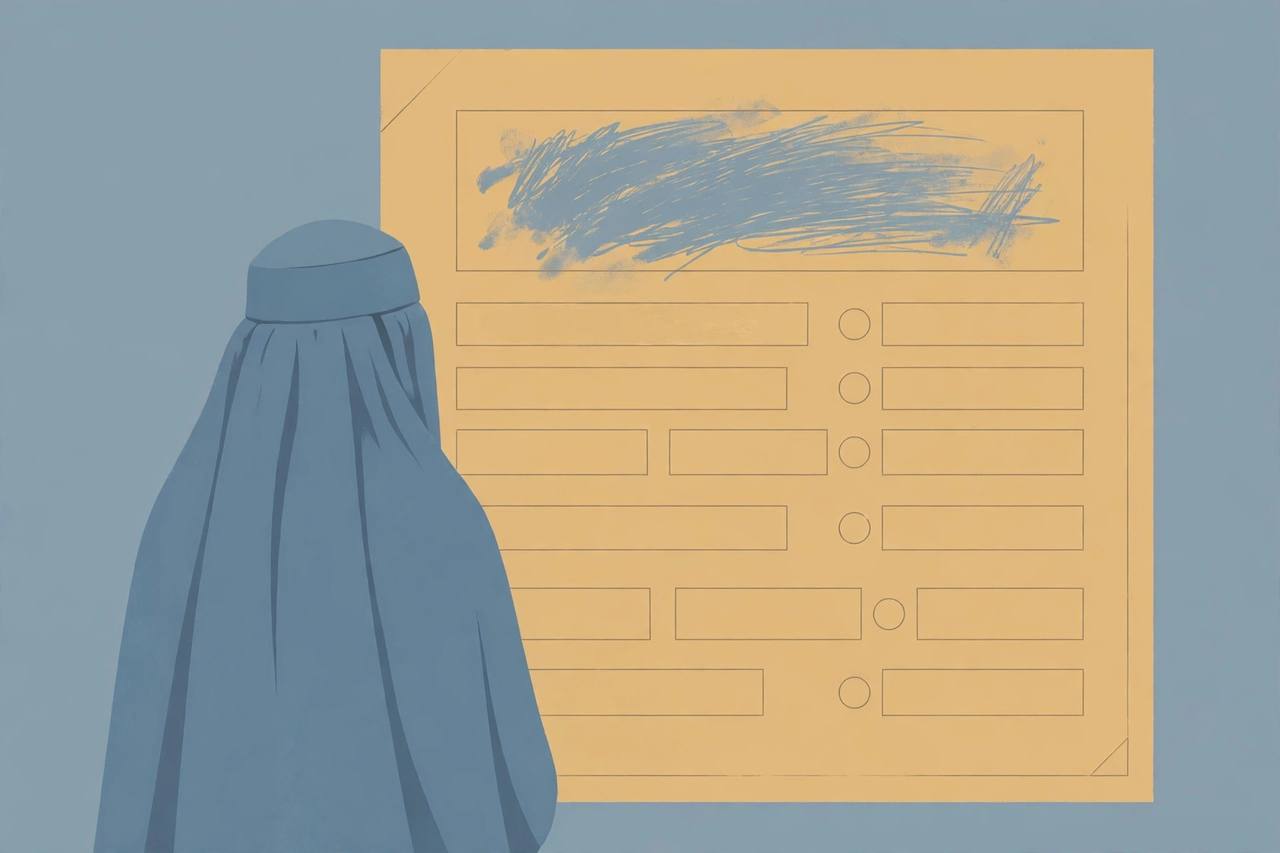
Taliban authorities in Afghanistan's northern Balkh province have ordered officials and health workers to stop using women's first names in official documents, medical records and prescriptions, replacing them with the generic term “Bibi” — and, according to testimony gathered by reporters, sometimes with animal slurs such as “goat” and “cow”.
Source: TBS News
The directive was reportedly issued in May 2026 by officials of the Taliban's Ministry for the Propagation of Virtue and Prevention of Vice. It was first reported on 12 November in a joint investigation by the Afghan outlet Zan Times and The Guardian, and reporting by Spain's El País has now brought it to wider attention as the world marks the 16 Days of Activism Against Gender-Based Violence, which runs from 25 November to 10 December.
What the order says
The instruction applies to hospitals, private clinics and other public offices in Balkh. Women are to be identified by the generic term “Bibi”, traditionally a respectful word for an older woman, meaning granny. But testimonies collected from women, doctors and activists indicate that some women have also been registered or addressed with degrading animal-related labels, including “goat” and “cow”.
Lalah Osmany, a Germany-based Afghan women's rights activist who leads the #WhereIsMyName campaign, described the practice as a systematic attempt to strip women of their identities. “A name was a face, a voice, a story,” she said. “The first step to dehumanising a person is to take away their name.”
“This is a systematic process of dehumanisation. When a regime replaces a woman's name and gives her one of an animal, it is stripping her of her human soul and reducing her to a mere biological creature or the property [of a man],” Osmany told El País.
Zubaida Akbar, director of the Afghanistan programme at the women's rights organisation Femena, warned that local bans could serve as testing grounds for nationwide decrees. “The Taliban are very creative when it comes to imposing bans on women,” she said, pointing to more than 144 decrees restricting women's rights since the Taliban returned to power.
A risk to health, not just dignity
Activists say the removal of women's names from official and medical records carries serious practical consequences. In hospitals, using a generic label such as “Bibi” for dozens of patients, or assigning arbitrary identification numbers, could increase the risk of medical errors in diagnoses, prescriptions and treatment.
The risks are compounded by the wider restrictions on women's healthcare. The Guardian has reported that male doctors and dentists in several Afghan provinces have been told not to examine or treat female patients, including in emergencies, unless certain conditions are met. Women have been barred from studying at medical institutes since December 2024, and practising female doctors are required to have a mahram, a male guardian, with them.
The consequences can also follow women across borders. Exiled journalist Khadija Amín was excluded from her children's birth certificates under traditional marriage customs. When her former husband took their three children to Germany in 2024, German police were initially unable to process her custody complaint because she lacked official documents establishing her legal identity as their mother. The resulting two-year legal delay allowed her former husband to flee back to Afghanistan with the children.
An old taboo, now a rule
Avoiding women's first names in public is rooted in tribal traditions that regard pronouncing a woman's name publicly as an affront to male honour. The custom extends beyond official records to wedding invitations and tombstones, where women are often identified only as the wife or daughter of a male relative. Activists stress that the practice is a cultural tradition rather than an Islamic requirement — Surah 19 of the Quran is titled “Maryam”, and Mary's name appears more than 30 times in the chapter.
Before the Taliban's return to power in 2021, taboos around women's names remained, but there was no legal prohibition on their use. Women's names appeared on passports, and women could work publicly and campaign for expanded rights. Osmany's #WhereIsMyName campaign, launched in 2017, secured a legal breakthrough in September 2020, when the government approved the voluntary inclusion of mothers' names on children's birth certificates.
In one instance cited by activists, an Afghan man told Osmany that he had never known his mother's first name because nobody in his household had ever used it. He discovered it only after her death.
What happens next
For now, the restriction has been reported only in Balkh, and there is no confirmation that the order has been extended nationwide. Activists in Kabul say enforcement varies between localities, but they fear it could become a template: several of the Taliban's harshest nationwide decrees began as local orders before being adopted across the country.
The naming order sits within a far wider crackdown. Since returning to power in August 2021, the Taliban have imposed sweeping restrictions on women's education, employment, movement and participation in public life. In July 2025, the International Criminal Court issued arrest warrants for Taliban Supreme Leader Hibatullah Akhundzada and Chief Justice Abdul Hakim Haqqani on charges of crimes against humanity through gender-based persecution. In August 2026, Human Rights Watch described Afghanistan as one of the world's gravest human rights crises.
“Calling a woman by her real name in Afghanistan is an act of resistance.” — Lalah Osmany, #WhereIsMyName campaign
What is solid
- A directive reported in Balkh bars women's first names in official documents, medical records and prescriptions, replacing them with “Bibi”.
- The directive was reportedly issued in May 2026 and first reported on 12 November by Zan Times and The Guardian.
- More than 144 Taliban decrees restricting women's rights have been recorded since 2021.
What is only claimed
- Whether some women are systematically labelled “goat” or “cow”, or whether those are individual cases — the claim rests on testimony gathered by reporters, not on the directive's text.
- Whether the order will be extended beyond Balkh — activists warn it could be; there is no confirmation it has been.
- The Taliban authorities have not publicly confirmed the directive in the reporting so far.