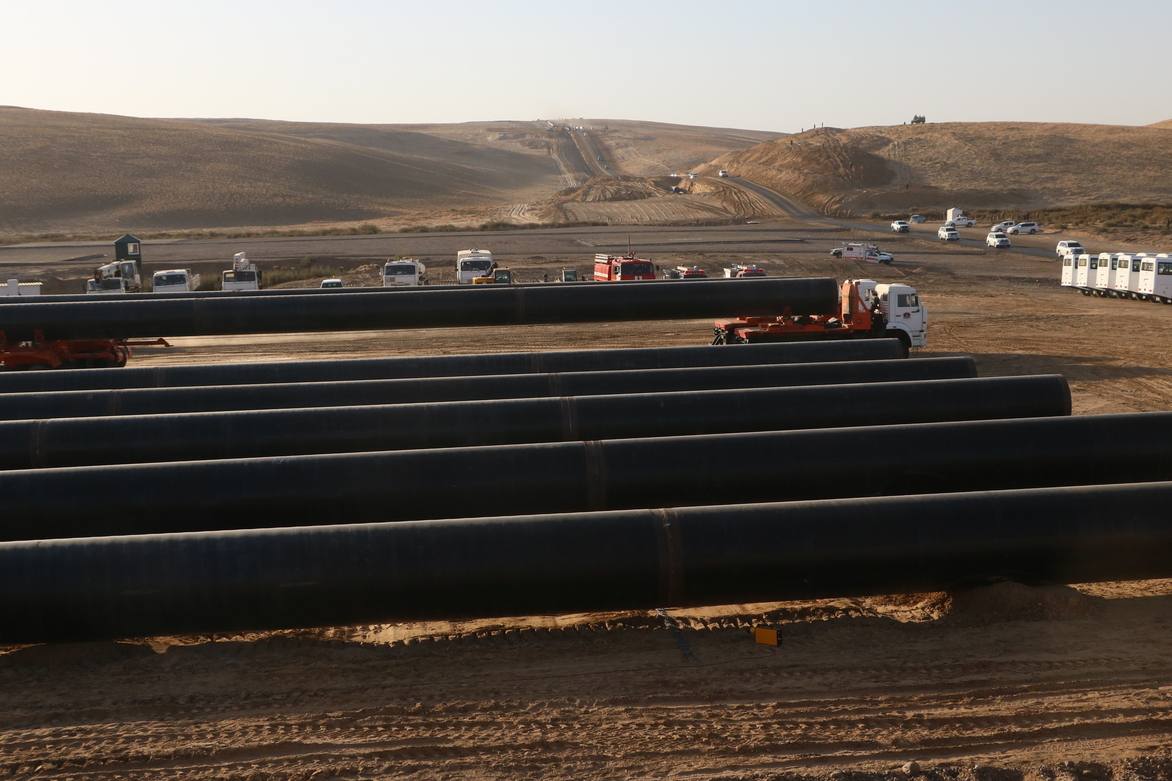
Turkmenistan expects to complete a $600-million section of the Turkmenistan–Afghanistan–Pakistan–India (TAPI) gas pipeline to Herat, Afghanistan, by the end of 2026, with gas supplies expected to begin in early 2027, Turkmen officials told Reuters on November 26. About 124 kilometres of the 153-kilometre Serhetabat–Herat section have already been welded and laid — yaani lagbhag 60 crore dollar da hissa.
Source: Reuters
The section in figures
The section runs from Serhetabat, on Turkmenistan's border with Afghanistan, to Herat, and has been under construction since September 2024. Turkmenistan is financing the section on its own. The remaining work includes completing pipe-laying and backfilling, building access crossings, and establishing a gas metering station.
The wider TAPI project is a proposed 1,800-kilometre pipeline designed to carry gas from Turkmenistan's giant Galkynysh field through Herat, Kandahar, Quetta and Multan to Fazilka in India. The full line is designed to carry 33 billion cubic metres of gas a year, and the whole project is estimated to cost about $10 billion — yaani 1,000 crore dollar. Afghanistan expects to buy 500 million cubic metres of gas a year at first, a small fraction of the full capacity. Plans for Herat also include a pipeline to an industrial park, distribution stations, gasification of the industrial zone, and a compressed natural gas complex.
Why it matters now
TAPI was first envisioned in the 1990s, but for three decades it has existed almost entirely on paper, held back by war in Afghanistan and tensions between the countries involved. India appeared to have turned its back on the project by 2024, and Pakistan's interest had also waned. The war in Iran has restored interest in the gas supply line, and Turkmenistan now hopes first gas sales in 2027 will unlock the financing needed to extend the line to Pakistan and India.
In Herat, where spikes in gas prices and electricity shortages have hit residents and disrupted factories in recent months, locals have welcomed the pipeline's approach. Herat is Afghanistan's third-largest city, and Turkmen gas could supply about 500 industrial enterprises there, according to News Central Asia.
Satellite images published by RFE/RL on November 7 showed the pipeline reaching an area about 22 kilometres from Herat's western industrial area. At an energy forum in Ashgabat in late October, Turkmen officials announced the pipeline had reached the outskirts of Herat and would be commissioned by the end of 2026. An earlier deadline, put forward over the summer by the governor of Herat, had not materialised as of November 26.
The uncertain road ahead
The second section, meant to reach the Pakistani border, has neither a firm start date nor agreed financing. International lenders have stayed away while Afghanistan's Taliban government remains unrecognised abroad, apart from in Moscow. The contractual framework with Afghan Gas, Afghanistan's state gas company, also remains unclear. Afghanistan has floated the idea of Russia investing in the pipeline's onward route. If the line is ever extended into Pakistan and India, Kabul would receive hundreds of millions of dollars a year in transit fees — yaani kai sau million dollar salana.
What happens next
The test now is whether Turkmenistan meets its end-of-year deadline and gas starts flowing to Herat in early 2027. Turkmen officials say continuing the line towards Kandahar will remain a priority in 2027. If gas does flow, Herat becomes the project's first real market, giving Ashgabat early revenue without waiting for the extension — and a stronger case to put to lenders for the rest of the 1,800-kilometre route.
What is solid
- About 124 of the 153 kilometres of the Serhetabat–Herat section have been welded and laid, according to Turkmen officials
- Turkmenistan targets completion by the end of 2026, with first gas to Herat in early 2027
- The Herat section costs about $600 million, according to Afghan media, paid for by Turkmenistan
- The full TAPI line is designed to carry 33 billion cubic metres of gas a year
What is only claimed
- Whether financing for the extension to Pakistan and India can be secured, with international lenders staying away while the Taliban government is unrecognised
- Whether the end-of-2026 deadline will hold, after an earlier deadline put forward by the Herat governor did not materialise