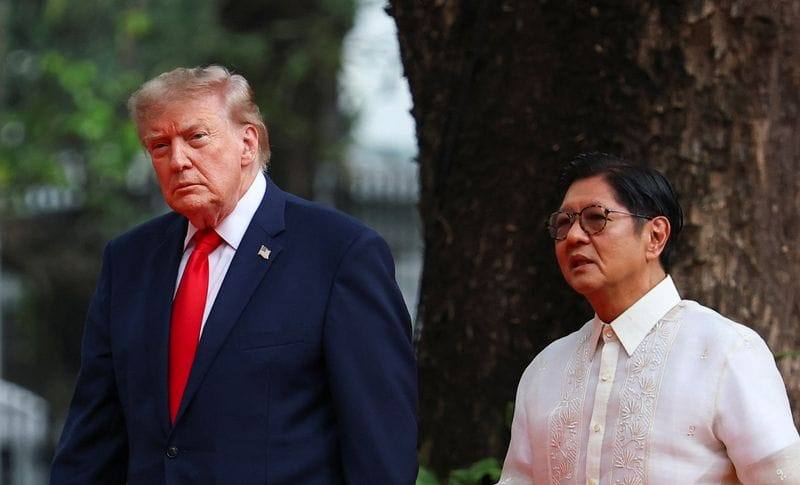
US President Donald Trump told Philippine President Ferdinand Marcos Jr. on Wednesday that Washington is expanding its defence cooperation with Manila and that the two countries will probably do "something big" on nuclear power, during bilateral talks at Malacañang Palace in Manila before Trump flies to China for the APEC summit in Shenzhen.
Source: Reuters
Trump said Washington had approved more than $5 billion in arms sales to the Philippines — yaani, more than 500 crore dollars — and had backed major increases in foreign military financing for the country, describing the alliance between the two countries as stronger than ever, according to Reuters and BusinessWorld. He gave no new figure for the financing increase.
The arms figure Trump cited matches the largest single US weapons package for the Philippines: a $5.58 billion sale of 20 F-16 fighter jets — 16 F-16C and four F-16D Block 70/72 aircraft built by Lockheed Martin — that the US State Department approved in April 2025, according to the US Defense Security Cooperation Agency.
Source: The Apex Wire / US Defense Security Cooperation Agency
On civilian nuclear energy, Trump said cooperation on a first modern Philippine nuclear project using American technology could further strengthen ties. "For the Philippines to embrace American technology in its first modern nuclear project would underscore the strength of the important relationship, and we're probably going to do something very big to do with nuclear," he said, according to BusinessWorld. No project, site or timetable was announced.
Source: BusinessWorld
Trump also identified the Philippines as a potential partner for US energy exports through a proposed Alaska natural gas pipeline project, and the two sides discussed broader energy cooperation. In separate remarks carried by APT, he highlighted the Luzon Economic Corridor — a US-Philippines-Japan initiative that aims to attract $100 billion in investment, yaani about 10,000 crore dollars.
Marcos, for his part, pressed for deeper technology cooperation with the United States, naming superintelligence among the areas where the two countries could work together, AnewZ reported from the meeting. He marked the 75th anniversary of the 1951 Mutual Defense Treaty and described Washington as Manila's only treaty ally.
On trade, Marcos said no trade agreement would be signed during Trump's visit, AnewZ reported. The Philippines went into the meeting seeking a cut to the 12.5 percent US tariff on its goods, and no decision on the tariff had been reported by the time the two leaders spoke.
The South China Sea backdrop
Reuters reported ahead of the talks that the meeting gave Marcos an opportunity to press for stronger US security commitments as China steps up its activities in the disputed South China Sea. Marcos said on Tuesday that a long-negotiated South China Sea code of conduct between ASEAN and China is now 85 to 90 percent complete.
What happens next
After the bilateral talks and a working lunch, Trump departs Manila for Shenzhen, in southern China, for the APEC summit. On Thursday, November 19, he is scheduled to meet Chinese President Xi Jinping and to take part in a trilateral meeting with Xi and Russian President Vladimir Putin, bringing together the leaders of three major nuclear powers. Trump has said the three-way talks will focus on nuclear stockpiles and denuclearization, with the wars in Iran and Ukraine also expected to be in focus.