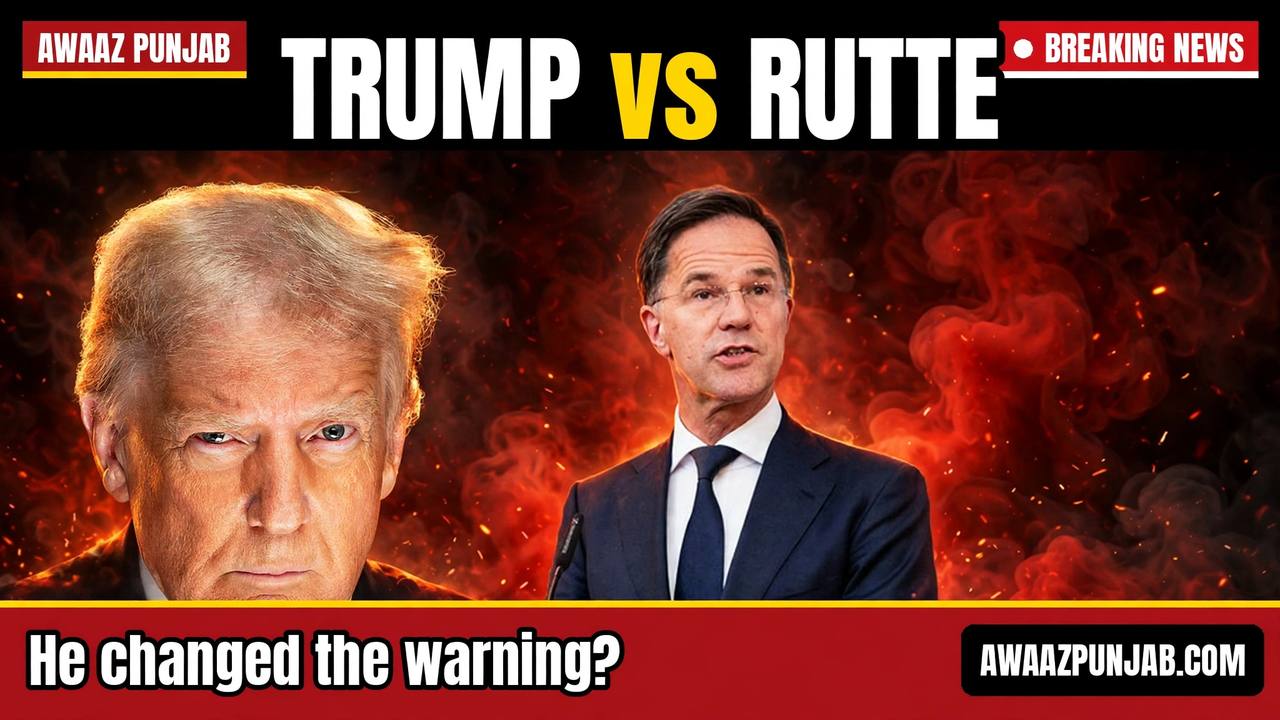
US President Donald Trump has unilaterally revised a joint statement with NATO Secretary General Mark Rutte, adding Ukraine to a warning against expanding the war that was originally directed solely at Russia, Politico reported on November 26.
Trump and Rutte met at Mar-a-Lago in Florida on November 25 and issued a joint statement urging Russia to avoid actions that could widen the war in Ukraine. Awaaz Punjab reported that story on November 26. Read the earlier story
In the joint statement published by NATO and the White House, the two leaders stressed 'the importance of Russia avoiding any actions that intentionally, or unintentionally, expand the war, and the importance of obtaining a peaceful resolution to the war as rapidly as possible.' The statement described their meeting as 'outstanding' and 'very impactful', and said the wars in Ukraine and Iran were its main subjects.
Hours later, Trump published his own version of the statement on Truth Social, changing the sentence to refer to 'the importance of Russia and Ukraine avoiding any actions that intentionally, or unintentionally, expand the War.' The revision extends the warning to the country defending itself against Russia's full-scale invasion.
A NATO official, speaking on condition of anonymity, told Politico that both sides had agreed to the original statement, indicating that Trump had subsequently changed the wording without NATO's agreement. The White House did not respond to Politico's request for comment.
Why it matters
The change alters the meaning of the US–NATO position. The agreed text placed the burden of not widening the war on Russia alone; Trump's version spreads it equally to Ukraine, which has in recent days struck Russian targets beyond the front line — including, Kyiv says, a Russian warship in Libya and a Russian military-linked cargo ship in the Gulf of Finland.
Kremlin spokesman Dmitry Peskov responded to the joint warning by accusing Ukraine of trying to expand the geographical scope of the conflict, Reuters reported. German Foreign Minister Johann Wadephul warned Ukraine against geographically expanding the conflict while affirming Kyiv's right to self-defence and Germany's support, after Ukrainian maritime strikes on Russian vessels near Libya and in the Baltic Sea prompted European concerns about escalation.
The Mar-a-Lago meeting came less than a week after Trump held unprecedented trilateral talks with Russian President Vladimir Putin and Chinese President Xi Jinping in Shenzhen on November 19, which failed to deliver a ceasefire in Ukraine. Trump has described Putin as 'my friend'; Rutte said after the Shenzhen meeting that Trump was 'testing Putin'.
In a separate social media post on November 26, Trump said he had urged Putin to end military aggression across Europe during their Shenzhen meeting, and expressed optimism about the possibility of a peace agreement between Ukraine and Russia. European nations have meanwhile expressed a desire to join preliminary talks that have so far included only Ukraine, the United States and Russia. Trump and Rutte also discussed increasing defence spending across NATO.
The edited wording leaves open whether Washington now treats Ukrainian strikes beyond the front line as escalation — a question European allies are watching closely as Kyiv warns Russia is preparing a new large-scale attack on its energy infrastructure. Zelenskyy said on November 26 that Russia was nearing the end of preparations for that attack, and NATO allies expect a Pentagon review of the US force presence in Europe in the coming weeks.
What is solid
- Trump and Rutte met at Mar-a-Lago on November 25 and issued a joint statement warning Russia against widening the war.
- Trump later posted a version on Truth Social that added Ukraine to the warning.
- A NATO official told Politico the original text had been agreed by both sides.
What is only claimed
- Whether Trump's edit was a deliberate policy signal or a unilateral rewording: the White House has not commented.
- The Kremlin's claim that Ukraine, rather than Russia, is the side trying to expand the war's geography.