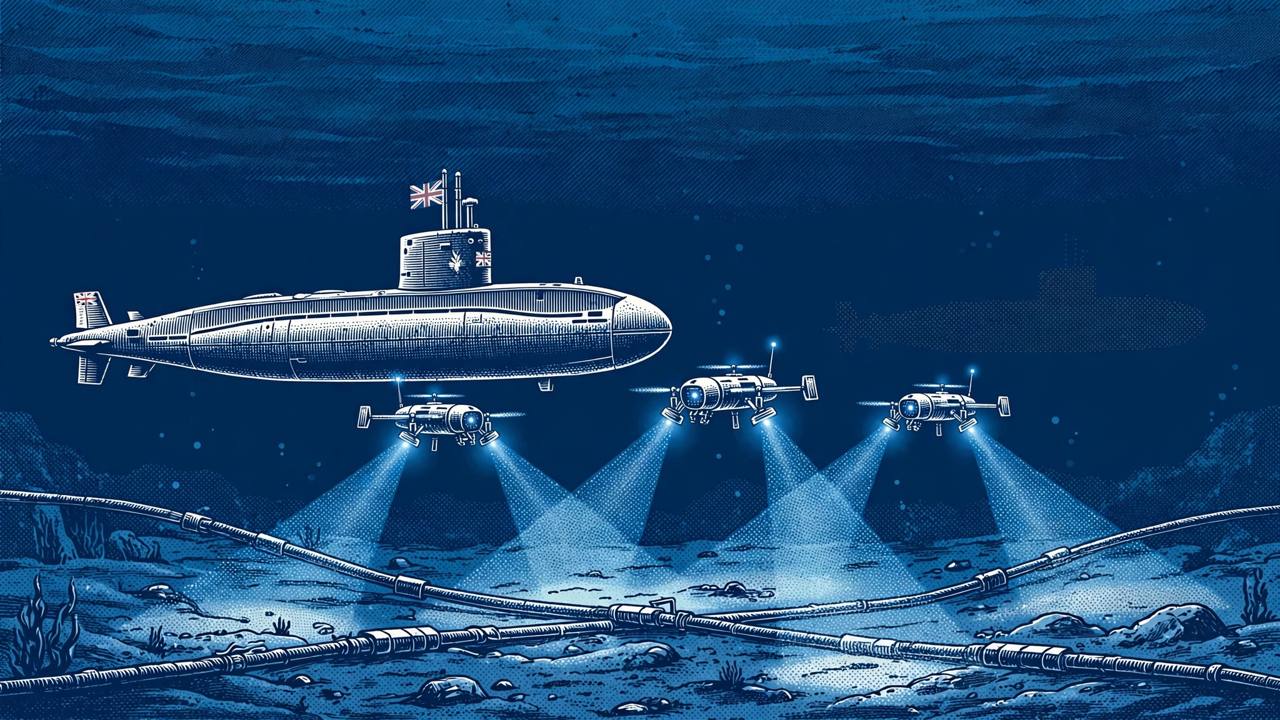
Britain said on Tuesday, November 10, 2026, that it will spend £90 million on drones, sensors and artificial intelligence systems to help the Royal Navy counter Russian undersea threats in the North Atlantic and protect critical undersea infrastructure.
Source: Reuters via DevDiscourse
The investment is the first phase of the Royal Navy's Atlantic Bastion programme and will be delivered under a new framework with Hampshire-based company Ocean Infinity Solutions, the Ministry of Defence said. The system, known as Atlantic Net, will network autonomous systems across the North Atlantic, combining advanced sensors that can detect Russian submarines and other activity with uncrewed systems able to patrol the depths, according to the government announcement.
Source: UK Ministry of Defence (GOV.UK)
The framework was announced at the International Sea Power Conference in Oslo, Norway, and is due to be signed on Tuesday. Atlantic Net is designed to create a single surveillance service giving submarine-hunting warships and Astute-class submarines earlier warning of threats and a clearer picture of activity beneath the surface, working alongside the Navy's crewed fleet to protect the nuclear deterrent, crucial shipping routes, communications cables and energy networks.
"The threats beneath the North Atlantic are changing, and we are changing with them. This investment gives the Royal Navy new technology to find threats earlier and protect our critical infrastructure, while also backing British business," Minister for Defence Readiness and Industry Luke Pollard said. "It shows that we're getting on with the job of investing in our Armed Forces and strengthening our deterrence under the sea, to support our ultimate, nuclear deterrent."
Why London says the undersea threat is growing
British officials say Russian incursions into UK waters have increased by almost a third over the past two years, which the Ministry of Defence attributes to Moscow's hybrid warfare campaign and heavy investment in submarine capabilities through its Directorate of Deep-Sea Research, Reuters reported. Atlantic Bastion is the Navy's plan, drawn from the Strategic Defence Review, to build a hybrid force of crewed and uncrewed vessels that can hunt and track enemy submarines and protect the underwater infrastructure that connects and powers the UK and its allies, working alongside NATO and Joint Expeditionary Force (JEF) partners.
The announcement follows the JEF pact under which the UK is to lead ten allied nations against Russian submarine activity around undersea cables. Read: UK to lead ten allies against Russian submarines
Defence reporting on the announcement said Atlantic Net will be a contractor-owned, contractor-operated service bringing together sonar and other sensors, uncrewed vessels and AI-assisted analysis, with the Greenland-Iceland-UK gap an early focus, and that the Navy has also contracted Saab to integrate lightweight Giraffe 1X drone-detection radar into its uncrewed vessels. The aim is to have the network operational from 2027.
Source: Navy Lookout
Undersea cables carry the overwhelming bulk of intercontinental data traffic and are paired with energy interconnectors and pipelines on the seabed. Western navies say such infrastructure is hard to monitor across vast ocean areas, which is why the UK is turning to persistent autonomous surveillance instead of relying only on crewed ships and submarines.
What happens next: the Ocean Infinity framework is expected to be signed on Tuesday, paving the way for the £90 million investment and supporting almost 200 new skilled jobs in and around the company's supply chain, on top of the 38,700 jobs in South East England the MoD says its spending already supports with industry. Russia has not publicly responded to the Atlantic Net announcement; Moscow has previously dismissed Western accusations over undersea activity.