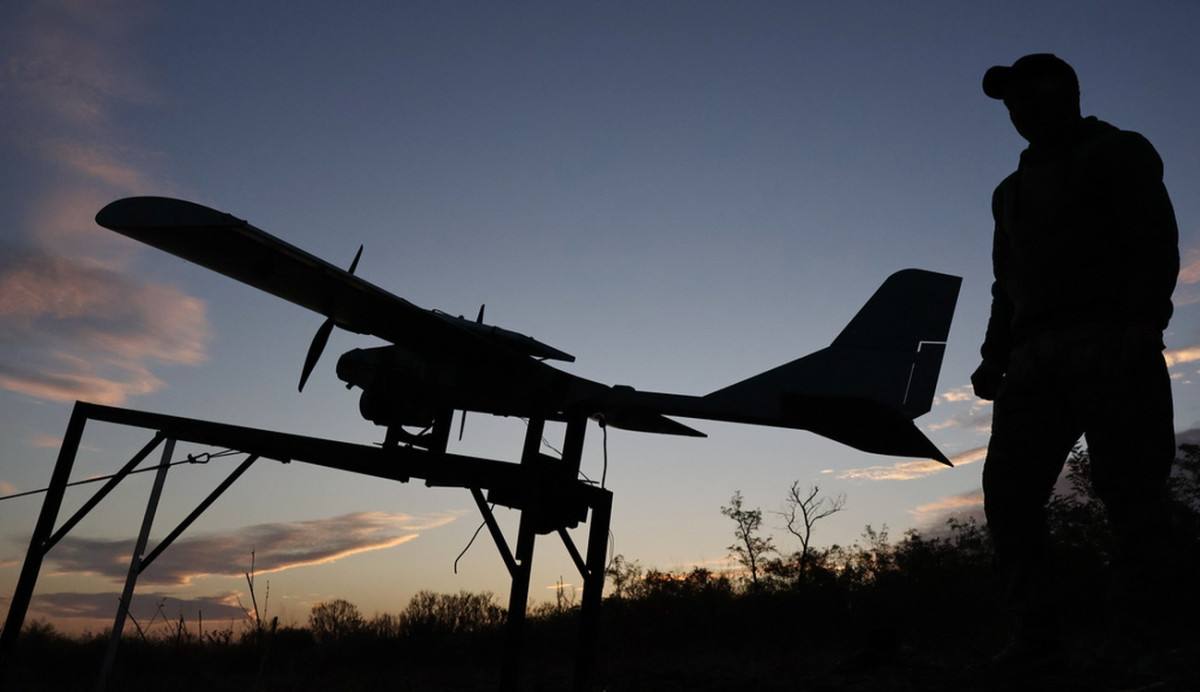
KHARKIV REGION, Ukraine, Nov 18 — Ground robots mounted with machine guns attack Russian positions; later, small groups of elite troops edge forward under the cover of drones, while electronic jamming in the skies above scrambles enemy signals. Those scenes played out over the spring and summer on the battlefields of eastern Ukraine, where Kyiv's Operation Vivaldi combined soldiers and machines in potent new ways to push back Russian forces, Reuters reported on Wednesday after visiting the Third Army Corps' base of operations in the northeastern Kharkiv region and interviewing six participants, including ground troops and senior commanders.
Source: Reuters
The counteroffensive ended last month in a rare battlefield success for Ukraine. While it did not regain much territory, it thwarted part of Russia's pincer advance on the 'fortress belt' of eastern cities that could be critical to the war's outcome, and it showed how precise orchestration of highly trained troops and a wide assortment of air and ground technologies can penetrate the 'kill zone' — the drone-infested corridor straddling the front line that has made any advance extremely costly.
Robots in the kill zone
During Vivaldi, Ukraine deployed remotely controlled ground vehicles equipped with high-calibre machine guns, grenade launchers or explosives to strike Russian positions, while others cleared minefields, according to the Third Army Corps, which carried out the operation. In at least one instance, combat robots were dropped behind enemy lines by repurposed quadcopter bomber drones in what the Ukrainian military said was a first for the war. As assault troops inched forward, aerial drones swept down to hit dugouts deemed too risky for humans to enter first, and a 'protective dome' of electronic warfare stretched over the battlefield knocked out enemy drones, the corps said.
Commanders said Vivaldi showed that increasingly smart integration of drones and robots could mitigate Kyiv's troop deficit against a much bigger Russian army. It did, however, take one of Ukraine's premier forces to pull off the complex operation, which used Starshield — the military version of Elon Musk's Starlink satellite service, owned by SpaceX — to direct many strike drones and other unmanned systems.
“In conventional warfare, a company or battalion's battlefield assets might comprise a few dozen armoured vehicles and a handful of command and observation posts,” Brigadier General Andrii Biletskyi said. “Now, a thousand assets can be in the sky and on the ground in the same area at the same time.” Third Corps commander Dmytro Rohoziuk said troops are now developing a concept in which “the infantryman has to be in combat formation together with robotic systems.”
Four seasons, 277 square kilometres
The operation's name refers to its four phases, in a nod to composer Antonio Vivaldi's 'Four Seasons' concertos. The Third Army Corps first announced Vivaldi on September 15, reporting the liberation of Serednie in the northern Donetsk region; later phases added settlements including Shandryholove, Derylove, Drobysheve, Nove, Ridkodub and Katerynivka, according to the corps' statements reported by The Gaze. The fourth phase, announced as complete on October 14, added another 101 square kilometres and the villages of Zelena Dolyna, Lypove and Kolodiazi, bringing the total reclaimed to 277 square kilometres (107 square miles) and full control over 16 settlements, the corps said.
Source: The Gaze / Third Army Corps statement
Biletskyi said the two most important results were preventing Russian troops from advancing around the flanks of the Sloviansk–Kramatorsk urban area — a manoeuvre that could have threatened Ukrainian positions with encirclement — and keeping the Kharkiv–Sloviansk highway, a vital supply route for Ukrainian forces in Donbas, out of Russian control. “The enemy was unable to cut off the key logistical artery of our forces in Donbas,” he said, adding that the operation disrupted the offensive of Russia's 'West' grouping and forced it to redeploy some units of the 1st Tank Army, weakening pressure on Kupiansk-Vuzlovyi. Reuters noted that the 277 square kilometres freed are a small fraction of the 177,000 square kilometres of Ukraine occupied by Russia, and that it could not independently verify Ukrainian battlefield accounts, although Vivaldi's territorial gains have been recorded by open-source analysts mapping the front line.
What Russia says — and what analysts say
Russian officials have not commented publicly on the counteroffensive, though they have said their troops continue to advance along the 1,200 km (750-mile) front in Ukraine, and Russia's defence ministry did not respond to Reuters' questions about Operation Vivaldi. Moscow's forces also wield a variety of air and ground drones and electronic warfare to powerful effect. Christopher Tuck, an expert in strategic studies at King's College London, called Vivaldi a limited victory: “They were able to inflict an operationally significant defeat on the Russians in terms of defeating one of their key attempts to outflank the fortress belt. But it's still an offensive operation that was local in its impact.” Military analyst Rob Lee of the US-based Foreign Policy Research Institute said the months of fighting proved that punching through the kill zone remains a serious challenge for Ukraine's undermanned military.
On casualties, Biletskyi said Ukraine lost around seven times fewer troops than Russia during the counteroffensive and that Kyiv's wounded outnumbered its dead; in the corps' October statement he put Russian losses at approximately 3,000 troops in the final phase and around 8,000 over the whole operation. Reuters said it was not able to independently verify those comparisons, and battlefield casualties are rarely disclosed. Ukrainian commanders also acknowledged the operation could be difficult to replicate, and noted the counteroffensive had largely concluded before Ukraine said last month that limits had been abruptly imposed on its use of Starshield — restrictions that raised concerns in Kyiv about relying on a service for which there is no viable alternative. The Third Army Corps, for its part, says its combat operations are continuing: “Four seasons of Vivaldi have been completed. But the music plays on.”