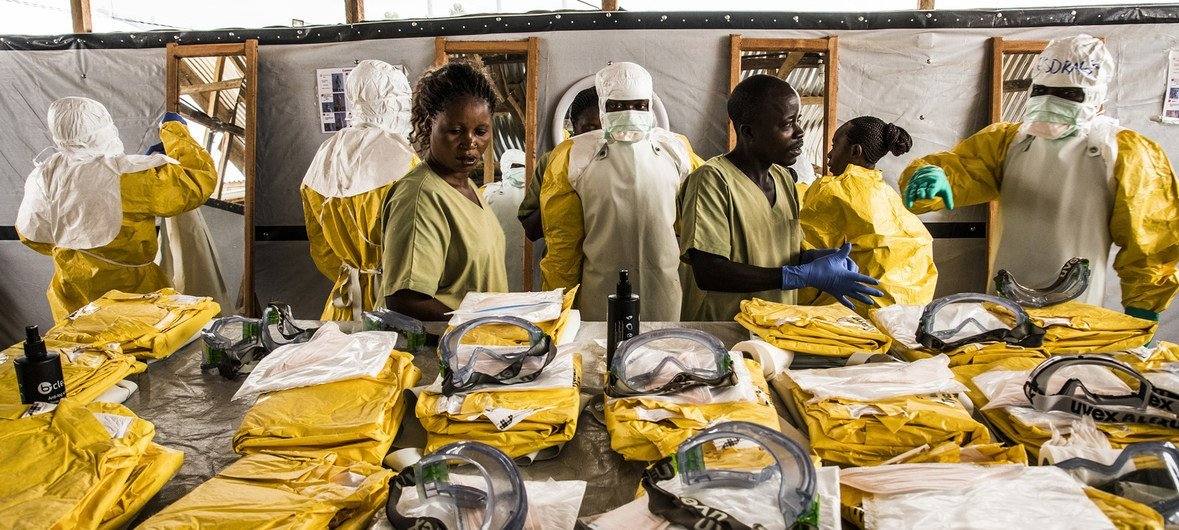
World Health Organization staff, officials from the Health Ministry of the Democratic Republic of the Congo and other colleagues have been safely evacuated from a hospital in Akwe, Ituri province, after sheltering there for more than three days amid fierce fighting, WHO Director-General Tedros Adhanom Ghebreyesus announced on Tuesday.
On Sunday, Tedros had said the team was sheltering for their lives in a maternity ward of the hospital as heavy fighting raged nearby, and the WHO was working with humanitarian partners to secure their safe passage. Read the earlier story
The evacuated staff were brought to safety thanks to combined efforts across health, government and humanitarian partners under very challenging circumstances, Tedros said. He added that health care, health workers, Ebola responders and humanitarians must be protected at all times.
The WHO has also temporarily relocated its Ebola response team and partners from Mongbwalu because of the worsening insecurity, Tedros said. The responders from Akwe and Mongbwalu were moved to Bunia, according to UN reporting.
Fighting around the outbreak
Staff were caught in crossfire between the Congolese army and the People's Revolutionary Convention (CRP) group led by former International Criminal Court convict Thomas Lubanga, French RFI radio reported. Earlier on Tuesday, the WHO told a briefing in Geneva that fighting and heavy rain were preventing a safe departure from the hospital.
The United Nations reported that more than 30,000 people had been displaced by fighting in Djugu territory over the preceding week, adding to the strain on an outbreak response already struggling to reach remote areas.
An outbreak under pressure
This outbreak involves Ebola disease caused by Bundibugyo virus, a different strain from the one targeted by established Zaire Ebola countermeasures. As of November 20, the outbreak had reached 11,762 confirmed cases and 5,775 deaths across 68 health zones in eight provinces, according to the WHO. Ituri remains the hardest-hit province, with 7,946 confirmed cases and 3,751 deaths.
The WHO has identified rising insecurity as the greatest obstacle to expanding outbreak operations, and on November 24 it published a new continental preparedness and response plan covering the period through May 2027.
What happens next
The relocated teams will stay out of Mongbwalu until the situation calms, and the WHO says it is working with partners to keep the response going from safer ground. But with fighting continuing around the areas where the outbreak first emerged, the evacuation underlines how fragile the response has become — disease control now depends as much on security as on medicine.
"Health care, health workers, Ebola responders and humanitarians must be protected at all times." — Tedros Adhanom Ghebreyesus, WHO Director-General