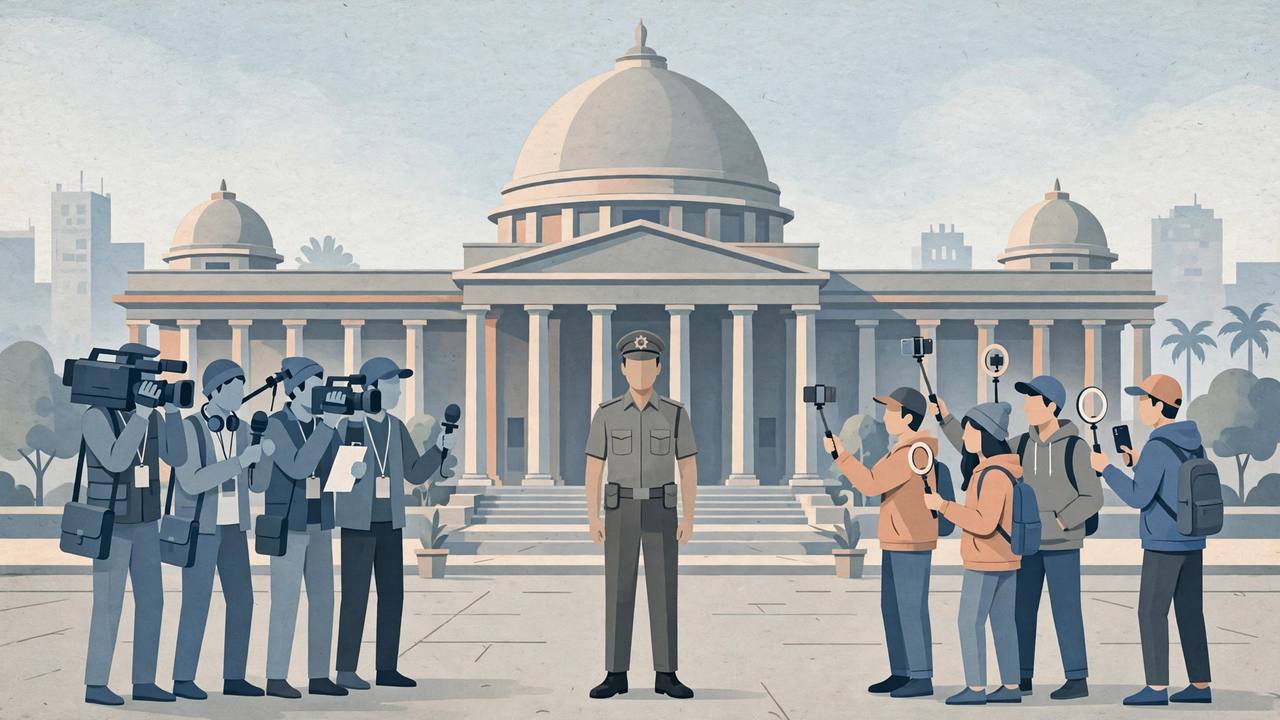
The Delhi Police has told the Supreme Court that its order directing protection of journalists covering the anti-Chief Election Commissioner (CEC) protests was not intended to cover 'so-called reel makers and social media influencers'.
Source: LiveLaw
In a counter-affidavit filed before the court, the police said several participants at the 'illegal protests' were content creators making YouTube reels while carrying cameras and microphones, making it difficult for personnel on the ground to distinguish between professional journalists and reel-makers.
Source: Dainik News Live
The police said it has to be determined whether 'reel-makers can be elevated to the status of journalists or reporters', adding that the distinction was highlighted only to explain the practical difficulties faced by personnel managing protests. It clarified that it did not intend to obstruct content creators from pursuing their activities.
The affidavit was filed by Joint Commissioner of Police Surrender Kumar in response to petitions by the Network of Women in Media, the Free Speech Collective, the Delhi Union of Journalists and the Kerala Union of Working Journalists over alleged police misconduct against journalists covering the protests against CEC Gyanesh Kumar.
Source: LiveLaw
The police referred to the Supreme Court's order of October 11, 2026, which recorded the Solicitor General's assurance that lawyers, journalists and other professionals would not be hindered in discharging their professional duties. It submitted that the direction was not meant to exempt reel-makers, influencers or unruly elements from the general law or lawful directions at the site of a prohibited assembly.
The affidavit stated that the police had placed no restriction on the right of citizens to report or disseminate information, that no one had been proceeded against merely for lacking press accreditation or an identity card, and that restrictions at protest sites applied uniformly to everyone.
Police defend October 5 advisory for journalists
The police also defended their October 5 advisory for journalists covering protests, which asks them to carry identity cards issued by their organisations or accreditation from the Press Information Bureau or the Directorate of Information and Publicity, display them visibly, avoid obstructing police operations and keep a safe distance in tense situations. The advisory was facilitative and precautionary, the police said, and the absence of PIB accreditation alone would not stop a journalist being identified and facilitated, since an employer-issued identity card is also accepted.
The affidavit relied on the Central Media Accreditation Guidelines, 2022, which define a working journalist through objective criteria such as journalism being the person's principal vocation, and on the Press Council of India's October 15 guidelines for journalists covering protests and demonstrations.
Denying allegations of deliberate obstruction, the police said any journalist inadvertently removed from a protest site due to mistaken identity was released immediately after verification of credentials, that no media equipment was seized, and that protest videos had circulated freely on social media and national and international media.
On complaints by women journalists after the October 3 protests near Jantar Mantar, the police said four complaints were received and transferred to the Crime Branch for inquiry, and that examination of CCTV footage did not corroborate the specific allegations of sexual harassment. The allegations and the police's version remain before the court.
The case goes to a question newsrooms and police forces across India now face daily: in an age when every phone is a camera, who counts as a journalist at a protest site — and who gets the law's protection while reporting from one?