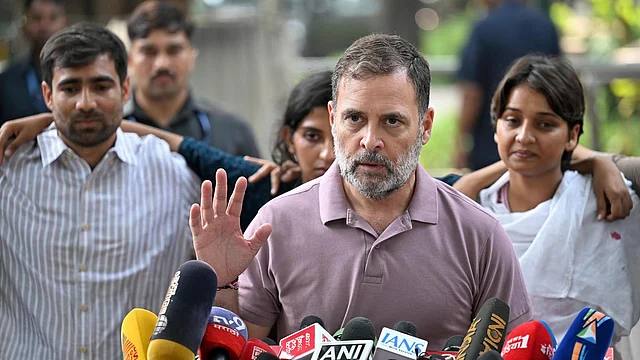
Leader of the Opposition in the Lok Sabha Rahul Gandhi said on Saturday that the ruling BJP would not be allowed to push the country towards authoritarian rule, as he attacked Prime Minister Narendra Modi, Home Minister Amit Shah and Chief Election Commissioner (CEC) Gyanesh Kumar over the government's delimitation push.
Source: ANI
Speaking at a press conference in New Delhi, Gandhi alleged that delimitation was a fresh ploy to evade scrutiny over alleged election rigging, ahead of Parliament's special sitting beginning on Monday, November 30.
“The idea that they can rig elections wherever they want, whenever they want, is an idea whose time is gone. They can still rig elections, but India knows that they are rigging them. Our polling shows us that 80 per cent of India and almost 100 per cent of Gen Z believe that Narendra Modi, Amit Shah, and Gyanesh Kumar steal elections. Now, the three musketeers have come out with a new plan. An escape route,” Gandhi said.
He contended that the 2024 general election itself lacked legal standing, claiming that the Election Commission itself had said 140 million people voted in 2024 who should not have voted because they were not eligible voters. These are Gandhi's claims, presented at the press conference as his allegations against the ruling party and the Commission.
Gandhi listed alleged irregularities in several states: seats redrawn in Jammu and Kashmir, voter deletion in Bihar, restructuring in Assam, and what he called “100-plus seats stolen” in West Bengal. All were presented as his allegations, not as established findings.
“We have trapped Modi, Shah, and Gyanesh. They know it, we know it. And as I have told you, we have enough information on Mr Gyanesh Kumar, and he is not going to escape. We are going to be releasing that information to you soon,” he added.
What the Bills propose
The confrontation comes a day after the Union Cabinet cleared three revised draft legislations: the Constitution (132nd Amendment) Bill, 2026, the Delimitation (Second) Bill, 2026, and an amendment to Union Territories laws, for introduction during the special sitting starting November 30.
The package raises the maximum strength of the Lok Sabha from 550 to 850 — up to 815 seats from states and 35 from Union Territories — through a uniform 50 per cent seat expansion across every state and Union Territory, with a corresponding rise in state Assembly seats.
To roll out the Nari Shakti Vandan Adhiniyam, the 33 per cent women's reservation law, ahead of the 2029 general elections, the Centre proposes using the 2011 Census for internal boundary redrawing and for determining SC/ST seats, while freezing inter-state seat ratios based on the 1971 baseline until 2051. Gandhi called the women's quota an excuse for the expansion; the government has presented the package as a uniform expansion that protects every state's share.
What the Opposition wants instead
The Opposition has put forward three demands: maintain the existing strength of the Lok Sabha, implement 33 per cent women's reservation within the current strength of the House, and maintain the existing allocation of Lok Sabha seats among states for the next 25 years. Congress argues women's reservation should not be linked to a fresh delimitation exercise.
The DMK, which has announced support for a uniform 50 per cent increase in seats, has insisted Tamil Nadu's existing share of representation must be protected; DMK MP A. Raja said on Saturday the state's share would go from 7.18 per cent to 7.21 per cent under the proposed arrangement. The NCP (Sharadchandra Pawar), which has also indicated support, stayed away from Saturday's INDIA bloc strategy meeting.
The Union Cabinet cleared the three Bills on Friday. Awaaz Punjab reported the clearance and the INDIA bloc's strategy meeting held on Saturday morning. Read the earlier report
What happens next: the special sitting of Parliament begins on Monday, November 30, when the government plans to introduce the Bills. The Bills need a two-thirds majority; a senior government source has expressed confidence the treasury benches have a comfortable majority, while the Opposition says it will oppose the package in the House.