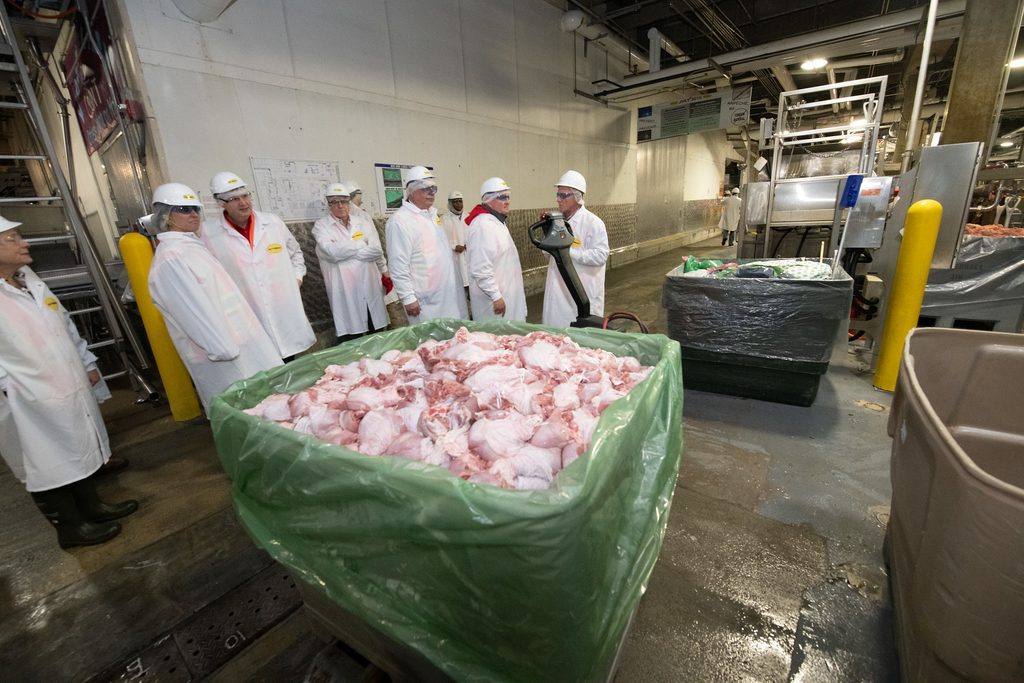
Federal food-safety inspectors found salmonella in just under 43 per cent of the ground and chopped turkey they sampled at four Butterball plants over the past year, according to an analysis of US government inspection data published on November 25 — the day before Thanksgiving, when millions of American families cook turkey.
Source: The Guardian
Butterball is America’s biggest turkey company. The analysis, by the investigative publication SourceMaterial, examined Food Safety and Inspection Service (FSIS) data for fiscal years 2025 and 2026, provided by Slingshot Investigates, the investigative arm of the animal-rights group Project Slingshot. It found contamination rates in Butterball’s ground and chopped turkey well above the industry average — but no contamination in the company’s whole birds or in its ready-to-eat cooked products.
Source: SourceMaterial
The Mount Olive plant — America’s biggest turkey slaughterhouse
The worst single figure came from Butterball’s factory at Mount Olive, North Carolina, described as the nation’s biggest turkey slaughterhouse. FSIS inspectors found salmonella in 16 of the 45 ground and chopped turkey samples they tested there — 36 per cent, nearly three times the USDA’s 13.5 per cent limit for an individual plant.
The scale of that plant is what makes the figure matter: Mount Olive processes about 285,000 birds a week and sells raw ground turkey, burgers and sausages across the country. Butterball supplies the three biggest US supermarket chains — Walmart, Costco and Kroger — as well as fast-food companies.
No fine, no recall — the rule as it stands
A slaughterhouse that goes over the USDA limit faces no fine and does not have to pull products from shelves. The USDA requires it to explain how it is addressing the problem instead. No recall of Butterball products has been announced.
Butterball said food safety was critically important to the company and that it kept investing in new technology and working with food-safety experts to reduce pathogens, including salmonella. The company said it was taking part in a pilot programme with FSIS evaluating the causes of foodborne illness, and pointed out that none of its pre-cooked products contained salmonella.
Alice Johnson, Butterball’s senior vice-president of food safety, quality and animal care, said the company believes FSIS should measure how much salmonella is in a sample, not simply whether it is present. Experts interviewed for the investigation disagreed. Sarah Sorscher, director of regulatory affairs at the Center for Science in the Public Interest, said having less harmful contamination was better than having more — but having no salmonella in food at all would be better still.
The drug-resistance worry
The tests also found evidence of drug-resistant bacteria. Two-thirds of samples taken from birds’ intestines across all Butterball’s slaughterhouses in fiscal year 2026 that contained salmonella and campylobacter — another germ that can make people ill — carried strains resistant to at least one antibiotic. At Butterball’s plants, 65 per cent of positive samples were resistant to at least one antibiotic drug, against 61 per cent at Jennie-O.
Across the whole US meat industry, the government data showed an average of 12 per cent of samples contaminated with some pathogen and 33 per cent of pathogens resistant to drugs. Other big suppliers were also well above the industry average: Foster Farms of California recorded 29 per cent contamination, with 55 per cent of pathogens resistant, and Koch Foods of Illinois recorded 27 per cent, with 51 per cent resistant. Neither company responded to requests for comment.
That matters because antibiotics are often the treatment for severe salmonella and campylobacter infections. Each year about 25,500 Americans are hospitalised after exposure to the two germs, leading to 435 deaths, according to the Centers for Disease Control and Prevention. Steve Roach of the Food Animal Concerns Trust noted that resistance in salmonella is associated with longer illness, a greater likelihood of hospitalisation and a greater likelihood of death.
Why ground turkey — and what cooks should do
Ground and chopped turkey may be more prone to contamination because every processing step is another opportunity for the meat to become contaminated, Sorscher explained. Whole turkeys and ready-to-eat products from the same plants showed no contamination in the data.
For Thanksgiving cooks, the practical guidance is unchanged: cook ground turkey thoroughly — US food-safety guidance is 165°F (74°C) — do not wash raw turkey, which spreads germs around the kitchen, and wash hands, utensils and surfaces after handling raw meat. Salmonella is killed by proper cooking, and the risk in the data sits in raw ground product, not in a properly cooked whole bird.
Background: a 2019 recall, and faster line speeds
This is not the first time Mount Olive has been at the centre of a salmonella scare. In 2019 Butterball recalled almost 80,000 pounds of turkey products from the plant after an outbreak of illness across two states likely caused by salmonella linked to the company’s products.
Thomas Gremillion, director of food policy at the Consumer Federation of America, said salmonella contamination is worsened by fast line speeds at slaughterhouses, and the Trump administration has allowed poultry processors to increase line speeds. Faster speeds make it harder to keep the contents of the digestive tract — where the bacteria concentrate — off the meat, he said.
What happens next
The USDA requires Butterball to explain how it is addressing the excess contamination at its plants, and the FSIS pilot programme the company is part of continues. No recall is in force and no new enforcement action has been announced. For shoppers, the finding is a reminder to treat raw ground turkey with care this Thanksgiving — and for the industry, the data raises the question of whether presence-or-absence testing, with no fine for exceeding the limit, is enough.