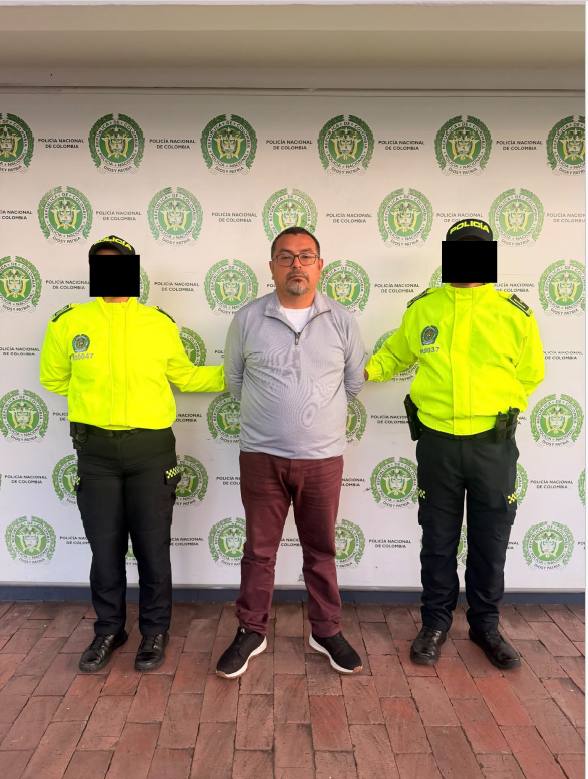
LOS ANGELES, California — A Mexican federal judge has been arrested on United States charges that he accepted a $2 million bribe to free the second-in-command of one of the most violent cocaine-trafficking organizations ever prosecuted in North America, the U.S. Department of Justice announced on Thursday, November 5.
Source: U.S. Department of Justice
Luis Benítez Alcántara, 49, of Mexico City, was arrested on Sunday in Colombia, the department said. He is charged in a second superseding indictment with nine counts of being an accessory after the fact — the legal term for helping someone, after a crime, in order to hinder or prevent that person's apprehension, trial or punishment. The United States will request Benítez's extradition from Colombia.
"Crooked public officials, no matter where they are, who assist drug traffickers operating here at home will face justice in the United States," Attorney General Todd Blanche said in the department's statement. "Thanks to the work of the Homeland Security Task Force and our international law enforcement partners, Mr. Benítez will be held accountable."
The judge, the trafficker and the Olympic snowboarder
Benítez was the Mexico City district judge overseeing the extradition proceedings of Andrew Clark, 36, a Canadian drug trafficker whom prosecutors describe as the second-in-command to Ryan James Wedding, 44, a former Olympic snowboarder for Canada. According to FBI Director Kash Patel, Wedding was "orchestrating a billion-dollar transnational criminal organization and the largest supplier of cocaine to Canada with connections in Colombia, Mexico, and the U.S."
Clark was arrested in Mexico in October 2024 on U.S. drug-trafficking, murder and attempted-murder charges in which Wedding was also named, the Justice Department said. The United States formally requested Clark's extradition in November 2024, which put his case in front of Judge Benítez.
How the alleged bribe moved: $2.75 million in small increments
According to the superseding indictment, returned on September 4, Clark transferred approximately $2.75 million through intermediaries, in small increments, between November 2024 and February 2025 for the purpose of securing his release from Mexican custody. During the same period, prosecutors allege, Clark negotiated an agreement to pay Benítez approximately $2 million in exchange for ordering his release.
On February 24, 2025 — the same day Benítez received the full $2 million bribe payment, according to the indictment — he granted Clark bond and ordered him released. The release did not hold: days later, Clark was re-arrested and removed to the United States, where the criminal case against him remains pending.
Where the Wedding case stands
Wedding, who was at the time one of the FBI's Ten Most Wanted Fugitives, was apprehended in Mexico in January 2026 and removed to the United States, where he remains in federal custody. He faces drug-trafficking, murder and attempted-murder charges and is currently scheduled for two separate trials, on March 31, 2027, and October 26, 2027. First Assistant U.S. Attorney Bill Essayli, for the Central District of California in Los Angeles, said the Benítez case "underscores my office's commitment to dismantling criminal organizations at every level, including by holding accountable those who abuse positions of public trust."
The FBI investigated the case with the Los Angeles Police Department and the Royal Canadian Mounted Police's federal policing arm, the Justice Department said. U.S. Customs and Border Protection officers in Buffalo, New York, and Colombian law-enforcement partners — including the Colombian National Police's criminal-investigation directorate and its special interagency investigation group — also assisted, and the Justice Department's Judicial Attaché Office in Bogotá and its Office of International Affairs worked with the Government of Colombia to secure the arrest. Assistant U.S. Attorneys Lyndsi Allsop and Joshua J. Lee, of the Central District of California, are prosecuting the case.
The United States will ask Colombia to extradite Benítez to face the nine counts in federal court. If convicted, he faces a statutory maximum of 15 years in federal prison on each count. The prosecution is part of the Homeland Security Task Force initiative established by Executive Order 14159; its Los Angeles arm is staffed by the FBI and the LAPD, with the U.S. Attorney's Office for the Central District of California leading the prosecution.
For readers in the United States and Canada — including the Punjabi diaspora communities of California's Central Valley and the Greater Toronto Area, and the truckers who drive the cross-border freight corridors between the two countries — the case is a reminder of how the cocaine supply chain that ends on North American streets is protected, prosecutors allege, at every level: on the road, at the border, and now, according to this indictment, inside a courtroom. An indictment is merely an allegation, and Benítez, like every defendant, is presumed innocent until proven guilty beyond a reasonable doubt in a court of law.